
BigDeal Make Up · Hong Kong
Korean Makeup Basics Versus Advanced Course
Choosing between a Korean makeup basics versus advanced course matters because each route practises different skills and gives different immediate results in your client work. Korean make-up basic course (16 hours) teaches sheer base control, natural brows and everyday balance you’ll use most often; Korean make-up intermediate specialist course (15 hours) focuses on texture, layering, variation and camera-aware finishes for those with a stable foundation. Classes are taught by instructor Maggie Yeung; check your fit with customer service before booking.

At a glance
Korean makeup basics versus advanced course
If you can already create a light, even base, soft gradient brows and simple eye definition, the Korean make-up intermediate specialist course develops texture, layered brows/eyes and photo-aware finishing. If you are still mastering sheer base control, sheen and natural brow shaping, the Korean make-up basic course is the right first step. BigDeal Make Up will confirm your current skills and goals with you before enrolment.
01
Korean makeup basics versus advanced course: level differences and who they suit
Who should consider the Korean makeup basics versus advanced course options?
The clearest distinction is foundation versus refinement. A basics pathway concentrates on creating a thin, even base and natural brow shapes that sit well for daily looks; the advanced pathway expects those foundation skills and adds deliberate texture work, layered colour and proportion adjustments. Deciding which level depends on whether you can consistently deliver the simpler techniques under time pressure and on different skin types.
Korean make-up basic course is designed around reproducible, everyday outcomes. Learners practise sheer base application, quick concealing and low-contrast eye work so they can recreate the look at clients’ homes or in walk-in sessions. Korean make-up intermediate specialist course assumes repeatable basics and redirects class time to experimenting with density, shadow layering and transitioning looks from daytime to studio lighting.
Entry is not automatic: BigDeal Make Up will ask about your portfolio, experience and what you want to practise next. Advanced suitability is determined from your experience and goals, not by a guaranteed placement. If the team recommends Korean make-up basic course first, that is to ensure you have the controlled ‘blank canvas’ the advanced techniques require.
For a closer comparison, consider Korean makeup advanced class Central
02
Korean makeup basics course: build a stable foundation
What the Korean makeup basics course helps you practise
Korean make-up basic course (Korean make-up basic course) runs 16 hours and is the practical route for learners concentrating on sheer base work, natural brows and simple eye definition. Expect exercises in thin base formulation, blending concealer, and sheen control so skin reads naturally under different lights. These are the everyday skills most clients request for a polished, effortless result.
Natural brow work in a basics course focuses on shape mapping and soft gradient techniques rather than heavy block brows. You’ll learn to balance brows with eye proportions, create symmetry with temporary cosmetic tools and practise lower-eye detail that keeps looks fresh and lifted. For many students, this stage removes a lot of day-to-day guesswork.
Korean make-up basic course’s group fee is HK$1,380 per person and the private one-to-one rate is HK$1,790 per student. Class arrangement, including tools and supplies, must be confirmed with customer service before enrolment. The course includes practical repetition so you develop speed without compromising the light, transparent finish that defines Korean-influenced everyday makeup.
Match your plans with advanced Korean makeup course price
03
Deciding by experience and learning goals
Key questions to choose the correct level
When deciding between Korean make-up basic course and Korean make-up intermediate specialist course, test yourself with a few targeted questions: can you apply a thin, even base consistently on different skin tones; do you achieve symmetrical soft brows without overworking the product; can you produce a natural, finished look within the time you’ll realistically spend with clients? If you answer ‘no’ to any, the basics course closes those gaps.
If your answers lean ‘yes’, consider what you want from advanced practice. Are you expanding into editorial or bridal work where layered texture and camera-aware finish matter? Do you want to offer variations such as smoky Korean looks, retro shapes or hair–makeup pairing? Korean make-up intermediate specialist course dedicates time to those advanced outcomes, including how looks translate to photos and video.
Remember, moving to advanced classes is a skill progression, not a credential escalation. BigDeal Make Up confirms readiness from your current work and goals. If you’re unsure, ask for a short skills review or bring photographs of recent makeup you’ve done; that helps the team recommend the correct Korean make-up basic course or Korean make-up intermediate specialist course route.
You may also find it useful to compare advanced Korean makeup course
04
Foundation-stage skills explained
What the Korean makeup basics course focuses on
Foundation-stage skills emphasise control and restraint: light layering of base products, minimal texture alteration and natural colour placement. Korean make-up basic course concentrates on blending without eliminating natural skin texture, concealing selectively, and finishing so the skin reads luminous rather than matte or cakey. These are practical skills for everyday clients and beginners alike.
Practice in Korean make-up basic course includes lower-eye shadow work and gradient lips as part of an overall harmony exercise. You will rehearse quick corrective techniques for small asymmetries and learn removable eyelid-crease tricks that are cosmetic and temporary, not medical. These are safe, non-permanent methods to improve symmetry and visual balance within a makeup session.
The basics stage also covers product selection appropriate to Korean-inspired looks: lighter coverage foundations, sheening agents and fine brushes for diffused edges. The instructor team uses brands such as NARS, Dior Beauty, Giorgio Armani Beauty, Estée Lauder and Laura Mercier as appropriate to demonstrate product textures and finishing options, always pairing tool choice with the intended finish.
For another approach, explore Korean eye makeup advanced training
05
Advanced practice: detail and variation you’ll learn
What the Korean makeup basics versus advanced course covers in depth
Advanced work in Korean make-up intermediate specialist course concentrates on deliberate texture, layering and proportion changes that create varied finished looks from the same base. You’ll practise layering cream and powder products to build depth, creating defined yet soft brow architecture and using shadow gradients to alter eye shape and perceived lid depth. The aim is controlled variation rather than heavier coverage.
Korean make-up intermediate specialist course’s syllabus includes party, smoky and retro Korean variations plus make-up & hair pairing and camera-ready practice. Students learn how to adjust contrast and sheen for studio lighting, and how layering impacts photography. The course emphasises learning to transition a daytime Korean look into an evening or editorial finish without losing the signature soft aesthetic.
Because Korean make-up intermediate specialist course is intended for those who already have a stable foundation, exercises focus on speed and decision-making: how much texture to add, where to deepen shadow, and when to use sharper lines for effect. The team may demonstrate additional tools and products from Clé de Peau Beauté, Bobbi Brown, M·A·C and Giorgio Armani Beauty where helpful to show texture differences.
Before deciding, take a look at Makeup Courses
06
Compare thin-base and natural-brow work with texture and layering
How basics differ from advanced layering and texture work
Thin-base application in basics training prioritises translucency and manageable coverage; texture and layering in advanced practice explore the controlled build-up of depth and dimension. In Korean make-up basic course you practise correction and seamless blending; in Korean make-up intermediate specialist course you practise deliberate product stacking so shadows and highlights look intentional across varied lighting conditions.
Natural-brow work in Korean make-up basic course stresses softness and proportional harmony; advanced layering in Korean make-up intermediate specialist course teaches how to add structure without losing the gradient effect—useful for editorial or evening looks. Where basics teach a reliable everyday shape, advanced classes show how to strengthen, lengthen or soften brows to suit different face angles and photographic framing.
These differences are practical, not theoretical. Korean make-up basic course gives you the reproducible daily toolkit; Korean make-up intermediate specialist course expands that kit with additional techniques for variation and camera awareness. If your practice involves clients with varied requests—social media content, events or bridal trials—advanced layering and texture work become valuable extensions of the basic repertoire.
07
Course durations and per-student fees compared side by side
Durations and standard fees for each course format
The two courses are priced and timed very differently to reflect their scope. Korean make-up basic course is a 16-hour Korean make-up basic course. Group rate is HK$1,380 per person and private one-to-one tuition is HK$1,790 per student. Korean make-up intermediate specialist course is a 15-hour Korean make-up intermediate specialist course with a group rate of HK$8,800 per person and private one-to-one rate of HK$11,390 per student.
These fees reflect the depth and bespoke attention in each option; Korean make-up basic course’s group setting is ideal for those needing practice-focused repetition, while Korean make-up intermediate specialist course’s higher cost reflects specialist material, closer instructor attention on proportion and camera-ready skills, and the smaller class sizes typically used for advanced practice.
Confirm dates, venue and exact tool/material provisions before enrolment. Course arrangement notes state that class size, tools/supplies and schedule for Korean make-up basic course and the exact basics-to-be-confirmed prerequisites for Korean make-up intermediate specialist course must be discussed with customer service to ensure you get the right environment for practising these techniques.
08
Self-check your experience and goals before you ask the team
Who should consider the Korean makeup basics versus advanced course options?
Run a brief self-check: can you create a thin base with consistent sheen control; do you produce soft gradient brows without heavy edges; can you match lower-eye definition to the upper lid? If not, Korean make-up basic course will eliminate those predictable errors and build speed and reproducibility. If you perform these reliably, Korean make-up intermediate specialist course will expand your expressive range.
Also reflect on your goals: are you working mostly in quick consults and everyday client work, or do you want to broaden into editorial and camera-centric assignments where layered texture and proportion decisions shape the final image? Korean make-up intermediate specialist course is structured for the latter, with practice that focuses on look transitions and photo-aware finishes.
If in doubt, bring visuals of your recent work or request a short skills review from BigDeal Make Up. The team will confirm the appropriate level from your experience and goals rather than relying on course titles alone. That confirmation is practical guidance, not the award of any external certification.
09
Confirm practical arrangements after you choose a route
Logistics and questions to ask before enrolment
Before you enrol, check the logistics: venue location, room layout, whether you need to bring your own kit or if materials are provided, and the class language (English). BigDeal Make Up requires confirmation of dates, venue and tools before enrolment so everyone arrives ready to practise. Practical journey and timing details should be requested if you have mobility or transport needs.
Ask how the class time is divided between demonstration and hands-on practice, and whether you’ll receive photographs or feedback notes to review after the session. For advanced classes, enquire about camera setups and lighting used in photo-aware practice so you can understand how looks translate to different devices and media.
Remember product safety and kit hygiene. The FDA guidance on cosmetics safety (Using Cosmetics Safely | U.S. Food and Drug Administration) offers independent general guidance on safe cosmetic use and is useful background reading; that link is independent guidance, not an endorsement of any course or product. If you have allergies or require specific sanitary arrangements, notify customer service before booking.
10
After you choose Korean make-up basic course or Korean make-up intermediate specialist course
Practical steps to confirm dates and materials
Once you choose Korean make-up basic course or Korean make-up intermediate specialist course, contact BigDeal Make Up to confirm the session date, class size and whether you want group or one-to-one tuition. The studio will advise on what to bring; if you prefer to practise with certain products, say so—team demonstrations often use NARS, Giorgio Armani Beauty, Estée Lauder, Laura Mercier, Clé de Peau Beauté, Bobbi Brown and M·A·C as appropriate, but you may work with your preferred items.
For private tuition, the one-to-one rate guarantees focused attention and tailored corrections suitable for rapid progression or specific client-work preparation. For group classes, expect structured repetition and peer observation, which many students find valuable for seeing variations across different skin tones and eye shapes.
Finally, confirm cancellation, rescheduling and whether a short pre-class skills check is available. BigDeal Make Up can advise which course better matches your experience during an enquiry; this recommendation is practical advice to help you get the most from the time you invest, not a promise of certification or outcome.
11
Which course matches common career and client needs?
Practical outcomes for freelance, salon and content work
Freelancers and salon artists often choose between predictable, repeatable results and flexible, camera-aware finishes. Korean make-up basic course equips you with a reproducible everyday toolkit—thin, even bases, soft gradients and quick corrective moves that help with walk-in clients, makeup parties and routine bookings. Mastering these basics reduces time spent correcting texture and helps you offer consistent service across a typical client roster.
If your work includes photoshoots, influencer content or events where looks must read well on camera, Korean make-up intermediate specialist course builds the additional judgement and layering skills you’ll use daily. The course practises controlled texture, increased contrast handling and proportion changes that translate to both still photography and short-form video. This level is about decision speed—choosing how much depth or sheen to add so a look survives harsh lights without appearing heavy in person.
Choosing between the two is as much about the clients you want as your current speed and control. If most of your bookings are bridal trials and studio shoots, advanced training helps you troubleshoot how makeup behaves under flash and continuous lights. If your bookings are quick consultations and daily clients, the basics course lowers the margin for simple, visible errors and improves your consistency under time pressure. Talk to BigDeal Make Up about the typical client scenarios you encounter so they can recommend the best practical route.
12
How to prepare for your chosen class and get the most from it
Pre-class checks, kit choices and day-of tips
Before the session, prepare a concise portfolio of three recent looks you’ve done (photos taken in normal lighting are fine) and list any products you always use. That gives the instructor immediate information about your current approach and lets them tailor demonstrations—showing differences using brands such as NARS, Dior Beauty or Laura Mercier when relevant. If you’re booking private tuition, specify particular skills you want concentrated work on so the lesson plan can be adapted.
Decide whether you’ll use the studio’s shared demo items or bring your regular kit. Shared items are helpful for learning texture differences; bringing your usual products ensures the techniques transfer to your practice. Notify customer service about any allergies or hygiene requirements before booking so accommodations can be discussed. Also ask how class time is split between demonstration, hands-on practice and photo-aware exercises; advanced sessions typically allocate more time to camera-testing and layering work.
On the day, arrive with clean, moisturised skin and a basic kit for touch-ups. For basics training, focus on repetition—practise thin base layering and soft brow mapping until the motions become second nature. For intermediate practice, concentrate on decision-making under a time limit: how much to deepen a shadow, when to switch from cream to powder and the steps to make a daytime look studio-ready. Book a short skills review if you’re unsure of level placement; that practical check clarifies whether to start with the basics or move straight to advanced practice.
Style references
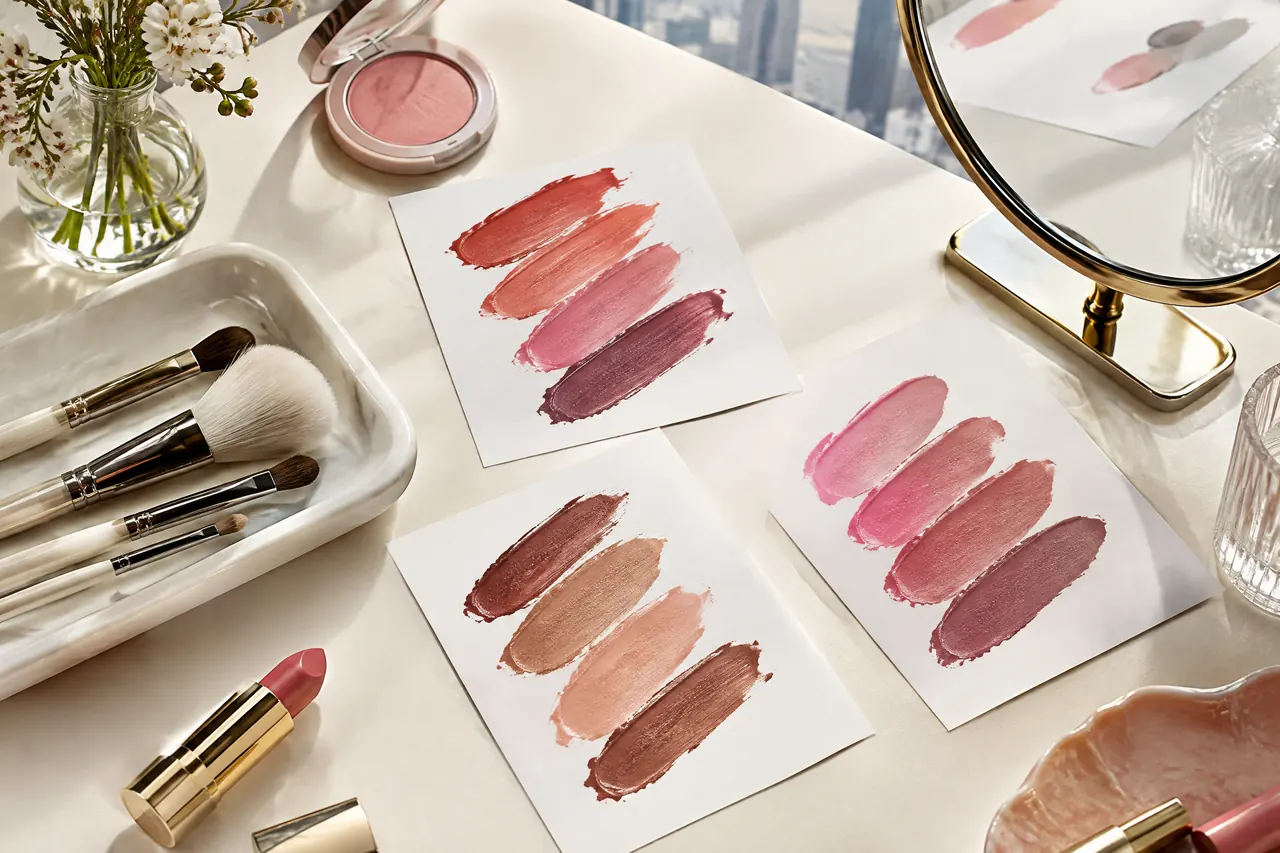
Related makeup style illustrations



Service & lesson fees
Relevant prices and inclusions
Prices and arrangements shown below apply to the listed scope. Confirm timing, location and the final arrangement directly before booking.
All group and private fees are per learner for the entire course.
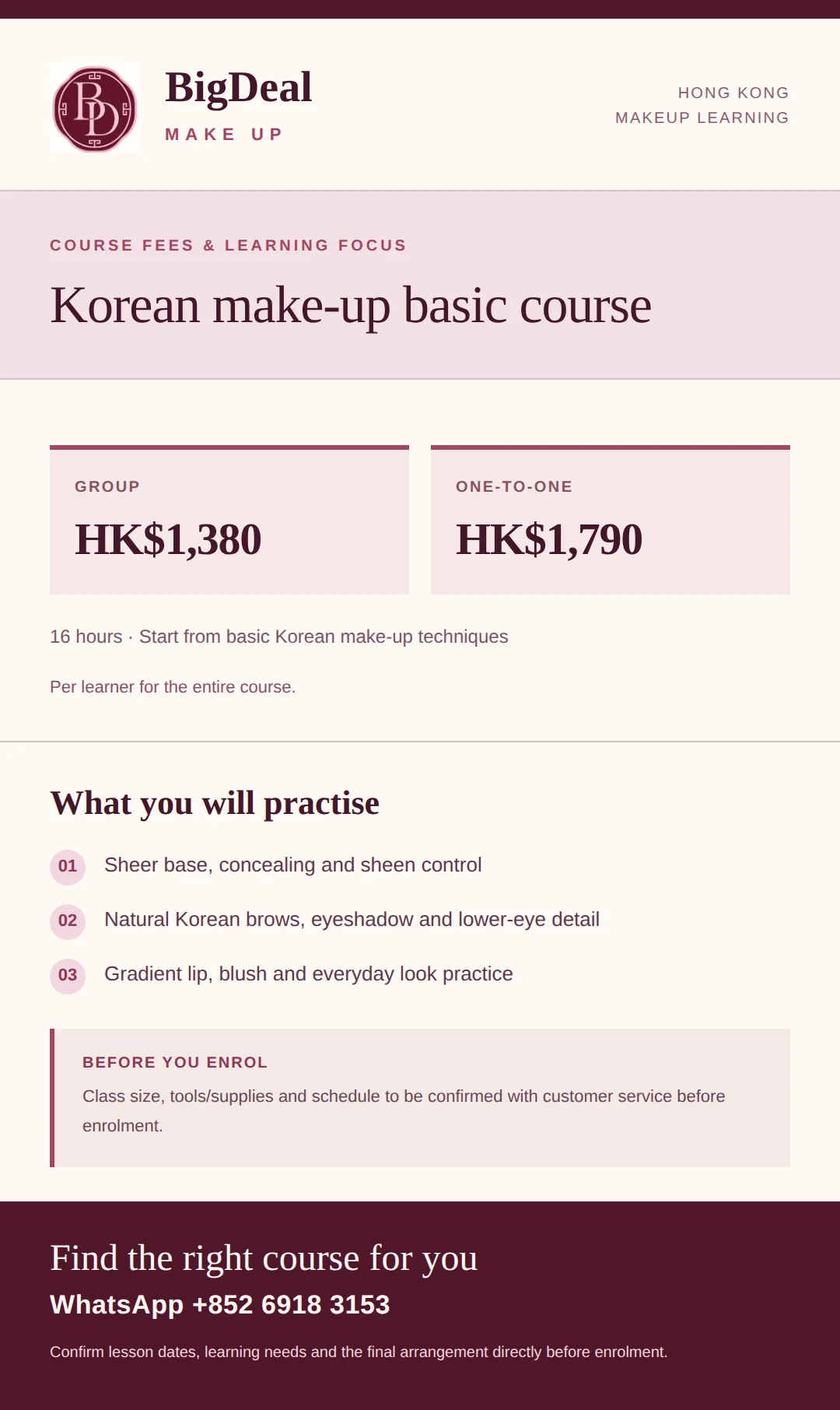
Korean make-up basic course
- Group
- HK$1,380
- Private
- HK$1,790
16 hours · Start from basic Korean make-up techniques
Lesson focus
- Sheer base, concealing and sheen control
- Natural Korean brows, eyeshadow and lower-eye detail
- Gradient lip, blush and everyday look practice
Arrangement: Class size, tools/supplies and schedule to be confirmed with customer service before enrolment.
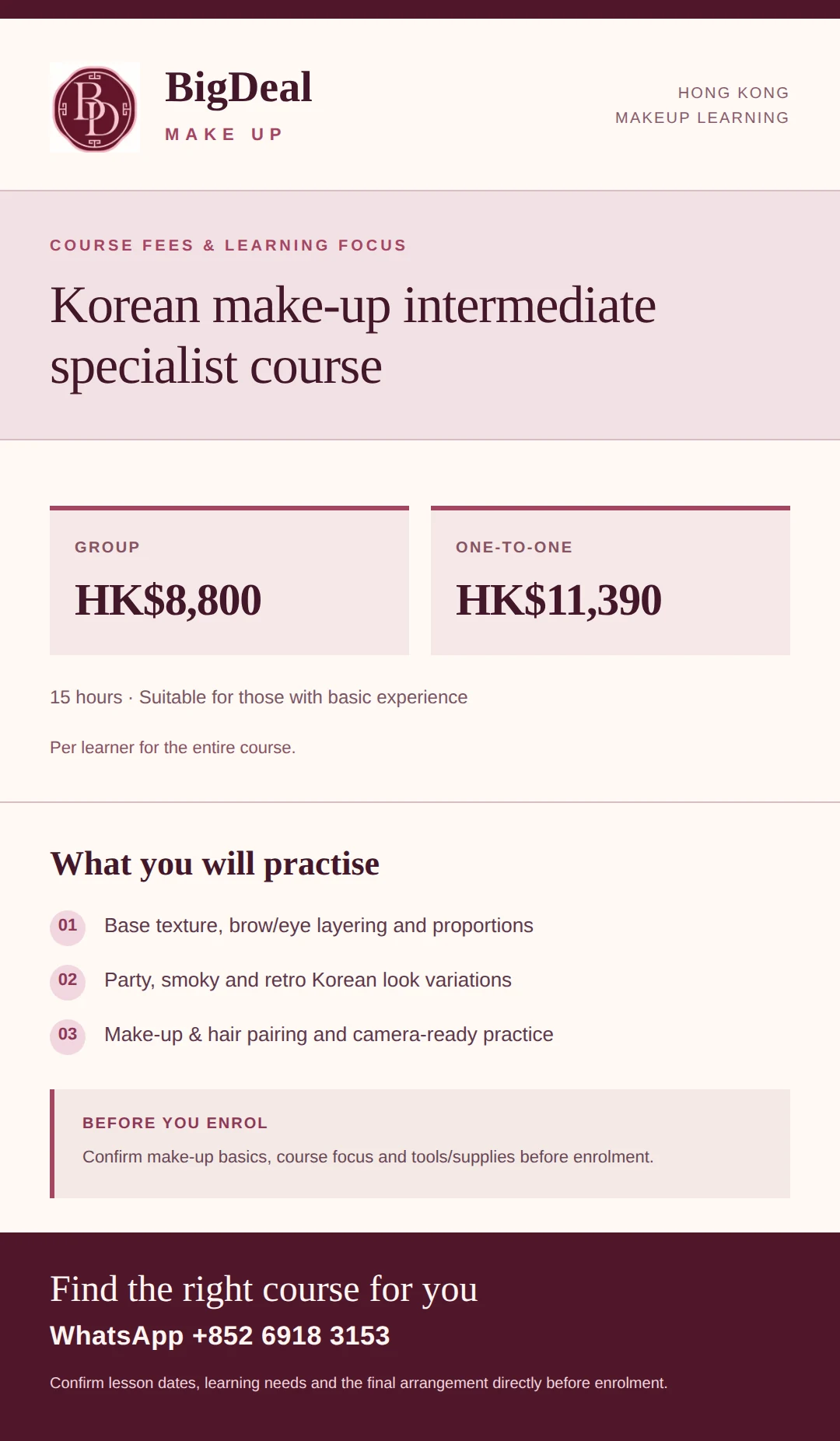
Korean make-up intermediate specialist course
- Group
- HK$8,800
- Private
- HK$11,390
15 hours · Suitable for those with basic experience
Lesson focus
- Base texture, brow/eye layering and proportions
- Party, smoky and retro Korean look variations
- Make-up & hair pairing and camera-ready practice
Arrangement: Confirm make-up basics, course focus and tools/supplies before enrolment.
Korean make-up basic course and Korean make-up intermediate specialist course — durations and standard fees
| Course ID | Course name | Duration | Group fee (HK$) | Private one-to-one fee (HK$) |
|---|---|---|---|---|
| Korean make-up basic course | Korean make-up basic course | 16 hours | 1,380 | 1,790 |
| Korean make-up intermediate specialist course | Korean make-up intermediate specialist course | 15 hours | 8,800 | 11,390 |
| Korean make-up basic course | Core focus | Sheer base, natural brows, everyday looks | ||
| Korean make-up intermediate specialist course | Core focus | Texture & layering, variations, camera-ready practice |
Helpful answers
Frequently asked questions
Do either Korean make-up basic course or Korean make-up intermediate specialist course award a qualification or certification?
No. Both Korean make-up basic course and Korean make-up intermediate specialist course are practical training courses meant to develop hands-on skills. They do not award external qualifications or regulatory certification. BigDeal Make Up provides completion details and feedback, and can point you to recognised programmes separately if you want formal accreditation.
If I’m a complete beginner, can I join Korean make-up intermediate specialist course with extra preparation?
Korean make-up intermediate specialist course assumes you already have a reliable thin base application and natural brow work. A complete beginner will benefit more from starting with Korean make-up basic course. If you want to accelerate, request a pre-course skills review from BigDeal Make Up; they can advise whether a tailored private route or beginning with the basics is the better option.
What does the photo-aware practice in Korean make-up intermediate specialist course involve?
Photo-aware practice covers how texture, sheen and contrast read in different lighting and camera settings. You will practise layering creams and powders, adjusting contrast for studio lights and making small proportion changes to suit photographic framing. The work is practical and intended to help your looks read well on camera, not to guarantee editorial placement.
Are tools and materials included in the course fees?
Course arrangements state that tools/supplies and class size must be confirmed before enrolment. Some classes may provide shared items for practice while others expect you to bring basic tools. Confirm with customer service which items are included or recommended; tell them if you want to use particular products during the session.
Can the courses teach removable eyelid techniques for asymmetrical eyes?
Yes. Both courses teach temporary, cosmetic methods to balance eyelid asymmetry within the non-medical scope of makeup. These removable techniques use cosmetic products or non-invasive aids to create visual symmetry. They are taught as temporary, cosmetic adjustments, not medical procedures.
How do I request a skills review or confirm class dates?
Contact BigDeal Make Up customer service to request a short skills review and to confirm available class dates and language. The team will ask about your current practice, recommend the course that best matches your goals and confirm logistical details like venue, timings and whether you prefer group or private tuition.
Can I switch from a group booking to private one-to-one tuition if I want more focused feedback?
Yes. Both courses offer group and private formats with different benefits. Korean make-up basic course group fee is HK$1,380 per person and private one-to-one rate is HK$1,790 per student; Korean make-up intermediate specialist course group rate is HK$8,800 per person and private one-to-one rate is HK$11,390 per student. Contact BigDeal Make Up to discuss availability and whether the session plan needs adjustment for private tuition.
Should I bring my own products or use the studio’s demonstrator items?
Either option works. Using studio demonstrator items helps you compare textures and finishes across brands used in demos, while bringing your own kit ensures the techniques transfer to the products you’ll use with clients. Confirm arrangements with customer service before enrolment so the class can be set up accordingly.
Ready to discuss it?
Confirm dates and reserve your place
Tell us what you are planning, and we will help clarify the service or lesson details that matter for your enquiry.
From the makeup blog