
BigDeal Make Up · Hong Kong
Korean Eye Makeup Advanced Training
Advanced Korean makeup is most effective when base control, eye layering, liner, lashes and colour choices are taught as a connected system. This page focuses on Korean eye makeup advanced training while linking flawless base work, contour placement and gradient‑lip finishing so you leave with practical, repeatable techniques. Read on for course options — including the Korean make-up intermediate specialist course — planning notes and hygiene guidance for intensive liner and lash practice.

At a glance
Korean eye makeup advanced training
If your priority is Korean eye makeup advanced training, begin with base texture and eye‑layer sequencing so delicate gradients and defined liner sit cleanly. The Korean make‑up intermediate specialist course (15 hours) suits students with basic experience who want to integrate glass‑skin work, brow shaping, liner precision and lashes into a whole‑look workflow. Short themed workshops are also available — confirm the current theme and prerequisites before booking.
01
Korean eye makeup advanced training: techniques and learning focus
Who can benefit from Korean eye makeup advanced training?
High-definition Korean eye work depends on a controlled base. Start by assessing skin texture: enlarged pores, dry patches, oily zones and previous product build-up all change how foundation, cream products and powders sit. In an advanced class you will practice targeted prepping—light chemical or physical exfoliation techniques (home-safe), moisturiser layering and primer placement—so eyeshadow edges read crisply rather than blur into stray texture.
A controlled base means judging product weight. For glass-skin effects use thin, buildable liquids and sheer-creams to preserve natural skin movement, then practice micro-layering with small brushes. The class time allows you to try different sequencing—colour correctors before hydrating serums, or spot-mattifying powders only after blending—to see how each choice affects liner crispness and eyelid shadow saturation.
Hygiene and tool choice are part of base control. Disposable sponge tips, clean flat brushes and a damp beauty sponge each change coverage and edge softness. During Korean make-up intermediate specialist course sessions you will test the same eye looks over varied base finishes to learn which combinations resist creasing and which create the clean canvas required for precise eyeliner and subtle gradient detail.
For a closer comparison, consider Korean makeup advanced class Central
02
Korean flawless base advanced class: choosing a practical next step — Map eye layering, liner and lash choices to the intended finish
Map eye layering, liner and lash choices to the intended finish
Eye layering is where Korean eye makeup advanced training becomes technical. The layering sequence—base wash, contour shade, transition tone, glitter or sheen and final liner—determines depth and distance perception. In practice sessions you will use small, tapered brushes to blend hairline-to-hairline, keeping pigment only where it adds dimension, not weight, and learn when to replace shimmer with reflective micro-pigments for camera-friendly highlights.
Liner choices should map to the finish you want: soft smudged lines for a youthful, natural look; sharp winged liner for retro or editorial styles. You will practise removable eyelid techniques to temporarily broaden or narrow lid appearance without invasive methods, and learn quick corrections for asymmetry. False-lash selection and application are calibrated to eye shape—longer outer corners for cat-like elongation, uniform bands for a doll effect.
For long-wearing Korean eye makeup, correction layers help: thin, translucent setting powders between cream and powder products reduce creasing, and light-touch setting sprays lock in delicate gradients. You will test combinations under studio lights and camera to see how different lash volumes and liner thicknesses change the photographed result, an essential step for commercial or bridal work.
Match your plans with advanced Korean makeup course price
03
Technique planning can begin with the detail that currently challenges you, then connect it to the rest of the makeup look — Use contour placement as proportion work, not a fixed diagram
Use contour placement as proportion work, not a fixed diagram
Contouring in advanced Korean makeup is proportion work, not copying a single diagram. Practitioners analyse bone structure, soft-tissue fullness and hairline before choosing contour depth and placement. You will learn to read jawline width, cheek origin and forehead height and then place colour to balance rather than mask—so contours soften angular cheeks or subtly lift a heavy-set midface, in ways that preserve the typically fresh, lit-from-within Korean aesthetic.
Product choice matters: cream contours can be blended into a glass-skin base for seamless sublimation of shadow, while very soft powder warms can create definition without harsh edges. During the course you will practice incremental shading and reversing the contour—lightening key zones to mimic highlight placement—so your adjustments remain subtle and photo-friendly, rather than appearing heavily sculpted under studio lights.
Because faces move, you will also apply contour to mobile areas and test movement with expression. Learn how a smiling client changes hollows and how to position contour so the effect survives natural facial actions. The goal is repeatability—techniques that work across different faces, lighting conditions and clothing choices rather than a one-size-fits-all map.
You may also find it useful to compare advanced Korean makeup course
04
Korean eyeliner techniques workshop: refine lip edges and gradient depth without overworking them
Refine lip edges and gradient depth without overworking them
Lip finishing is part of the Korean look and should be gentle: the gradient-lip advanced class focuses on softness at the edges and depth at the centre. You will practise feathered borders using sponge-tipped applicators and small brushes, layering stain or tint rather than heavy lipstick. The technique teaches micro-feathering so the lip edge appears natural and soft while the centre pigment builds to the desired intensity.
Avoid overworking the lip; repeated strokes can create patchiness or over-saturation. The course demonstrates how to use balm tints as a base, then add a denser pigment centrally and blend outward to preserve translucence. For photographic work you will also learn how to create a durable gradient using balm, tint and a thin sealing powder, always testing durability without making the finish look cakey.
When coordinating lip and eye choices, practise restraint: a saturated liner or heavy lash typically pairs best with a softer gradient lip. Students will pair several eye looks with lip finishes in the studio, evaluating balance in natural and studio lighting. These paired exercises train your eye to keep the look harmonious rather than letting a single feature dominate.
For another approach, explore Korean makeup basics versus advanced course
05
Korean makeup colour theory course: coordinate colour with skin tone, clothing and desired mood
Coordinate colour with skin tone, clothing and desired mood
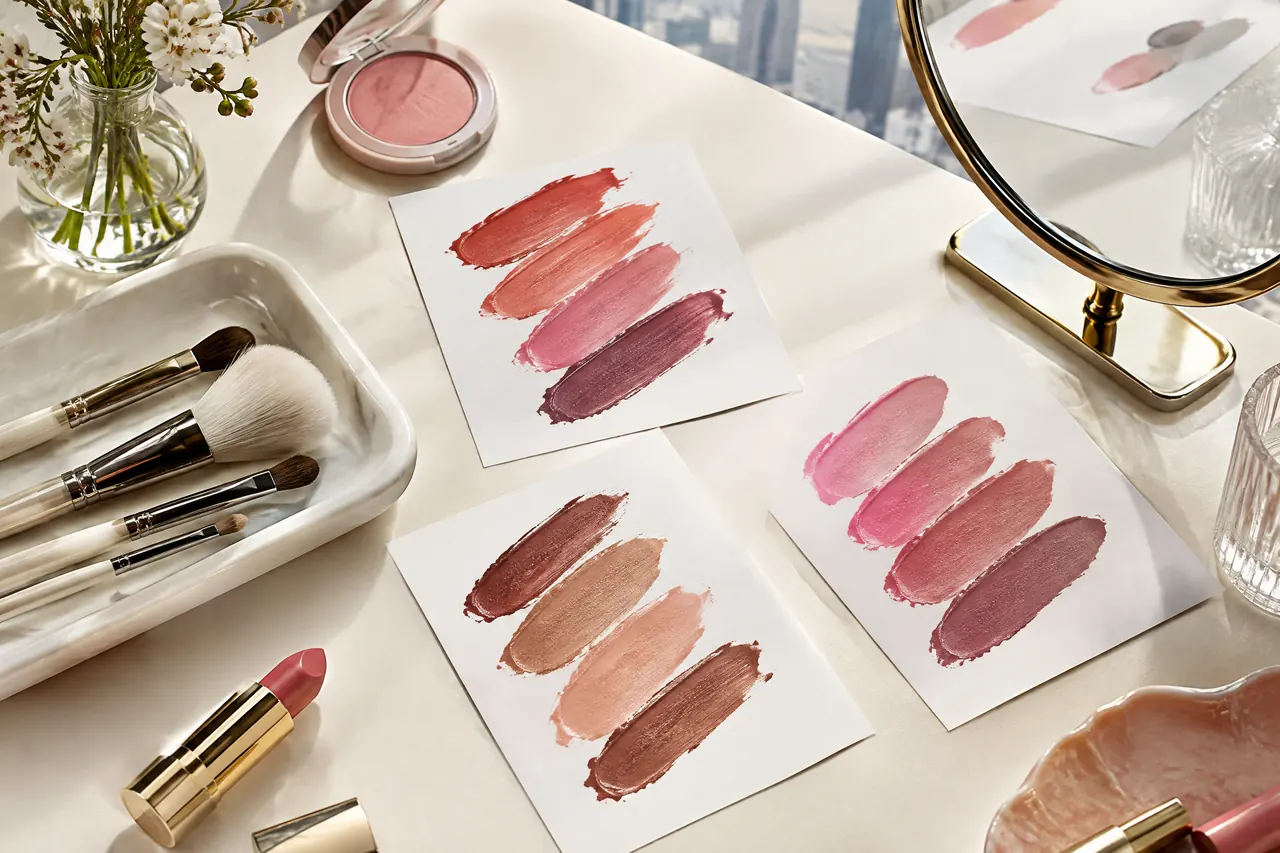
Colour theory in Korean makeup focuses on subtle harmonies rather than bold clashes. You will learn to match tonal temperatures—cool, neutral or warm—to the client’s skin tone and clothing palette. Exercises include building small swatch palettes near the face to test reflectivity and to avoid unflattering undertone clashes. This is especially important for glass-skin ideas where reflective pigments can emphasise undertones.
Mood drives saturation choice. For a soft, romantic finish choose muted roses and mauves; for high-definition editorial looks use stronger pigments but keep application controlled. The course teaches how to scale pigment intensity for different purposes: editorial, bridal, bridal-cameraready and everyday elevated looks. You will practise these adjustments live, switching a single element—liner thickness, blush intensity or lip saturation—to see instant mood shifts.
Practical wardrobe coordination is included: learn quick pairing checks so you can advise clients or prepare looks for photoshoots. This includes simple rules—bring clothing samples or photos, and choose one dominating colour family for eyes or lips, not both—so the final image is cohesive and feels intentional rather than a collection of pretty elements.
Before deciding, take a look at Makeup Courses
06
Choose the Korean make-up intermediate specialist course or check a themed workshop that matches your goal
Decide whether the 15‑hour specialist course or a themed workshop meets your objectives
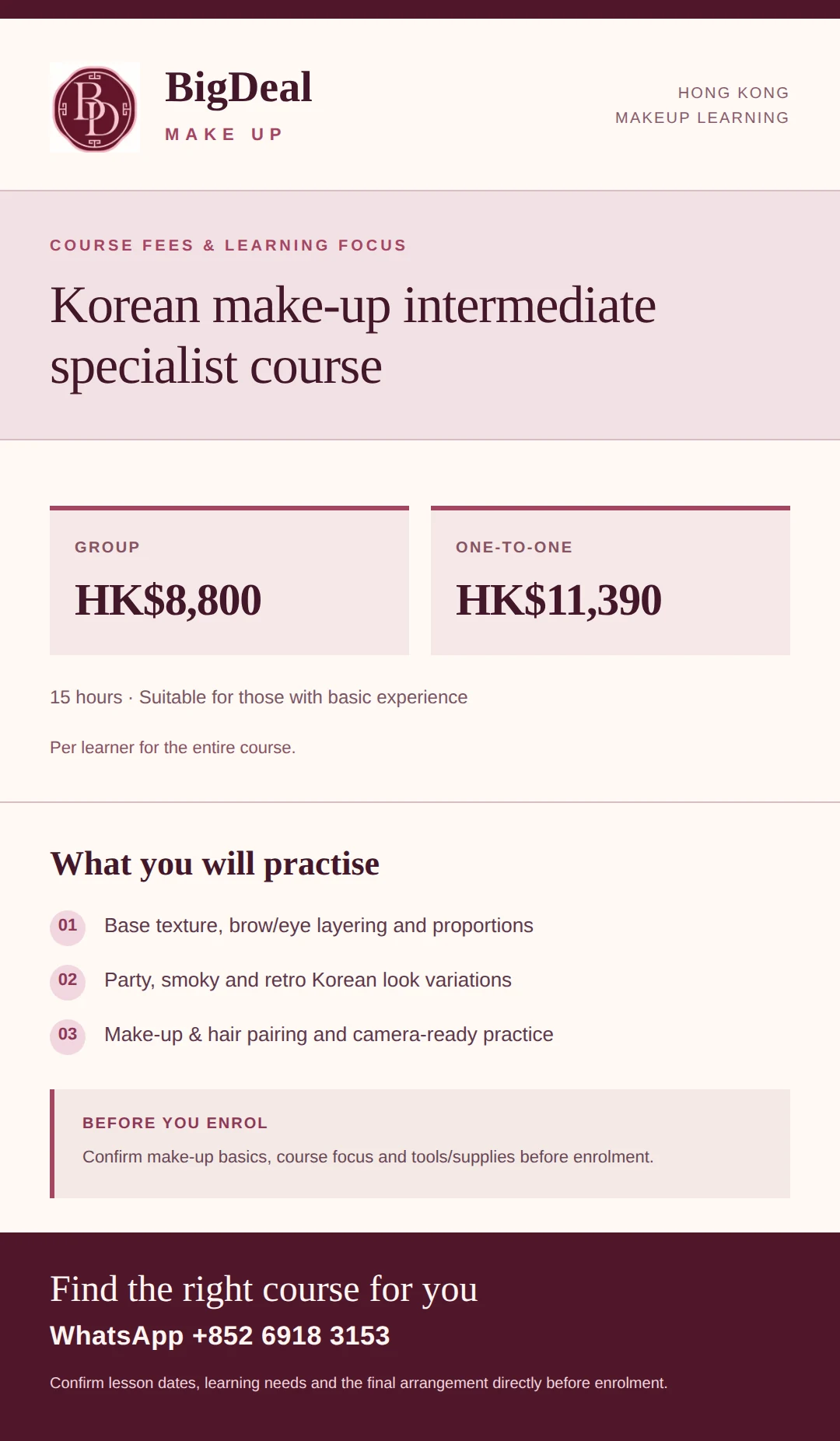
The Korean make‑up intermediate specialist course is a 15‑hour option for students with basic experience. It covers base texture, brow and eye layering, proportion work and camera‑ready practice; the group fee is HK$8,800 per person and one‑to‑one tuition is HK$11,390 per student. This format gives substantial hands‑on time to connect base control with eyeliner, lash and gradient‑lip practice.
Make‑up continuing education themed workshop is a shorter five‑hour session with a rotating theme; fees are HK$1,800 group or HK$2,330 one‑to‑one. Because themes change, confirm whether the current workshop covers the specific techniques you want — some sessions focus on a single skill rather than the integrated workflow offered in the 15‑hour specialist course.
Before booking, clarify which techniques you want to prioritise and ask about required supplies, camera practice time and who will lead the session. Maggie Yeung and other BigDeal instructors teach practical classes; confirm the instructor for your dates. The course description covers hands‑on instruction rather than formal accreditation — discuss how the syllabus aligns with your objectives and request confirmation of dates and exact workshop themes.
For a closer comparison, consider Korean eye makeup for beginners
07
Advanced application modules you can add or focus on
Pick a targeted module when booking to sharpen a single skill or link it into the 15‑hour course
Beyond the core Korean make‑up intermediate specialist course content, you can prioritise discrete modules that translate directly to client work. If your priority is luminous complexions and camera clarity, request the Korean glass skin advanced technique module — it concentrates on ultra‑thin layering, optical highlighters and micro‑blending so reflective pigments enhance rather than emphasise texture. During these drills you’ll test how different primers and serums change pigment sit‑time and how to sequence powders to protect a translucent finish under studio lights.
For photographers and commercial work, a Korean high definition makeup course focus is available within the 15‑hour syllabus. This practical segment trains you to maintain detail for high‑res capture: tiny brush control for hair‑fine liner, selective sharpening around the eyes and controlled sheen placement to avoid hot spots. You’ll practise camera checks and quick corrective steps so looks that read well at arm’s length also photograph cleanly at close range.
If your clients ask for longevity, include the Korean long lasting makeup techniques class content. These lessons demonstrate setting strategies—micro powdering between cream layers, strategic mattifying only where needed and light sealing sprays. You will learn to adapt the sequencing to oilier or drier skin and to evaluate a client’s likely wear conditions, so the same approach is tuned differently for a day wedding, outdoor shoot or evening event. Ask at booking whether you want these modules integrated into your group session or reserved for one‑to‑one time.
08
Practical face‑shaping, lashes and lip finishing options
Choose hands‑on practice in contouring, lashes and gradient lips to complete the Korean look
Makeup is proportion work; request the Korean makeup face shape analysis section to learn how to alter perceived proportions without heavy sculpting. This instruction shows you how to place cream or powder shadow based on bone structure—widening appearance at the temples, softening a strong jaw or subtly shortening a long face—so results remain true to the fresh Korean aesthetic. Practice is sequenced with expression tests so your contouring decisions survive smiles and conversation rather than appearing static or mask‑like.
False lash work is a separate technical skill and we offer a Korean false lash application class module. It covers lash band selection, trimming for eye shape and safe adhesive application, plus removal and client aftercare. You will experiment with styles that elongate versus those that round the eye, and practise balancing lash volume with liner thickness so the final look feels integrated, not pasted on. Remember that children’s face paints and prosthetic lashes are different from standard cosmetics and require specialist supplies; if that’s relevant, please mention it at enquiry.
Lip work completes many Korean looks: the Korean gradient lip advanced class segment teaches the feathering process that keeps edges soft while building central depth. Using balm tints, micro‑brushes and a light sealing layer, you’ll practise creating durable gradients that still look natural and dewy. Students pair a chosen eye look with gradient lips during practice runs to learn the visual trade‑offs — how much lip saturation the image can tolerate when you’re already using stronger eyeliner or denser lashes — and to develop quick fixes for touch‑ups on location.
Style references
Related makeup style illustrations



Service & lesson fees
Relevant prices and inclusions
Prices and arrangements shown below apply to the listed scope. Confirm timing, location and the final arrangement directly before booking.
All group and private fees are per learner for the entire course.
Korean make-up intermediate specialist course
- Group
- HK$8,800
- Private
- HK$11,390
15 hours · Suitable for those with basic experience
Lesson focus
- Base texture, brow/eye layering and proportions
- Party, smoky and retro Korean look variations
- Make-up & hair pairing and camera-ready practice
Arrangement: Confirm make-up basics, course focus and tools/supplies before enrolment.
Course options and practical details
| Course code | Duration | Group fee (HK$) | Private fee (HK$) |
|---|---|---|---|
| Korean make-up intermediate specialist course | 15 hours | 8,800 | 11,390 |
| Make-up continuing education themed workshop (theme varies) | 5 hours | 1,800 | 2,330 |
| Short skill session (liner/lash focus) | confirm length | Confirm with customer service | Confirm with customer service |
| One-to-one progression (tailored syllabus) | varies | Confirm with customer service | Confirm with customer service |
Helpful answers
Frequently asked questions
Who benefits most from Korean eye makeup advanced training?
Students with a basic makeup background who want to refine eye layering, liner precision and lash selection will benefit most. Freelance artists, bridal stylists and enthusiasts who understand foundations gain value from learning how to sequence products for camera and improved wear. If you feel your basics need work, discuss a preparatory session before enrolling in the 15‑hour Korean make‑up intermediate specialist course.
Does Korean make-up intermediate specialist course teach glass-skin and high-definition Korean makeup techniques?
Yes. Korean make-up intermediate specialist course includes base texture work and practices that support glass-skin and high-definition looks, such as micro-layering, light-reflective product placement and camera-ready blending. The course frames these techniques as part of an integrated workflow so you can reliably combine a flawless base with detailed eye and lip finishing.
Is long-lasting wear guaranteed by these techniques?
No technique can guarantee absolute long wear because individual skin types and environmental conditions vary. The course teaches practical long-lasting methods—correct layering, setting sequences and product choices—but outcomes depend on client skin, activities and touch-up routines. You will be shown how to test durability and adjust application for better longevity.
What safety or hygiene guidance is included for liner, lashes and tools?
The curriculum emphasises hygiene: cleaning brushes between clients, using disposable applicators where needed and following product-expiry best practice. We reference independent guidance such as the FDA’s Using Cosmetics Safely documentation for eye-area and product-hygiene context; this is general information, not an endorsement, and you should follow any region-specific rules as well.
Does the Korean make‑up intermediate specialist course include glass‑skin and high‑definition techniques?
Yes. The 15‑hour Korean make‑up intermediate specialist course includes base texture work and practices that support glass‑skin and high‑definition looks, such as micro‑layering, light‑reflective product placement and camera‑ready blending. Specify the emphasis you need when you enquire so booking confirms whether those modules are scheduled into the group session or reserved for one‑to‑one time.
Can I learn Korean contouring advanced class and Korean makeup skin tone matching class skills in the same booking?
Yes — contour placement and skin‑tone matching are complementary and can be practised together within the 15‑hour syllabus. Request the Korean contouring advanced class and Korean makeup skin tone matching class components at booking so time is allocated for live swatch work, lighting checks and proportion adjustments; if you need extended one‑to‑one practice the private fee applies.
Is Korean false lash application class taught alongside eyeliner and is there a Korean long lasting makeup techniques class element?
Yes — contour placement and skin‑tone matching are complementary and can be practised together within the 15‑hour syllabus. Request the Korean contouring advanced class and Korean makeup skin tone matching class components at booking so time is allocated for live swatch work, lighting checks and proportion adjustments; if you need extended one‑to‑one practice the private fee applies.
Ready to discuss it?
Book a short consultation to plan your advanced Korean track
Tell us what you are planning, and we will help clarify the service or lesson details that matter for your enquiry.
From the makeup blog