
BigDeal Make Up · Hong Kong
Camera-ready Makeup And Editorial Makeup
Camera-ready makeup responds to light, lens distance, wardrobe and a clear brief. Editorial makeup can be boldly conceptual, while commercial camera-ready work favours a controlled, repeatable finish that reads cleanly on camera. Before booking tuition or a service, decide whether you need the technical foundations for photoshoot makeup or a creative editorial approach — the training pathway and practical preparation differ.

At a glance
camera-ready makeup
This page separates camera-ready makeup technique from editorial makeup concept work and maps your shoot goals to two confirmed course options: Editorial / commercial shoot basic unit (6–8 hours) and Fashion magazine & commercial shoot specialist course (24 hours, HK$10,800 group / HK$13,980 private). Photographers, locations, models and extras are arranged separately; confirm language availability, dates and exact fees with customer service.
01
A practical guide to camera-ready makeup
Practical considerations for camera-ready makeup: light, lens and finish
The first technical decision for camera-ready makeup is how the equipment will see the face. Softbox lights placed close to the subject flatten texture but increase specular highlights; hard light emphasises skin structure. High-resolution cameras and close lens distances reveal pores and product edges, so a smoother, less reflective base with controlled contour is often required for stills or beauty close-ups.
Lenses compress or stretch facial proportions depending on focal length. A 50–85mm portrait lens on full-frame produces a natural look; wider lenses at short distance make noses and central features appear larger. When you plan a look, consider whether the lens choice will demand softer contouring or stronger sculpting to maintain balance on camera and avoid reworking in post.
Colour rendering varies with colour temperature and the camera’s white balance. Tungsten versus daylight or mixed lighting changes how warmth or coolness reads. Adapt foundation undertone and blush saturation accordingly — camera-ready makeup often uses incremental layering and colour checks on a tethered monitor to ensure an intended tone reads accurately under actual set lighting.
For a closer comparison, consider avant garde makeup workshop
02
A practical guide to editorial makeup — balance complexion texture with camera needs
Practical considerations for editorial makeup: creative finishes that read on camera
Editorial makeup is concept-led and may intentionally show texture, brush strokes or unusual finishes for creative effect. Still, texture control matters: photographers and retouchers plan for a degree of visible skin detail, so discuss whether you want a matte, satin or textured finish in advance. A creative concept that preserves natural texture must still use reliable base techniques to survive close-up shots.
Products chosen for editorial work often include cream pigments, metallics and specialty glazes that read on film differently from commercial powders. Use test photography to check how reflective particles and cream products interact with flash. For dramatic editorial finishes, apply thinner layers with deliberate placement to avoid muddiness under strong lights or coloured gels.
When a brief asks for an exaggerated editorial aesthetic, you still need to layer with restraint: heavy product can cake and cause patchiness on camera. Build coverage in thin passes, blend edges with brushes or sponges designed for photographic work, and use setting techniques that maintain the chosen finish without producing unwanted shine or patchy absorption under lights.
Match your plans with camera makeup course
03
A practical guide to commercial makeup — distinguish commercial briefs from editorial concepts
Practical considerations for commercial camera-ready makeup
Commercial makeup for advertising or catalogue work prioritises clarity, repeatability and brand fidelity. The brief will often specify tolerances for skin visibility, logo colours and retouch expectations. Commercial camera-ready makeup uses a predictable base, consistent contour and conservative colour choices to ensure uniformity across multiple frames and model changes during a shoot day.
A clear commercial brief should list end-use: e-commerce, billboard, TV or print. Each format assigns different tolerances for texture and saturation. For example, e-commerce needs neutral, accurate skin tones and minimal gloss to avoid glare on product shots, whereas TV and advertising might allow slightly more glow to convey health under moving images and changing light.
Communication is essential: confirm whether the job expects a beauty close-up or three-quarter body, whether colour-critical items (lip or eye shades) must match brand swatches, and who supplies props or wardrobe. These details determine the level of finish and the scope of the makeup session; courses that teach commercial camera-ready techniques focus on consistency and how to document looks for handover to clients or retouchers.
You may also find it useful to compare editorial makeup course Hong Kong
04
How to adapt technique to your features and the occasion — plan contour, colour and shine for set and wardrobe
A realistic way to assess the finished look for camera-ready and editorial makeup
Adapting camera-ready technique to an individual’s features starts with honest analysis of bone structure, asymmetry and skin surface. Cosmetic balancing of asymmetrical eyes and brows is a temporary, cosmetic technique: use shading, highlight and lash placement to create visual symmetry on camera, understanding the effect is non-permanent and designed for the shot alone.
Wardrobe colour and set textures affect how colour sits on the face. Strong colours close to the face demand balanced lip and cheek shades to avoid clashing; reflective fabrics increase the apparent glow on skin so dial down highlighter or change placement. Conduct a quick colour draping during lessons or on set to test how blush and lip tones read against costume and backdrops.
Shine control is a functional decision. Matte areas can anchor a luminous cheek or brow bone, but too much matte on mature skin can accentuate fine lines. Use product sparingly in high-definition contexts: light-reflecting primers and thin layers of cream products deliver a fresher, less cakey finish under strong lights while still allowing selective shine where appropriate.
For another approach, explore makeup for fashion shoot class
05
Compare a foundational module with a longer specialist course — choose between camera-ready units and editorial specialist training
Practical considerations for editorial makeup and commercial camera-ready skills
The Editorial / commercial shoot basic unit runs for 6–8 hours and is ideal if you want an intensive, concentrated session covering camera, lighting and a clean commercial base. Editorial / commercial shoot basic unit focuses on camera-aware foundation, contouring and single-theme design communication. Fees and lesson hours are confirmed with customer service; photography packages are not included automatically, so confirm any additional shoot needs.
The Fashion magazine & commercial shoot specialist course spans 24 hours and suits learners with basic experience who want deeper practice. Included are studio lighting, runway procedures, creative make-up design and advertising styling, along with guidance on portfolio curation. Fashion magazine & commercial shoot specialist course is offered at HK$10,800 per student for group sessions or HK$13,980 for private tuition; models and shoot arrangements must be organised separately.
Neither Editorial / commercial shoot basic unit nor Fashion magazine & commercial shoot specialist course promises studio access, employment or a packaged photoshoot. Both courses teach techniques you can use on set and explain how to communicate with production teams. If your goal is to walk into a professional shoot, plan to secure a photographer and model separately and use the course to demonstrate controlled, camera-ready application under realistic conditions.
Before deciding, take a look at Makeup Courses
06
Confirm tuition, language, schedule, models and production resources before enrolment
Practical considerations for commercial makeup bookings and course arrangements
Before enrolling, confirm the teaching language and available dates. We can confirm whether English instruction is available for each course on request. Course seats and formats vary; Fashion magazine & commercial shoot specialist course has set group and private fees listed but you must contact customer service for current scheduling and to confirm model practice sessions and studio hours for either course.
Ask specifically who supplies photography equipment, studio hire and model fees — photography packages are not automatically included. Clarify if you need to bring your own kit (brands we typically use include NARS, Dior Beauty, Giorgio Armani Beauty, Estée Lauder, Laura Mercier, Clé de Peau Beauté, Bobbi Brown and M·A·C) or whether products will be provided for class use only.
Use the Voluntary Code of Practice published by the consumer council as an independent reference to guide prepayment and clear scope communication; this is general guidance, not an endorsement of any course. Confirm cancellation terms, what is included in lesson hours, and whether any additional one-on-one practice sessions or model fees are necessary to meet your learning goals.
For a closer comparison, consider fashion makeup consultation
Style references
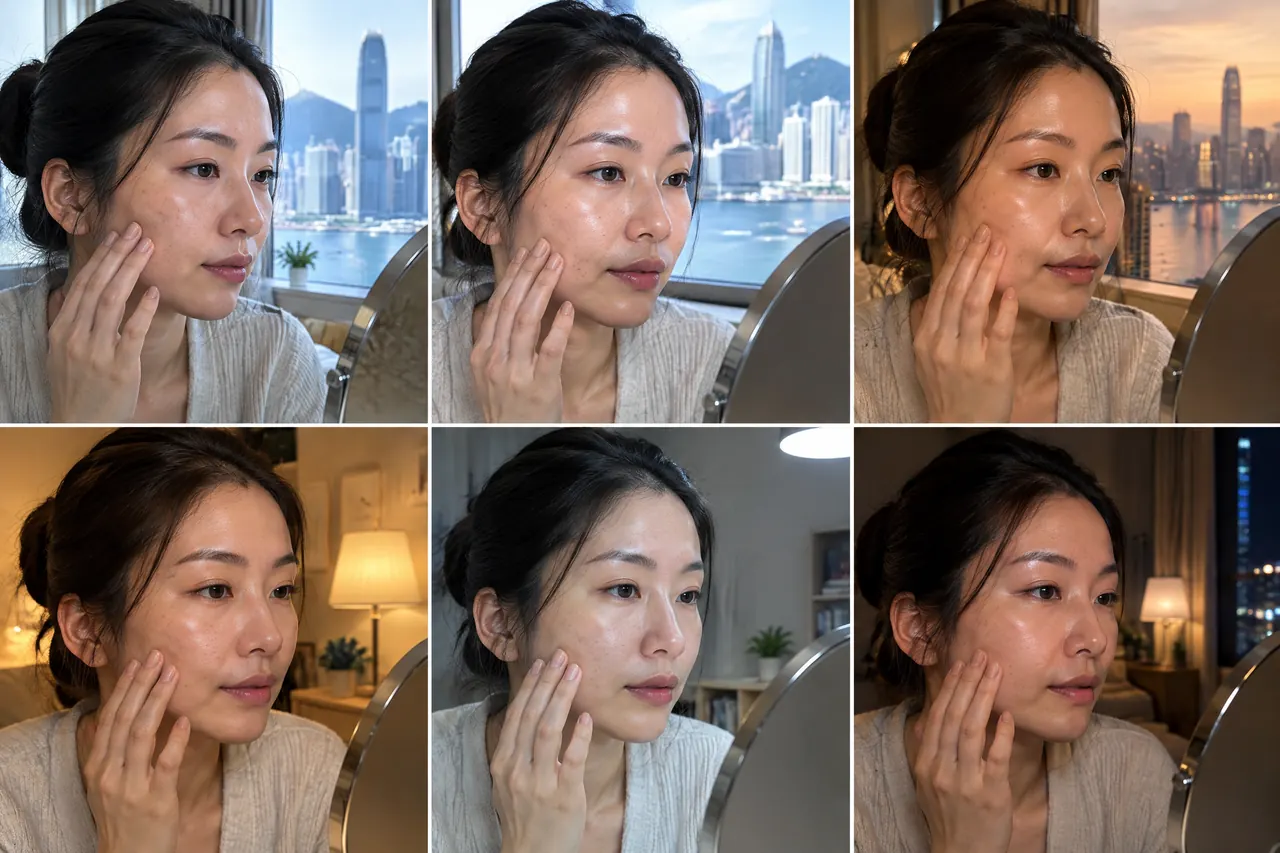
Related makeup style illustrations



Service & lesson fees
Relevant prices and inclusions
Prices and arrangements shown below apply to the listed scope. Confirm timing, location and the final arrangement directly before booking.
All group and private fees are per learner for the entire course.
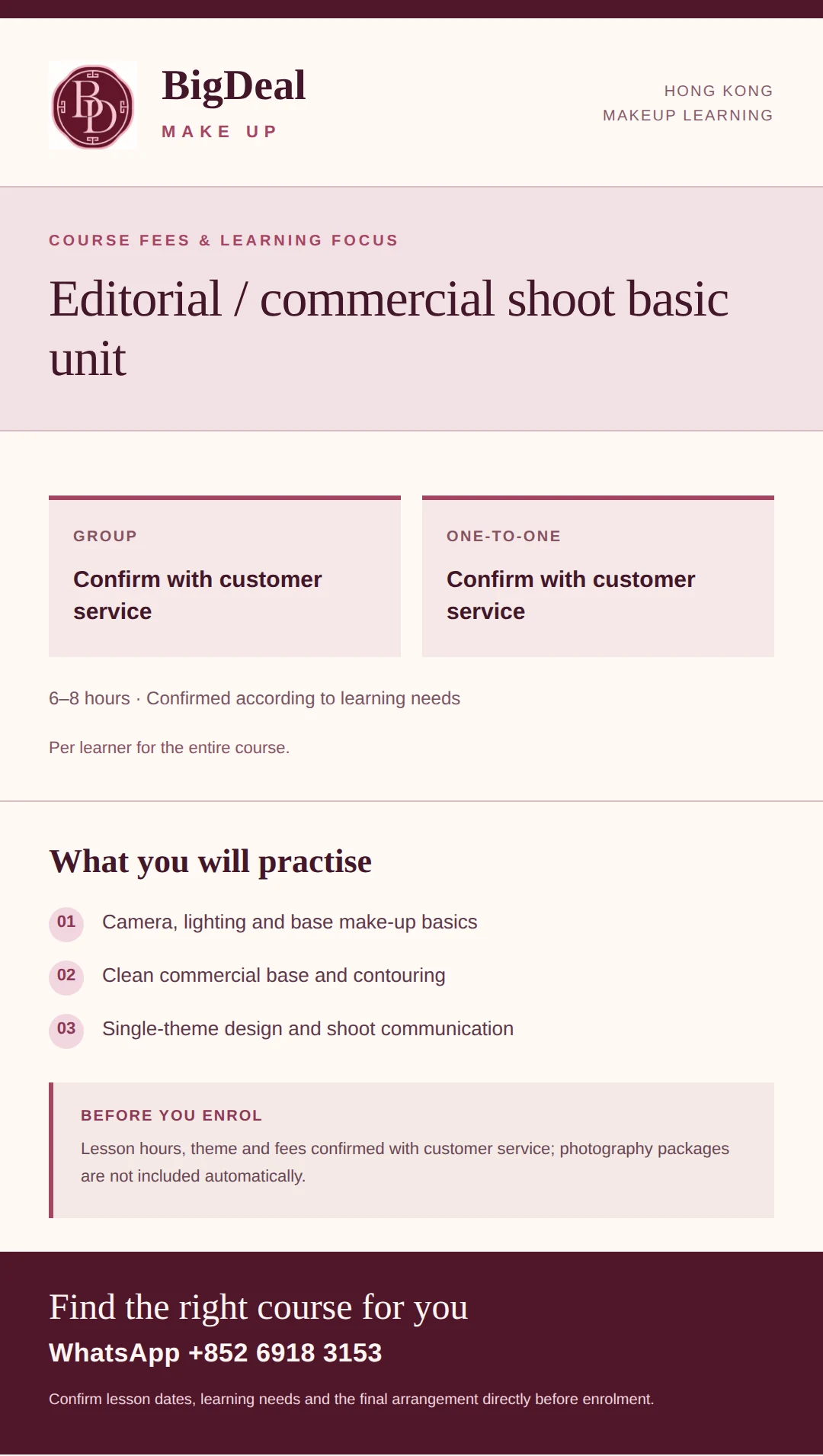
Editorial / commercial shoot basic unit
- Group
- Confirm with customer service
- Private
- Confirm with customer service
6–8 hours · Confirmed according to learning needs
Lesson focus
- Camera, lighting and base make-up basics
- Clean commercial base and contouring
- Single-theme design and shoot communication
Arrangement: Lesson hours, theme and fees confirmed with customer service; photography packages are not included automatically.
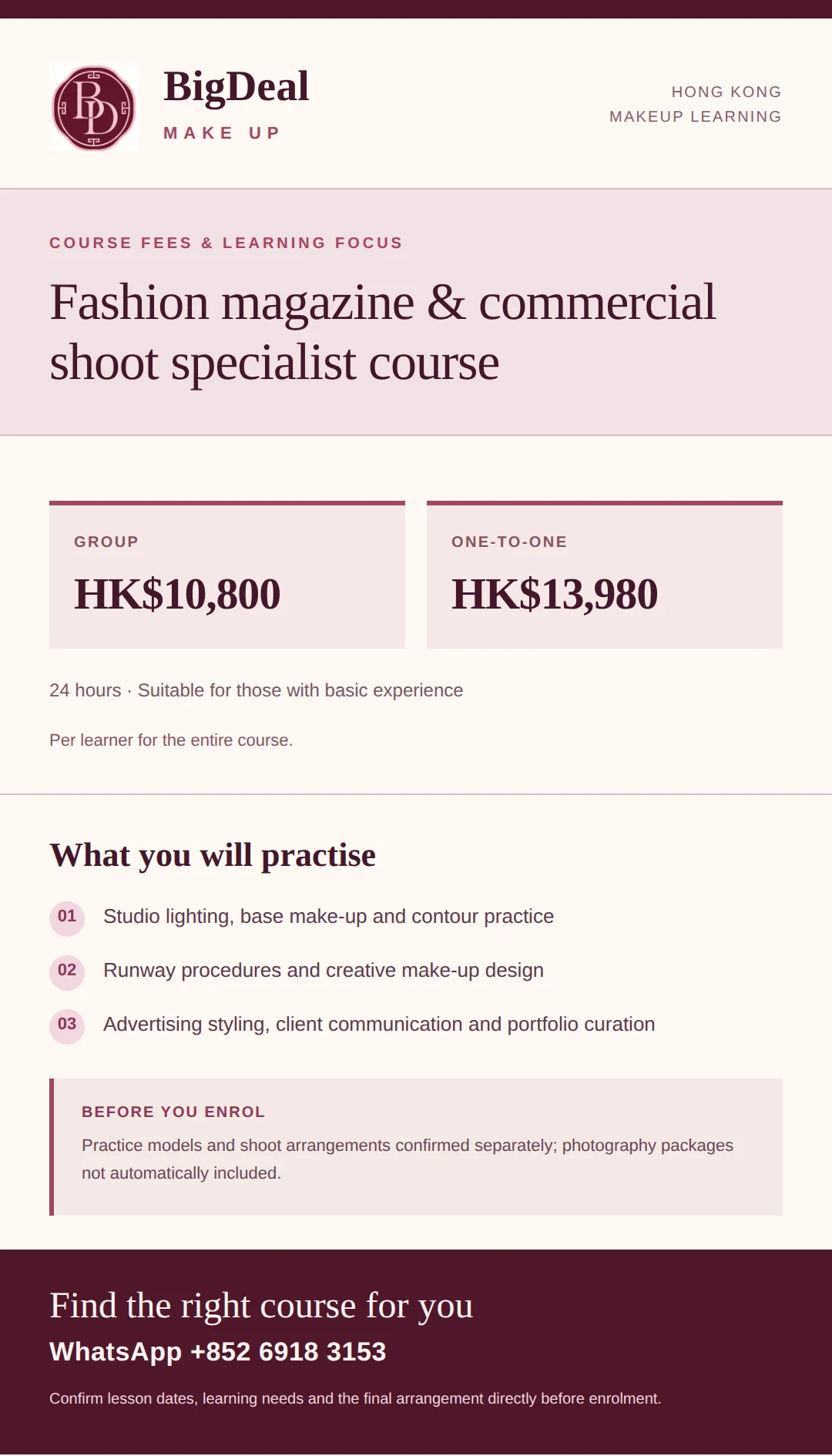
Fashion magazine & commercial shoot specialist course
- Group
- HK$10,800
- Private
- HK$13,980
24 hours · Suitable for those with basic experience
Lesson focus
- Studio lighting, base make-up and contour practice
- Runway procedures and creative make-up design
- Advertising styling, client communication and portfolio curation
Arrangement: Practice models and shoot arrangements confirmed separately; photography packages not automatically included.
Course comparison for camera-ready and editorial makeup
| Course ID | Name and duration | Included focus | Fees (per student) |
|---|---|---|---|
| Editorial / commercial shoot basic unit | Editorial / commercial shoot basic unit — 6–8 hours | Camera, lighting basics; clean commercial base; single-theme design communication | Fees and lesson hours confirmed with customer service (photography not included) |
| Fashion magazine & commercial shoot specialist course | Fashion magazine & commercial shoot specialist course — 24 hours | Studio lighting; contour practice; runway procedures; portfolio curation | Group: HK$10,800; Private: HK$13,980 (models and shoot arrangements charged separately) |
| Short practical follow-up | 1–4 hours (arranged separately) | Targeted practice: colour matching, tethered monitor checks, specific technique drills | Confirm fee with customer service — charged per session |
| Model and studio hire | Variable (arranged separately) | Provision of models, photographers, studio time and props when requested | Costs quoted on confirmation; not included in course fees |
Helpful answers
Frequently asked questions
What is the difference between camera-ready makeup and editorial makeup?
Camera-ready makeup emphasises a controlled, repeatable finish that reads cleanly across frames and lighting setups. Editorial makeup is concept-driven and may use more texture, theatrical colour or visible brushwork for creative effect. Both require technical discipline — camera-aware bases and understanding of light and lens — but editorial work allows greater expressive risk within those constraints.
Does the course fee include photography, models or studio hire?
No. The listed course content covers tuition, studio practice where specified and technical coaching, but photographers, models and studio hire are arranged and charged separately. For Fashion magazine & commercial shoot specialist course the tuition fees are HK$10,800 per student group or HK$13,980 private; for Editorial / commercial shoot basic unit, lesson hours and fees are confirmed with customer service.
Can I learn camera-ready makeup if I only do freelance or personal photoshoots?
Yes. Both course options teach camera-aware techniques useful for freelance or personal projects. Editorial / commercial shoot basic unit is a concentrated unit for immediate, practical application; Fashion magazine & commercial shoot specialist course offers extended practice and portfolio guidance. Plan your own shoot logistics or ask customer service about arranging practice with models and a photographer to replicate commercial conditions.
Will the training certify me to work professionally on shoots?
Courses teach professional techniques and how to communicate with production teams, but they are learning options rather than guarantees of employment, studio access or packaged photoshoots. Confirm what the course provides and treat the training as skills development; securing commercial bookings requires separate professional practice, networking and production arrangements.
What should I bring to a camera-ready makeup lesson?
Bring your usual kit if you prefer to work with familiar products; the team also provides a professional selection during lessons. If you bring products, include primers, foundations in the correct undertone range, setting powders, cream and powder colour options, brushes, sponges and a reliable concealer. Confirm any brand preferences and whether English instruction is required when booking.
How do lighting and lens choice affect the makeup I should practise?
Lighting and lens choice change how texture, colour and contour read: soft, close lights flatten texture and can increase highlight, while hard light or high-resolution lenses reveal more skin detail. Practise layering thinly, test on a tethered monitor where possible, and adapt product finish and placement to the focal length and resolution you expect to work with on actual shoots.
Ready to discuss it?
Book a pre-course consultation to confirm language, dates and model needs
Tell us what you are planning, and we will help clarify the service or lesson details that matter for your enquiry.
From the makeup blog