
BigDeal Make Up · Hong Kong
Makeup Techniques
Small choices in base, brows and eye makeup can completely change how you look in person and on camera. This hub brings together practical Makeup Techniques you can use right away: choosing base coverage for different lighting, simple brow and eye adjustments to create balanced visuals, and when a hands-on lesson or styling appointment will help you practise under real conditions. Safety notes and temporary limits are included so you can test techniques responsibly.
At a glance
Makeup Techniques
Makeup Techniques here focus on temporary, visual adjustments: choosing base coverage and finish for light and distance, shaping brows and eyes to create perceived balance, and preparing camera-ready makeup for flash and outfit contrasts. Courses and private lessons are listed with fees and durations; contact customer service to confirm class size, schedule and tools before you enrol or book an event styling trial.
01
Makeup Techniques for base, eyes and brows
Makeup Techniques: balancing features with temporary makeup
Decide what you want your base to achieve for the occasion. Do you need light, breathable coverage for daytime events or longer-wearing, fuller cover for evening and photography? Choose coverage, finish and setting to match that need: a sheer, dewy finish suits daylight and casual settings; a matte or medium cover often helps when flash or extended wear is expected. These are temporary cosmetic choices, not permanent changes.
Think about the lighting and how close people will see you. Natural daylight, shop lighting and camera flash all interact differently with foundation undertones and finish. Ask whether you will be photographed, filmed or mostly seen at conversational distance. If flash is likely, slightly more coverage and a matte or softly powder-set finish reduces shine; for stage or distant photography, balance stronger contouring with softer blending so features stay readable.
Product preference and skin sensitivity matter. If your skin is reactive or you have special requirements, check ingredient lists and follow patch-test guidance. When a technique mentions a product type—primer, cream concealer, setting powder—treat recommendations as options to test rather than guarantees. A lesson or private session is the best place to try textures on your skin under real light conditions.
For a closer comparison, consider English Makeup Services
02
Makeup Techniques for base, eyes and brows: brow and eye adjustments as temporary visual choices
Makeup Techniques: balancing features with temporary shading and placement
Brows and eyes frame expression; small adjustments can change how balanced a face looks. Techniques include mapping brows to your facial proportions, using soft microblending for sparse areas, and creating a gentle lift illusion with shadow above the tail. These are temporary cosmetic decisions designed to create an appearance you prefer, not medical corrections for structural asymmetry.
For uneven eyes, choose reversible tricks: deepen the socket shadow on the smaller-seeming side to add depth, or apply a thin liner slightly higher on the smaller lid to visually align lid lines. Temporary crease tape, removable glue and skilful shadow placement can be effective styling tools but must be tested for comfort and safety before extended wear.
Avoid over-correcting. Trying to match everything perfectly can create an overly made-up result or emphasise differences. Instead, choose one focal adjustment—lifting a brow tail or evening a lid line—and keep surrounding steps softer. If you want guided practice, the 3-hour Everyday personalised make-up beginner course and the 10-hour Comprehensive personalised make-up practical course let you practise mapping and repeat techniques with supervised feedback.
Match your plans with Makeup Courses
03
Makeup Techniques for cameras and special occasions: plan for flash, distance and outfit
Makeup Techniques for cameras and special occasions should be adapted to lighting and the image style you want to create
When preparing for photos, video or stage appearances, consider how lighting affects texture and reflectivity. Flash tends to flatten features and exaggerate shine; a slightly higher coverage, subtle contouring and careful setting powder can restore perceived depth without looking cakey. Keep highlighter controlled and pick powders that photograph well in your chosen light.
Outfit and colour coordination change how makeup reads. Strong colours, sequins or busy patterns can draw attention away from the face; balance your makeup intensity with the outfit. For dramatic gowns or evening wear, slightly bolder brows and defined eyes stop features from being lost at distance. Softer outfits pair well with a dewy or natural-camera finish.
Practice is essential. The Korean make-up intermediate specialist course includes make-up and hair pairing and camera-ready practice; if photography is central to your event, schedule a class or private session to test your look on camera. Bring the outfit, hair idea and sample lighting if possible so you turn technique advice into repeatable steps for your own photos.
You may also find it useful to compare Makeup Services
04
Makeup Techniques for cameras and special occasions: choose one or two priorities for a coherent look
Makeup Techniques: prioritise longevity, drama or a natural finish and accept the trade-offs
Attempting to make a look long-wearing, highly dramatic and perfectly natural all at once forces compromises. Decide what matters most: staying flawless for a long ceremony, matching a dramatic outfit, or looking like yourself on camera. For longevity, focus on prep, setting and a medium coverage base; for drama, prioritise stronger eye and lip definition and allow for more touch-ups.
Simplify by choosing a focal point. If eyes are the focus, keep lips softer; if a bold lip is central, keep eye makeup cleaner. This keeps a look coherent and avoids every feature competing with the others. It also reduces the number of techniques you need to master during a lesson or at-home practice.
A short workshop quickly clarifies trade-offs. The 5-hour Make-up continuing education themed workshop demonstrates trends and practical textures so you experience decisions in real time. For long events or bridal work, contact customer service about a styling appointment and trial rather than relying only on self-taught techniques; event bookings require scheduling, trial runs and timing confirmation.
For another approach, explore Party and Occasion Makeup
05
Makeup Techniques: when a personal lesson helps you practise at your own pace
Makeup Techniques: choosing a lesson or styling service and what to expect from our courses
Personal lessons give you time and feedback to repeat motions until they feel natural. If you struggle with base matching, brow shaping or balancing uneven eyes, a guided session lets you try product textures, multiple tools and lighting setups. Many students start with the 3-hour Everyday personalised make-up beginner course for foundational steps; group and private fees are listed so you can choose which format suits you.
Longer programmes suit comprehensive practice. The 10-hour Comprehensive personalised make-up practical course covers foundation selection, concealing, setting and practising multiple looks across everyday and date styles. The 16-hour Korean make-up basic course and the 15-hour Korean make-up intermediate specialist course deal with base texture and eye layering in more depth, with camera-ready practice included in certain modules.
Confirm class logistics before you book: class size, schedule and required tools are arranged with customer service. The courses provide practical skill development and supervised practice but are not described here as externally certified programmes. If you prefer English-language instruction or a private session, request that explicitly when enquiring so we can note it for scheduling.
Before deciding, take a look at Korean eye makeup advanced training
06
Makeup Techniques for events and bridal work: when to request a service enquiry
Makeup Techniques for events and bridal work should be discussed in a booking conversation to confirm trials and logistics
Event and bridal work involves logistics beyond technique: trial runs, arrival time and the execution of touch-ups under live conditions. A general technique guide helps you prepare questions—preferred finish, sensitivity concerns and photography needs—but it cannot replace a booking conversation that confirms availability, trial timing and the final look.
For weddings and multi-person styling, ask about on-site setup time, travel, additional assistants if required and contingency plans for weather or late changes. These operational details ensure your chosen techniques can be executed under the real conditions of your event. If you need prosthetics or children’s face paint, these use different materials and need a separate discussion.
Some bookings benefit from a trial with photos and a short list of alternatives; this is the time to test how a base behaves under your event lighting and whether a brow or eyelid technique is comfortable for extended wear. Contact customer service to arrange trials or styling appointments and to confirm course fees if you prefer practice lessons first.
Style references
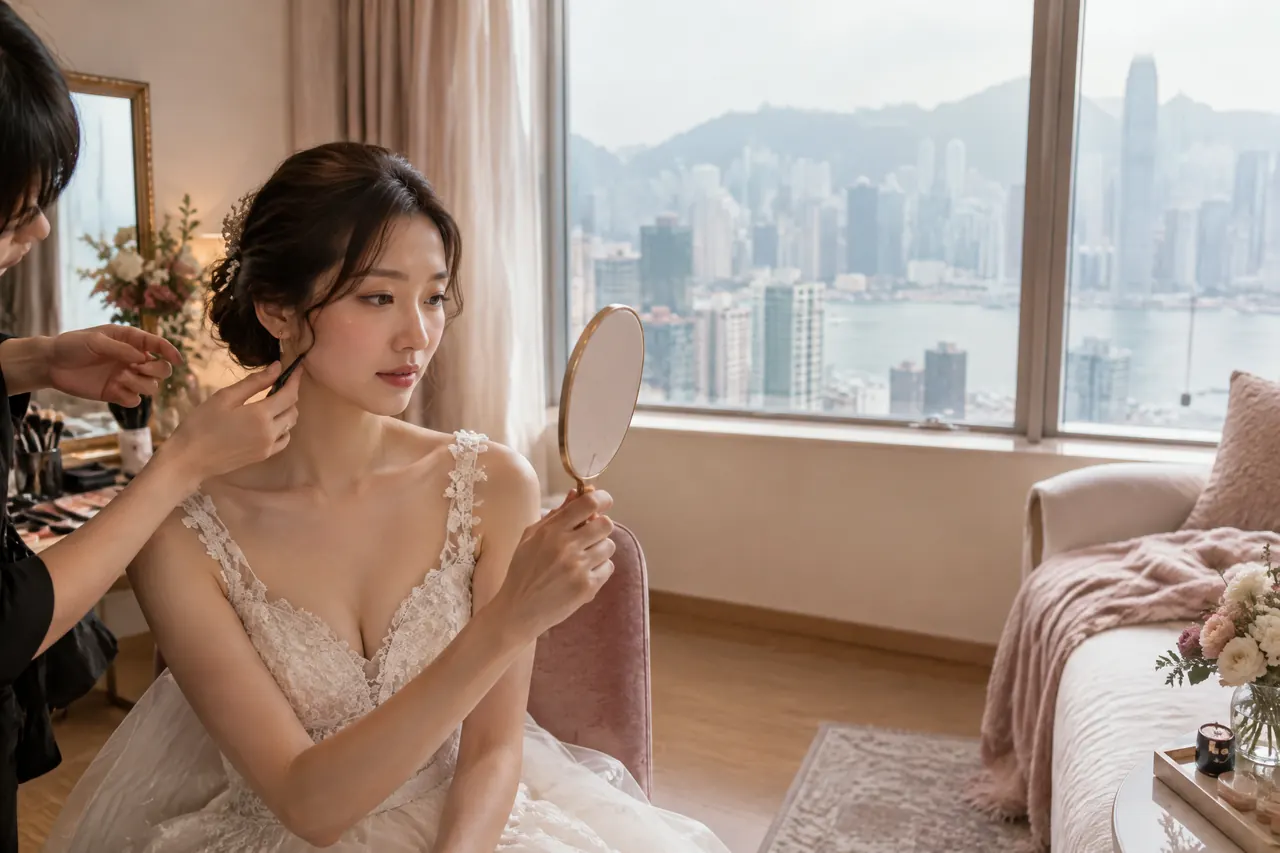
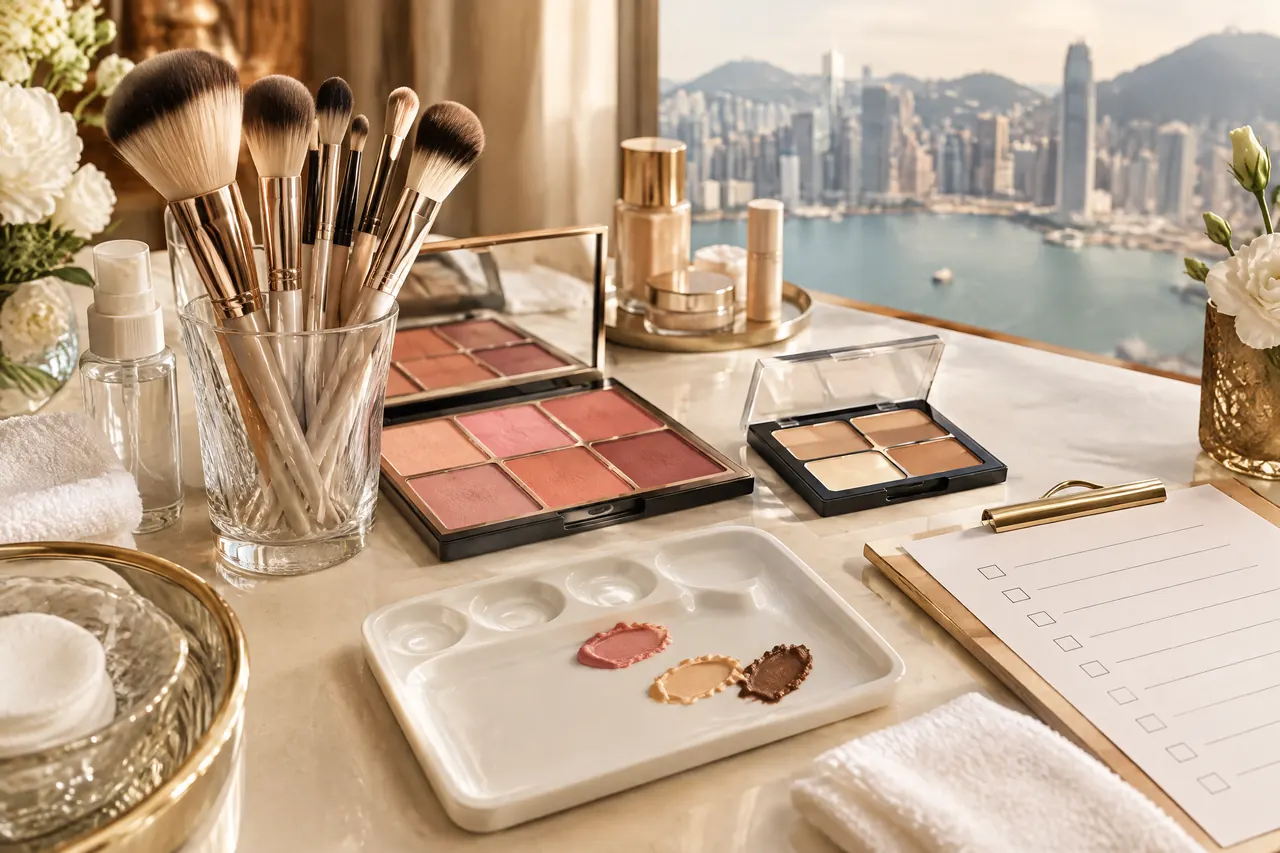
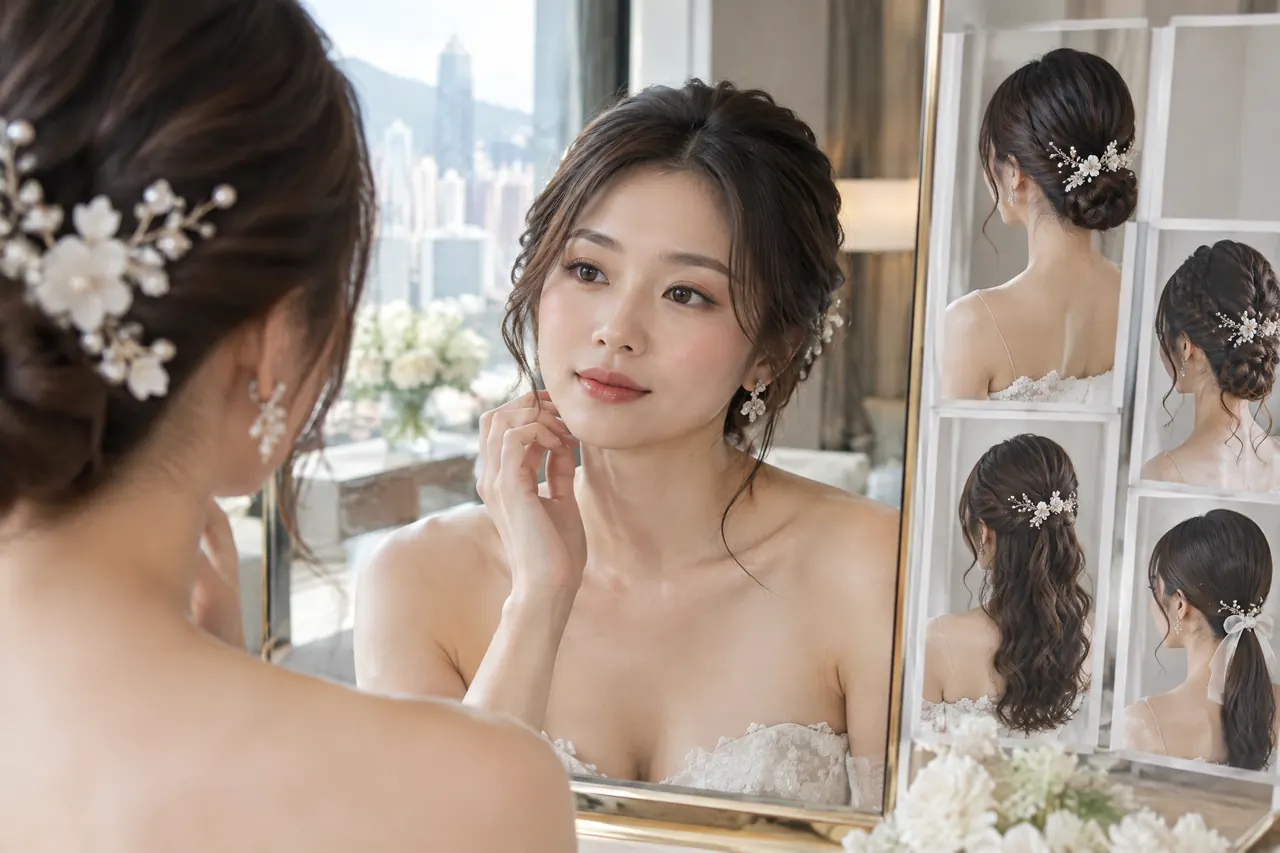
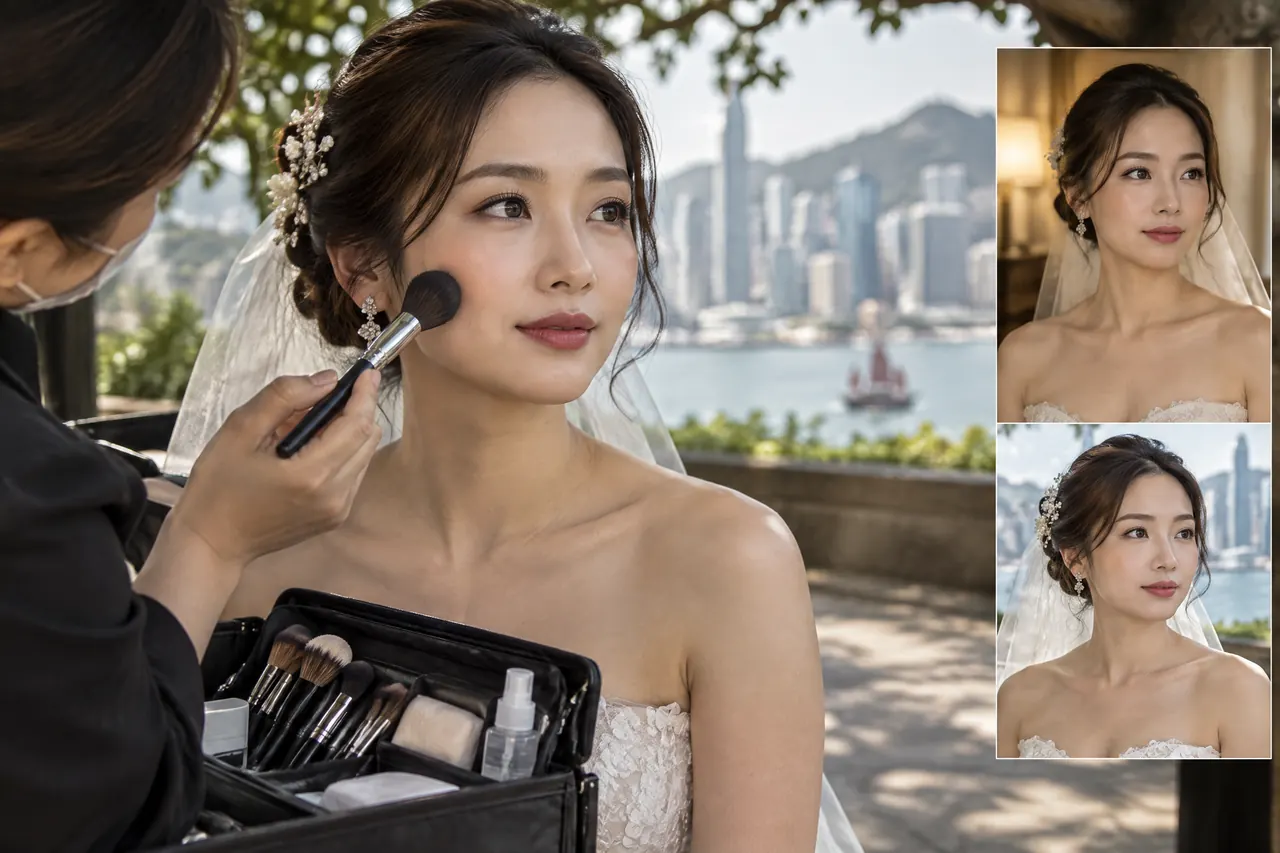
Related makeup style illustrations


Service & lesson fees
Relevant prices and inclusions
Prices and arrangements shown below apply to the listed scope. Confirm timing, location and the final arrangement directly before booking.
All group and private fees are per learner for the entire course.
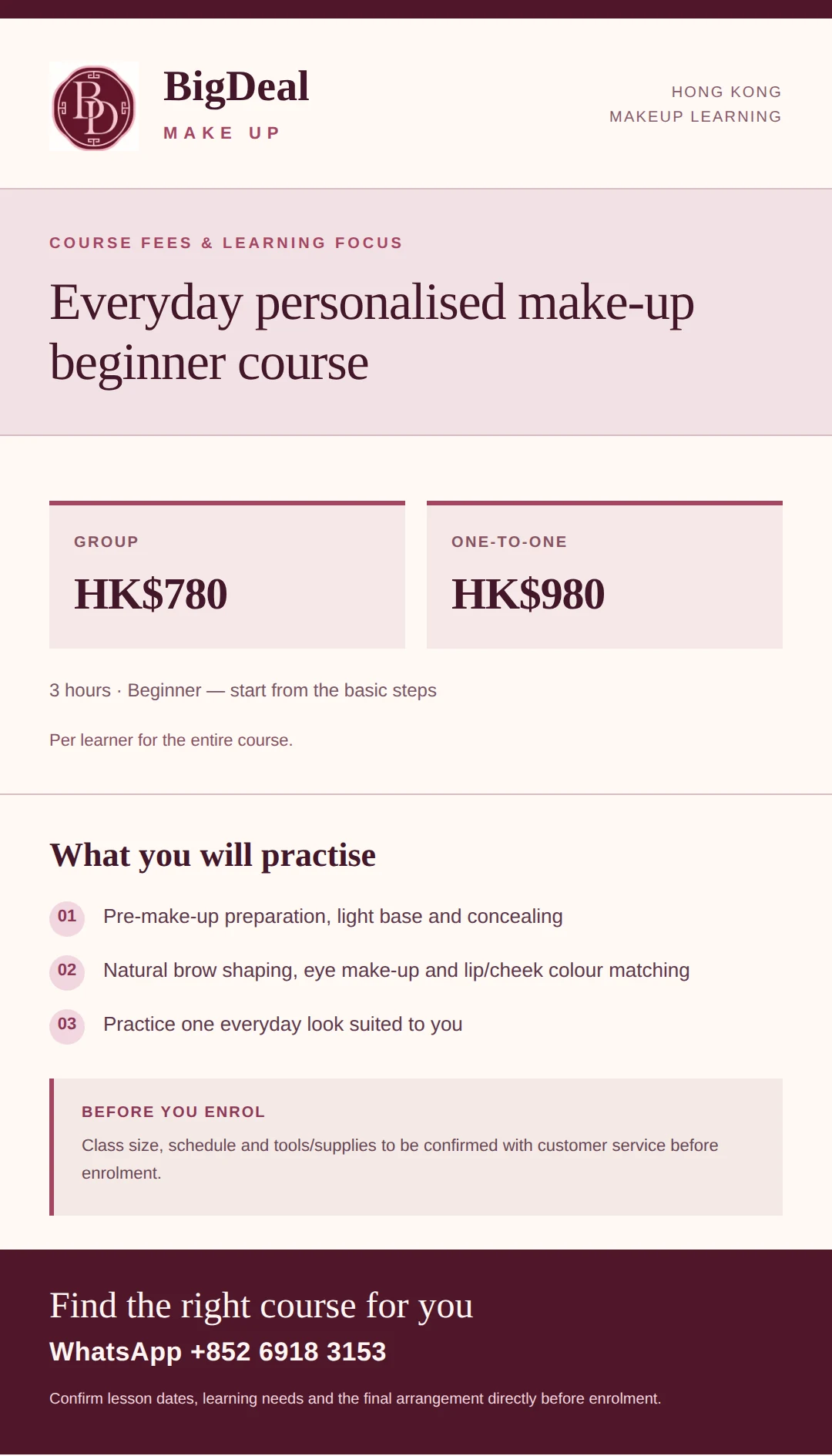
Everyday personalised make-up beginner course
- Group
- HK$780
- Private
- HK$980
3 hours · Beginner — start from the basic steps
Lesson focus
- Pre-make-up preparation, light base and concealing
- Natural brow shaping, eye make-up and lip/cheek colour matching
- Practice one everyday look suited to you
Arrangement: Class size, schedule and tools/supplies to be confirmed with customer service before enrolment.
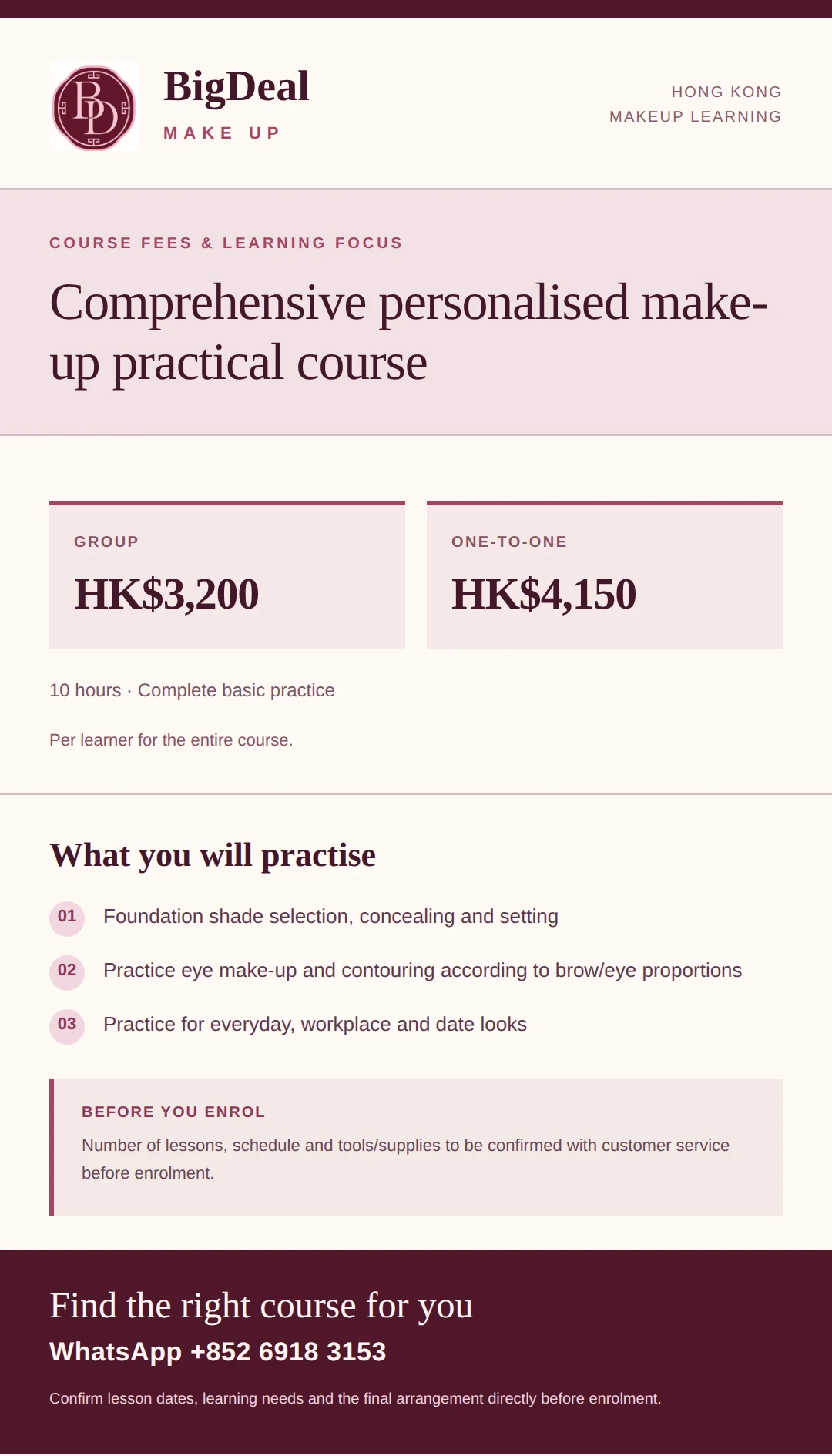
Comprehensive personalised make-up practical course
- Group
- HK$3,200
- Private
- HK$4,150
10 hours · Complete basic practice
Lesson focus
- Foundation shade selection, concealing and setting
- Practice eye make-up and contouring according to brow/eye proportions
- Practice for everyday, workplace and date looks
Arrangement: Number of lessons, schedule and tools/supplies to be confirmed with customer service before enrolment.
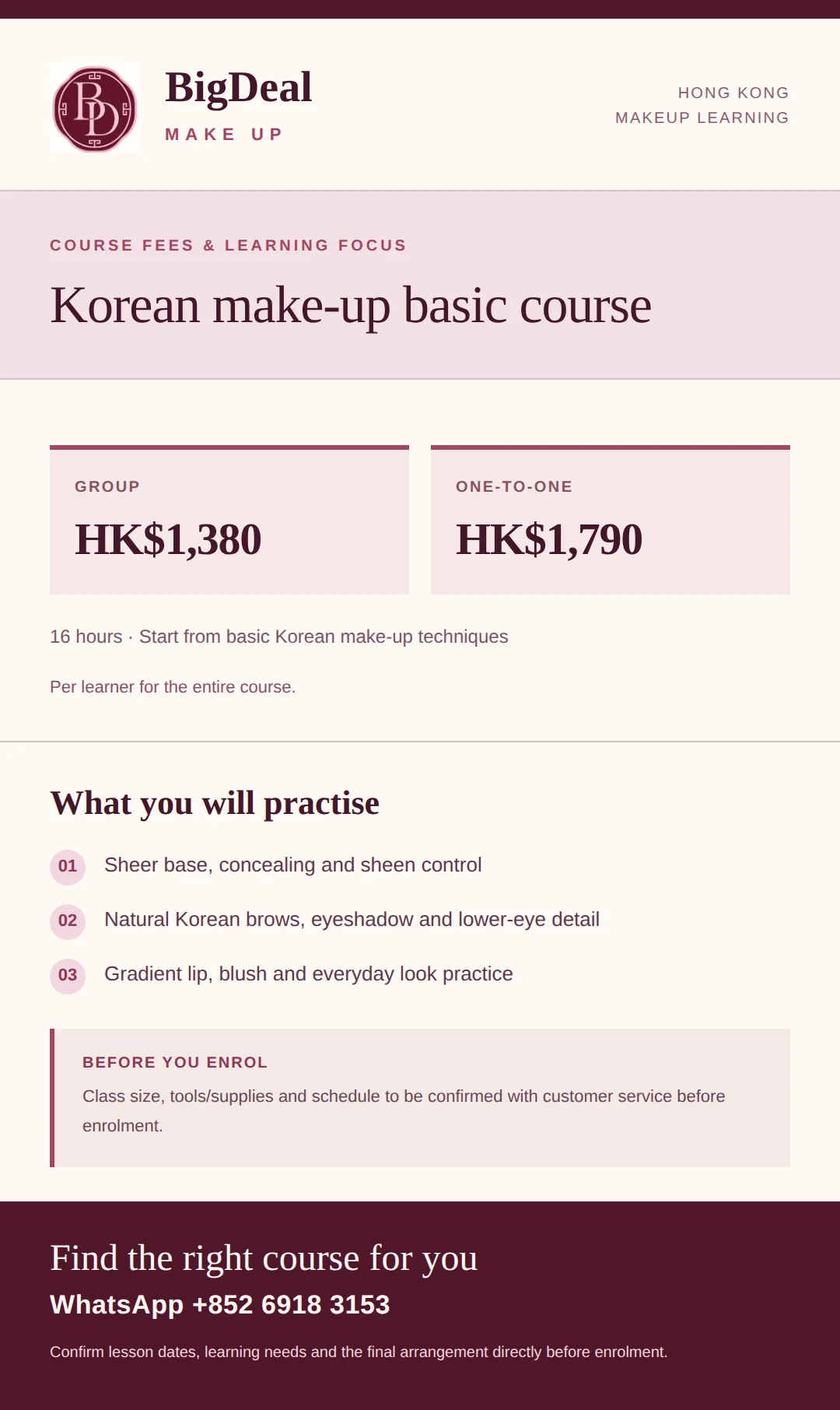
Korean make-up basic course
- Group
- HK$1,380
- Private
- HK$1,790
16 hours · Start from basic Korean make-up techniques
Lesson focus
- Sheer base, concealing and sheen control
- Natural Korean brows, eyeshadow and lower-eye detail
- Gradient lip, blush and everyday look practice
Arrangement: Class size, tools/supplies and schedule to be confirmed with customer service before enrolment.
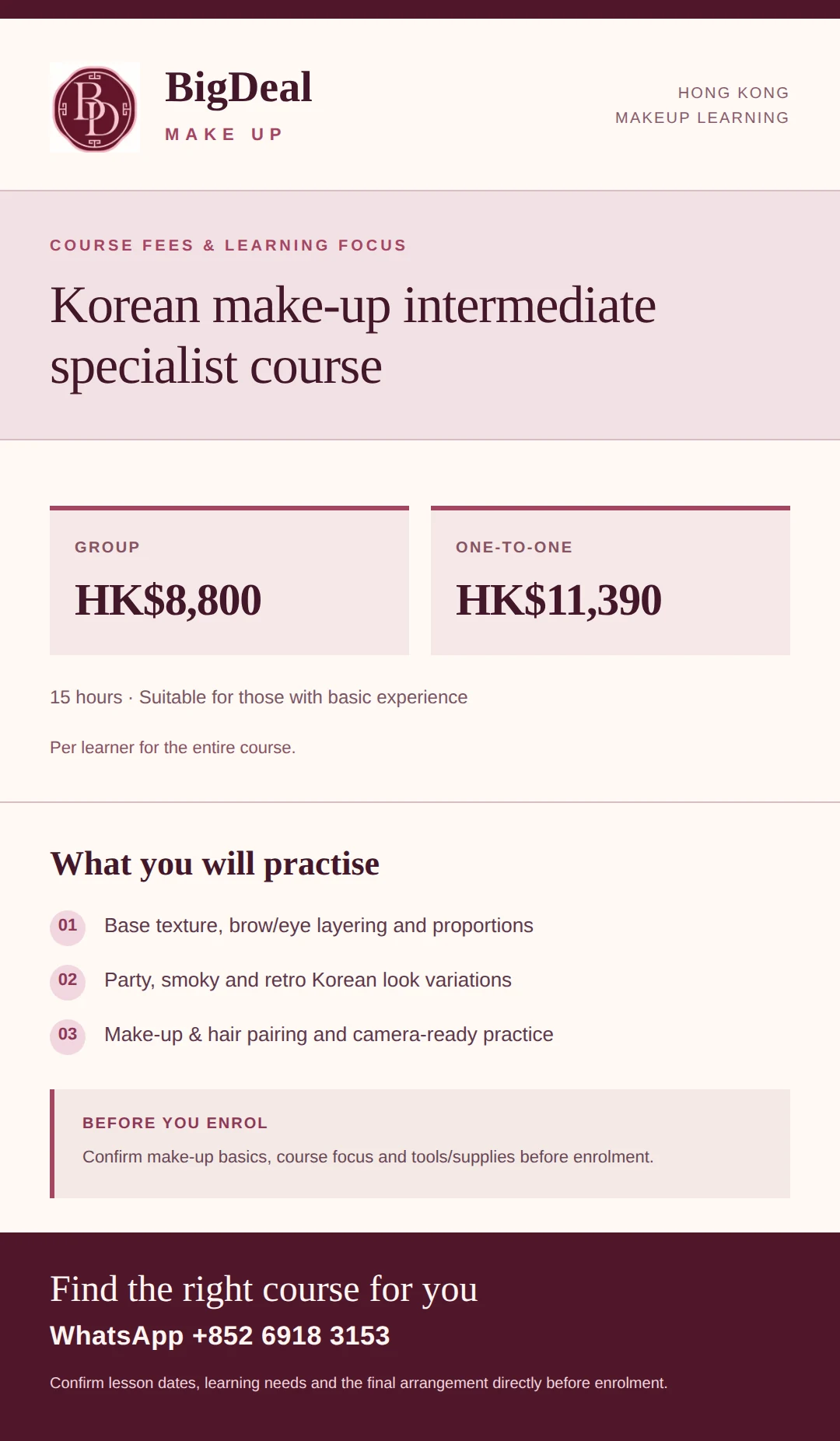
Korean make-up intermediate specialist course
- Group
- HK$8,800
- Private
- HK$11,390
15 hours · Suitable for those with basic experience
Lesson focus
- Base texture, brow/eye layering and proportions
- Party, smoky and retro Korean look variations
- Make-up & hair pairing and camera-ready practice
Arrangement: Confirm make-up basics, course focus and tools/supplies before enrolment.
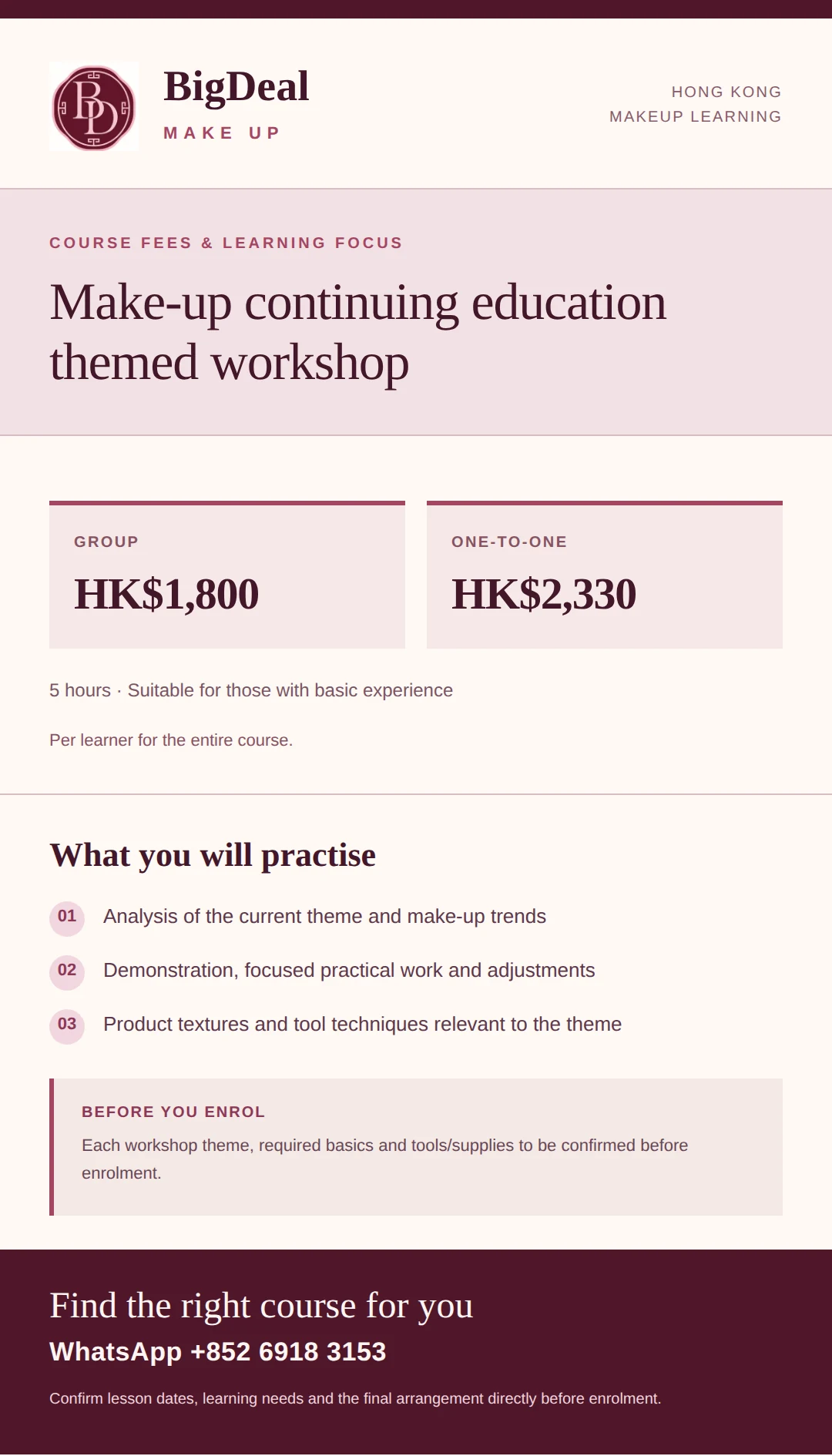
Make-up continuing education themed workshop
- Group
- HK$1,800
- Private
- HK$2,330
5 hours · Suitable for those with basic experience
Lesson focus
- Analysis of the current theme and make-up trends
- Demonstration, focused practical work and adjustments
- Product textures and tool techniques relevant to the theme
Arrangement: Each workshop theme, required basics and tools/supplies to be confirmed before enrolment.
Courses that teach practical Makeup Techniques and what each includes
| Course ID and name | Duration & level | What you’ll practise & fee (private per person) |
|---|---|---|
| Everyday personalised make-up beginner course | 3 hours · Beginner | Pre-make-up prep, light base, natural brows and eye make-up · HKD 980 |
| Comprehensive personalised make-up practical course | 10 hours · Complete basic practice | Foundation shade selection, concealing, setting, contouring practice · HKD 4150 |
| Korean make-up basic course | 16 hours · Beginner to basic | Sheer base and sheen control, Korean brows, lower-eye detail · HKD 1790 |
| Korean make-up intermediate specialist course | 15 hours · Intermediate | Base texture, brow/eye layering, camera-ready practice · HKD 11390 |
| Make-up continuing education themed workshop | 5 hours · Basic experience required | Trend analysis, demonstration and focused practical work · HKD 2330 |
Helpful answers
Frequently asked questions
How should I choose foundation coverage for indoor versus outdoor events?
For outdoor daytime events, choose lighter coverage and a slightly dewy or natural finish to look natural in daylight; heavy mattes can appear flat. For indoor events with flash, use medium coverage and set lightly to control shine without looking cakey. Always patch-test new products and, when possible, try your base in the actual event lighting or bring samples to a lesson or trial.
Can makeup techniques permanently correct unequal eyebrows or eyelids?
No. Makeup Techniques create temporary visual balance using shading, shaping and placement; they do not permanently change anatomy or treat medical asymmetry. Removable methods such as temporary crease tape can change appearance while worn but must be tested for comfort and are reversible. For structural or medical concerns, consult a healthcare professional.
Which course should I pick to practise camera-ready makeup?
If camera-ready practice is your priority, the Korean make-up intermediate specialist course explicitly includes make-up and hair pairing and camera-ready work. The 10-hour Comprehensive personalised make-up practical course also covers foundation and concealing useful for photography. Confirm class format, schedule and any language preferences with customer service before enrolment.
What should I bring to a one-to-one lesson or a workshop session?
Bring your usual cleansers and moisturisers, any current foundation or concealer you use, and the outfit or accessory you plan to wear if the session includes camera or styling practice. Tools and sample products may be requested; each course’s arrangement notes state that supplies and class size need confirmation with customer service. If you have known sensitivities, bring ingredient information and do a patch test beforehand.
Ready to discuss it?
Book a styling trial or event consultation
Tell us what you are planning, and we will help clarify the service or lesson details that matter for your enquiry.
From the makeup blog