
BigDeal Make Up · Hong Kong
Fashion Shoot Makeup Class And Fashion Show Makeup Training
A runway look, catalogue image and fashion‑shoot face use similar techniques but have different priorities. Decide whether the 24‑hour Fashion magazine & commercial shoot specialist course fits your goals. The course teaches studio lighting, creative make‑up and runway procedures but does not automatically include models, hair training or photography packages — confirm practice scope before enrolling.

At a glance
fashion shoot makeup class
If you want to work in editorial, advertising or on the catwalk, the learning focus changes: shoots require micro detail for high‑resolution images, catalogues need consistency across frames, and runway favours impact and speed. The Fashion magazine & commercial shoot specialist course covers these priorities in a 24‑hour format with studio lighting, runway procedures and advertising styling. Confirm whether models, hair support and photography are provided on your dates.
01
fashion shoot makeup class: techniques and learning focus
Who can benefit from a fashion shoot makeup class?
A fashion shoot makeup class should start by defining the visual brief: is the client asking for a bold, high‑contrast runway face, a catalogue look that reads consistently across multiple outfits, or a close‑up editorial where skin texture and fine blending are scrutinised at high resolution? Each brief shifts tool choice, working order and the finish you’ll aim for. The Fashion magazine & commercial shoot specialist course emphasises how those briefs translate into studio practice rather than promising placement at an event or entry into a show.
For catalogue work, the priority is tonal consistency and repeatable application that reads the same in multiple shots and lighting setups. That means neutralising shadows, mapping a base so shade matches across bodies and faces, and choosing finishes that avoid flashback or unwanted shine. The Fashion magazine & commercial shoot specialist course syllabus includes studio lighting and base make‑up practice so you can see how the same face photographs at different distances and with different modifiers.
Editorial or high‑concept shoots demand creative choices that communicate a narrative in one frame: exaggerated colour blocking, textured skin effects or theatrical contouring. Those techniques still need technical control — adhesion of pigments, safe use of adhesives near the eye, and hygienic shared use of palettes. Fashion magazine & commercial shoot specialist course covers creative make‑up design and runway procedures while making clear that hair, models and photographer bookings are arranged separately from tuition.
For a closer comparison, consider fashion makeup artist Hong Kong
02
fashion show makeup training: choosing a practical next step
fashion show makeup training: translate clothing, hair and styling references into a face plan
A fashion show makeup training environment teaches speed, continuity and backstage systems: quick touch‑ups, lighting‑agnostic impact and an order of operations that keeps many faces show‑ready. That training is about creating looks that read from a distance under stage lighting and inside movement; it’s different from the micro‑detail required for editorial close‑ups. Fashion magazine & commercial shoot specialist course introduces runway procedures so you can practise those rhythms in a controlled studio environment.
Translating a designer’s look into a makeup brief means interpreting fabric, silhouette and hairstyling cues as colour, texture and shape on the face. For example, a matte, sculpted cheek might complement crisp tailoring; dewy skin can soften volume from heavy fabrics. The course helps you create a face plan by teaching you how to build a makeup continuity board, pick complimentary palettes and choose finishes that either complement or deliberately contrast with hair and wardrobe concepts.
When selecting between fashion show makeup training and a fashion shoot makeup class, think about the outcomes you want: do you need to build a portfolio of photographed work or learn backstage logistics? Fashion magazine & commercial shoot specialist course is useful for both because it includes advertising styling, portfolio curation and runway procedures, but you should confirm practical model and photographer arrangements before enrolment if you need images for professional promotion.
Match your plans with fashion image styling certificate Hong Kong
03
The page helps a learner turn a visual-production interest into a realistic course-scope discussion
Build a base that supports the intended light and distance
A reliable base is always planned with the final view in mind: distance (runway vs catalogue), lighting (flash vs continuous), and camera sensor behaviour. For runway, heavier pigments and defined sculpting read better at a distance. For catalogue work, thinner layers with careful colour correction avoid maskiness in close‑ups. Fashion magazine & commercial shoot specialist course’s studio lighting and base make‑up practice sessions let you test how different bases photograph under controlled conditions.
Technique matters: blocking undertones, neutralising redness and sculpting with light and shadow are foundational skills taught in a fashion shoot makeup class. Students learn to choose priming, colour‑correcting and finish products to suit the medium—mattifying powders for stage, microfibre primers for high‑resolution stills, and hybrid finishes for mixed projects. The curriculum emphasises product restraint to keep skin flexible under lights, not brittle or cakey.
Hygiene and kit organisation form part of building a working base. The FDA’s guidance on using cosmetics safely—advising against sharing palettes and encouraging clean containers—supports why multi‑person practice must include sanitised brushes, single‑use applicators and disinfection protocols. Fashion magazine & commercial shoot specialist course reinforces professional hygiene as part of preparing a base that will withstand long shoots or quick show turnovers.
You may also find it useful to compare fashion makeup or editorial course comparison
04
fashion shoot makeup class: plan quick, consistent changes for a show-style sequence
Plan quick, consistent changes for a show‑style sequence (fashion show makeup training)
In a show-style sequence, time is the greatest constraint: looks must be repeatable and convertible in minutes. A fashion show makeup training emphasis on mapping change points—eyes, lips, cheek intensity—lets you prepare modular steps you can slot in during a quick change. Fashion magazine & commercial shoot specialist course teaches runway procedures and rehearsed changeovers so you can practise the choreography of multi‑face transformations.
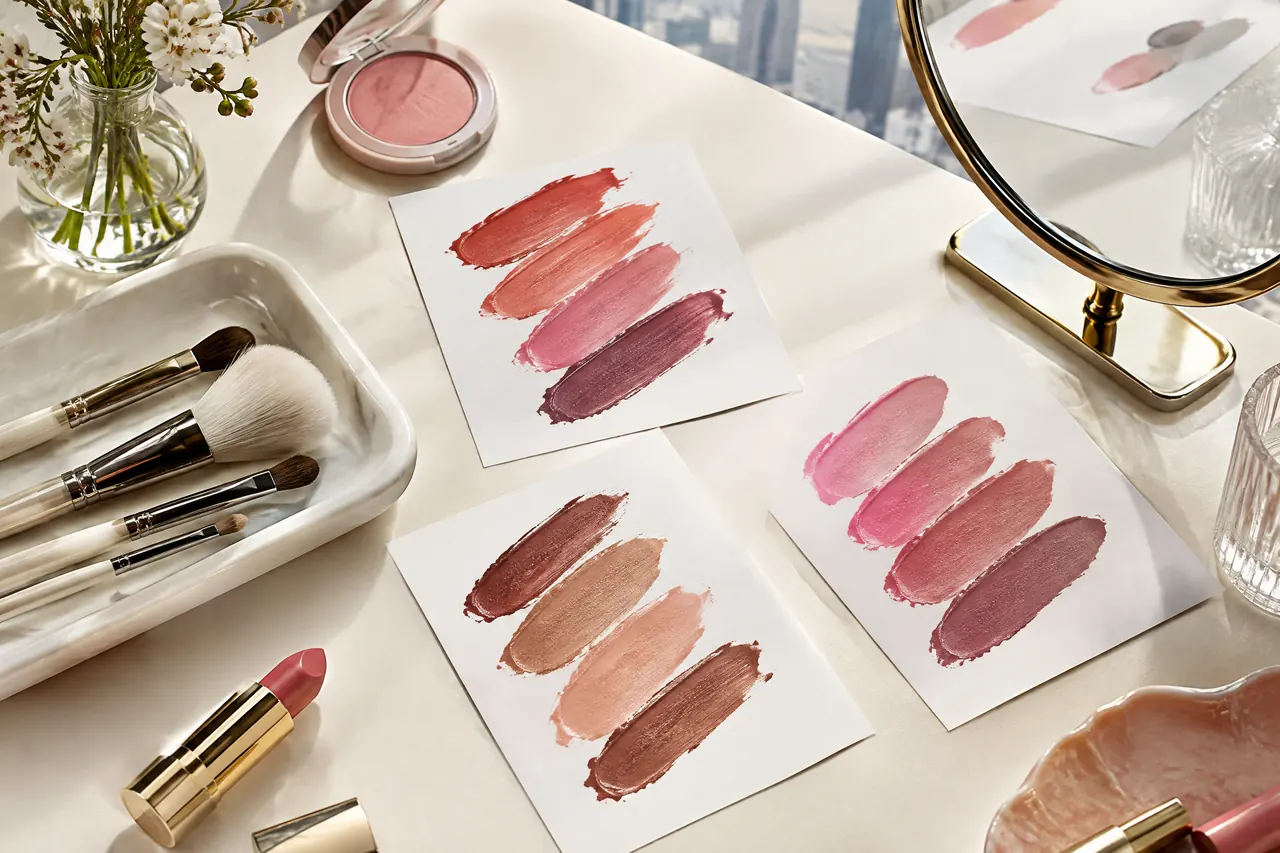
Tools and product choices should support speed. Cream‑to‑powder hybrid products that set quickly, dual‑ended brushes and pre‑mixed tints save seconds; palette labelling and swatch cards speed selection. During the Fashion magazine & commercial shoot specialist course you’ll learn how to prepare a quick‑change kit and label items for backstage efficiency rather than relying on trial and error under pressure.
Consistency across models is another discipline: swatches, reference photos and test patches ensure make‑up reads the same across different skin tones and face shapes. The course covers how to note adjustments for asymmetrical eyes and brows and how to communicate those changes to a runner or assistant so that the creative intention remains intact for each rotation through a show sequence.
For another approach, explore fashion makeup course fees Hong Kong
05
fashion show makeup training: discuss model and hair needs without assuming either is included
Discuss model and hair needs — confirm what a fashion show makeup training session actually supplies
Course descriptions often list ‘models and practice’ as a component, but it is essential to confirm what is actually provided. The Fashion magazine & commercial shoot specialist course states that practice models and shoot arrangements are confirmed separately; photography packages are not automatically included. If you require on‑set hair styling experience or models of a particular demographic, raise this at booking so BigDeal Make Up can advise on availability and potential extra costs.
Hair and makeup are collaborative on shoots and shows. A hair reference can completely alter the plan for products and timing—slicked‑back styles need stronger adhesives and different contour placement, while voluminous hair might require a softer complexion to prevent visual competition. The curriculum explains how to liaise with stylists and how to plan a make‑up brief that factors in the hair direction even if hair training itself is not part of your course.
If your intention is to work professionally, plan practice sessions where you can rehearse with moving models or a hairstylist even if that means booking additional studio time. BigDeal’s Fashion magazine & commercial shoot specialist course will equip you with the techniques and a portfolio curation primer, but practical collaborative sessions with photographers and stylists need separate confirmation so everyone’s responsibilities, kit and hygiene measures are clear.
Before deciding, take a look at Makeup Courses
06
Confirm the actual creative-practice scope before enrolment
Confirm the actual creative‑practice scope before enrolment (fashion shoot makeup class matters)
Before enrolling ask clear, specific questions: will there be models on the dates you want, is a photographer supplied or do you supply your own, and what level of hair support is available? The Fashion magazine & commercial shoot specialist course is offered as a 24‑hour course at HK$10,800 per person in group sessions or HK$13,980 one‑to‑one; the listing explicitly says practice models and shoot arrangements are confirmed separately. Use those facts to budget additional studio time or hired services if you want photographic deliverables.
Also confirm materials: does the course supply shared product, or do you bring a personal kit? For multi‑person practice the hygiene note is crucial—students should bring single‑use sponges, personal lip products and be prepared to sanitise shared palettes. BigDeal instructors use cosmetics from brands such as NARS, Dior Beauty and Bobbi Brown as appropriate; this informs the teaching but does not imply a product bundle is provided to each student.
Finally, be clear about outcomes. The Fashion magazine & commercial shoot specialist course supports portfolio building and teaches advertising styling and client communication, but it does not guarantee bookings, fashion‑week placements or a professional contract. If you need images or staged show practice, ask about optional photography packages and model hire when you enquire so the course content aligns with the practical work you require.
07
Choosing the right practical class and what each delivers
Match your goals to a catwalk makeup class or a fashion makeup for models class
If you want to focus on backstage rhythm, fast colour reads and making looks visible from a distance, select a catwalk makeup class style focus within your training choices. These sessions prioritise quick‑change systems, strong pigments and set products that survive stage lighting. The 24‑hour Fashion magazine & commercial shoot specialist course includes runway procedures so you will practise many backstage skills in a studio setting; confirm whether on‑set models and hair support are arranged for the dates you book because practical extras are organised separately.
For learners whose aim is pristine photographed results, consider a fashion makeup for models class that concentrates on high‑resolution skin, subtle blending and colour correction for cameras. The course teaches studio lighting, base make‑up and contour practice so you can test how a photographed face differs from a stage face. If your priority is building photographed work for a portfolio, enquire about optional photographer hire or model bookings at the point of enrolment rather than assuming they are supplied.
Some students want a hybrid skill set: the ability to cover both campaigns and live shows. If that describes you, request collaborative practice with a hairstylist and photographer to emulate a makeup and hair for fashion shoots course approach. The Fashion magazine & commercial shoot specialist course covers advertising styling and portfolio curation in its 24‑hour syllabus, but hair and model arrangements are separate—plan additional studio time or book a one‑to‑one session at HK$13,980 per learner if you need bespoke practice with hair support for campaign‑style shoots.
Style references
Related makeup style illustrations



Service & lesson fees
Relevant prices and inclusions
Prices and arrangements shown below apply to the listed scope. Confirm timing, location and the final arrangement directly before booking.
All group and private fees are per learner for the entire course.
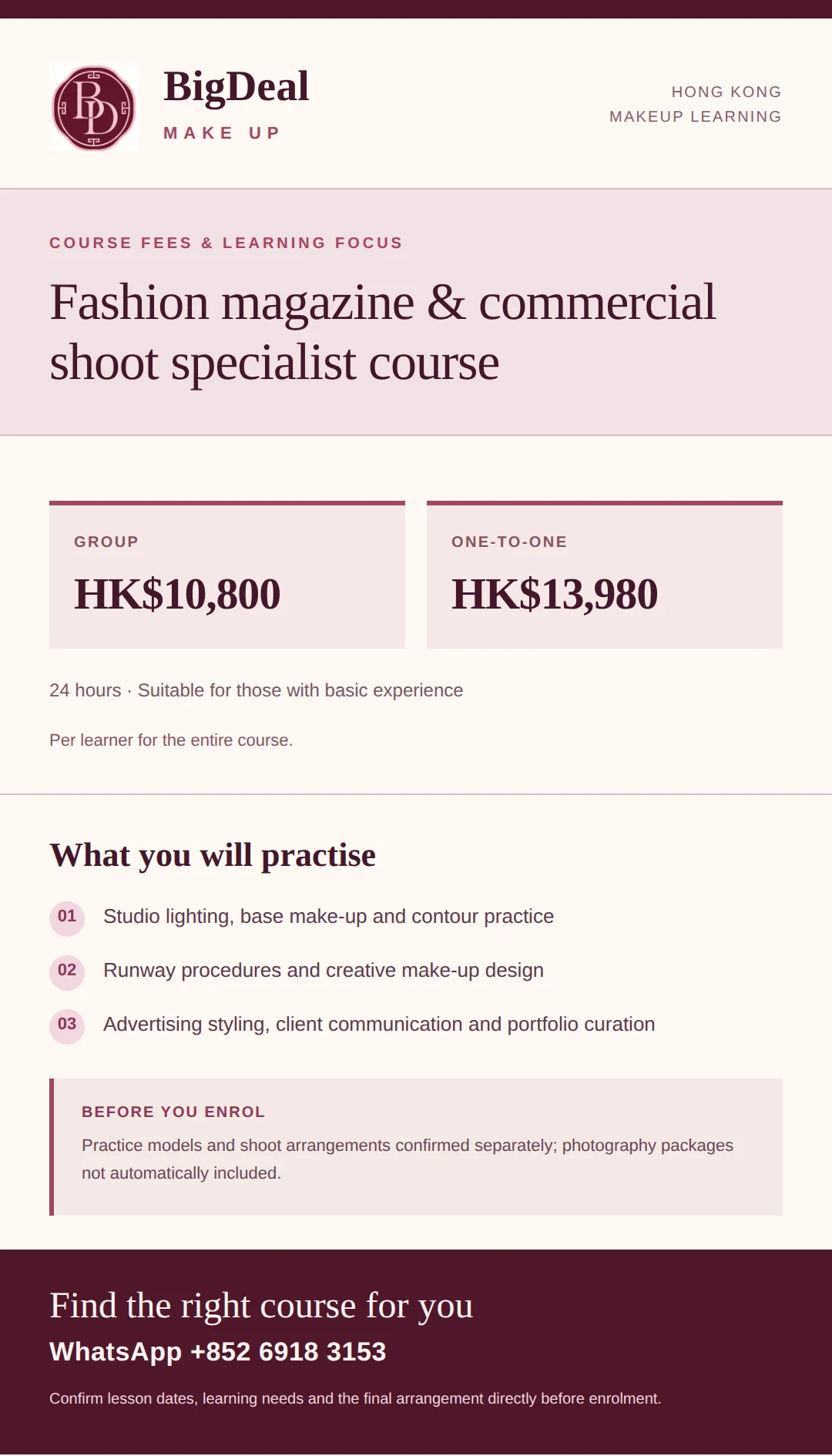
Fashion magazine & commercial shoot specialist course
- Group
- HK$10,800
- Private
- HK$13,980
24 hours · Suitable for those with basic experience
Lesson focus
- Studio lighting, base make-up and contour practice
- Runway procedures and creative make-up design
- Advertising styling, client communication and portfolio curation
Arrangement: Practice models and shoot arrangements confirmed separately; photography packages not automatically included.
Practical comparisons: runway, catalogue and fashion-shoot priorities
| Context | Key visual priority | Typical studio focus |
|---|---|---|
| Runway / Catwalk | Impact at distance and under stage lights | Bold pigment, fast set products, quick-change procedures |
| Catalogue / E‑commerce | Consistency and repeatability across frames | Neutral base, colour-corrected matching, controlled lighting |
| Editorial / Fashion shoot | Textural detail and storytelling in single frames | Fine blending, creative colourwork, close-up lighting control |
| Hybrid look (campaign + show) | Balanced visibility and skin fidelity | Hybrid finishes, rehearsal with photographer and stylist |
Helpful answers
Frequently asked questions
Who should take a fashion shoot makeup class versus fashion show makeup training?
Choose a fashion shoot makeup class if your priority is photographic control, portfolio images or working in advertising and editorial contexts; these classes focus on studio lighting, skin texture and detail. Select fashion show makeup training if you want to learn speed, continuity and backstage systems for live presentations. The Fashion magazine & commercial shoot specialist course sits between both worlds by teaching studio and runway procedures in a 24‑hour programme for learners with basic experience.
Does Fashion magazine & commercial shoot specialist course include models, hair training or photography?
Fashion magazine & commercial shoot specialist course’s listing explains that practice models and shoot arrangements are confirmed separately and photography packages are not automatically included. Hair training is not part of the guaranteed course content. If you need models, a photographer or hair support on specific dates, ask at booking so BigDeal can advise on availability and any additional fees.
How does a fashion shoot makeup class teach base make-up for different lighting?
The course demonstrates base techniques under studio lighting so you can see how products react to flash and continuous light. Expect sessions on colour correction, undertone mapping, primer choices and finishes that prevent flashback or unwanted shine. Practical tests show how heavier contouring reads for runway and how finer, thinner layers suit high-resolution close-ups.
Are hygiene and shared kit protocols covered in fashion show makeup training?
Yes. Professional hygiene and sanitisation are part of the curriculum. The FDA guidance on using cosmetics safely supports the course’s approach of not sharing lip and eye products, sanitising brushes and using single‑use applicators when required. For multi‑person practise bring personal essentials and be prepared to follow sanitisation routines for any shared palettes or tools.
Is this the same as a fashion week makeup artist course?
A fashion week makeup artist course implies direct show placements and extensive backstage logistics across multiple designers, which this 24‑hour programme does not automatically provide. The Fashion magazine & commercial shoot specialist course teaches runway procedures and quick‑change rehearsal to prepare you for that environment, but placements, model lists and show access must be arranged separately—ask at enquiry about any partnerships or extra booking support BigDeal may offer for fashion‑week opportunities.
Will the Fashion magazine & commercial shoot specialist course cover fashion makeup course catalogue styling?
Yes, catalogue styling priorities are taught as part of the course’s studio lighting and base lessons: you'll practise tonal consistency, shade matching and finishes that read reliably across frames. However, if you need a dedicated catalogue shoot with a photographer and multiple outfit rotations, discuss hiring models and photography time when you book because such practical arrangements are confirmed separately from the HK$10,800 group and HK$13,980 one‑to‑one course fees.
Do you offer a separate catwalk makeup class or fashion makeup for models class as stand‑alone options?
Yes, catalogue styling priorities are taught as part of the course’s studio lighting and base lessons: you'll practise tonal consistency, shade matching and finishes that read reliably across frames. However, if you need a dedicated catalogue shoot with a photographer and multiple outfit rotations, discuss hiring models and photography time when you book because such practical arrangements are confirmed separately from the HK$10,800 group and HK$13,980 one‑to‑one course fees.
Ready to discuss it?
Book a place on the 24‑hour Fashion magazine & commercial shoot specialist course
Tell us what you are planning, and we will help clarify the service or lesson details that matter for your enquiry.
From the makeup blog