
BigDeal Make Up · Hong Kong
Foundation Shade Matching And Foundation Coverage And Finish
Foundation choices become easier when shade, coverage, finish and skin condition are considered together. This guide explains a practical base-makeup sequence: observe the skin, decide what needs coverage, choose a finish that suits the moment and check colour in relevant lighting. Skin type analysis here is cosmetic and educational, not medical, and is designed to help you prepare questions before a lesson or appointment with our instructor, Maggie Yeung.

At a glance
foundation shade matching
Start by observing your jawline, neck and chest in natural daylight to read undertone accurately. Select a shade that matches where face and neck meet, then decide coverage only after you know what you want to conceal. Finish — matte, satin or radiant — should respond to skin condition, occasion and wear-time. If you’re booking the Everyday personalised make-up beginner course, mention your undertone and any texture concerns so the 3-hour session can focus on your base needs.
01
Foundation shade matching: a practical guide
How to approach foundation shade matching
Read undertone across daylight, neck and chest rather than rely on a single quick test. Open a window or step outside and look at the jawline where facial skin meets the neck — that junction is the most reliable place to judge whether your skin reads cool, warm or neutral. Check the same area against your chest or décolletage if you plan to wear a low neckline for an occasion such as a wedding.
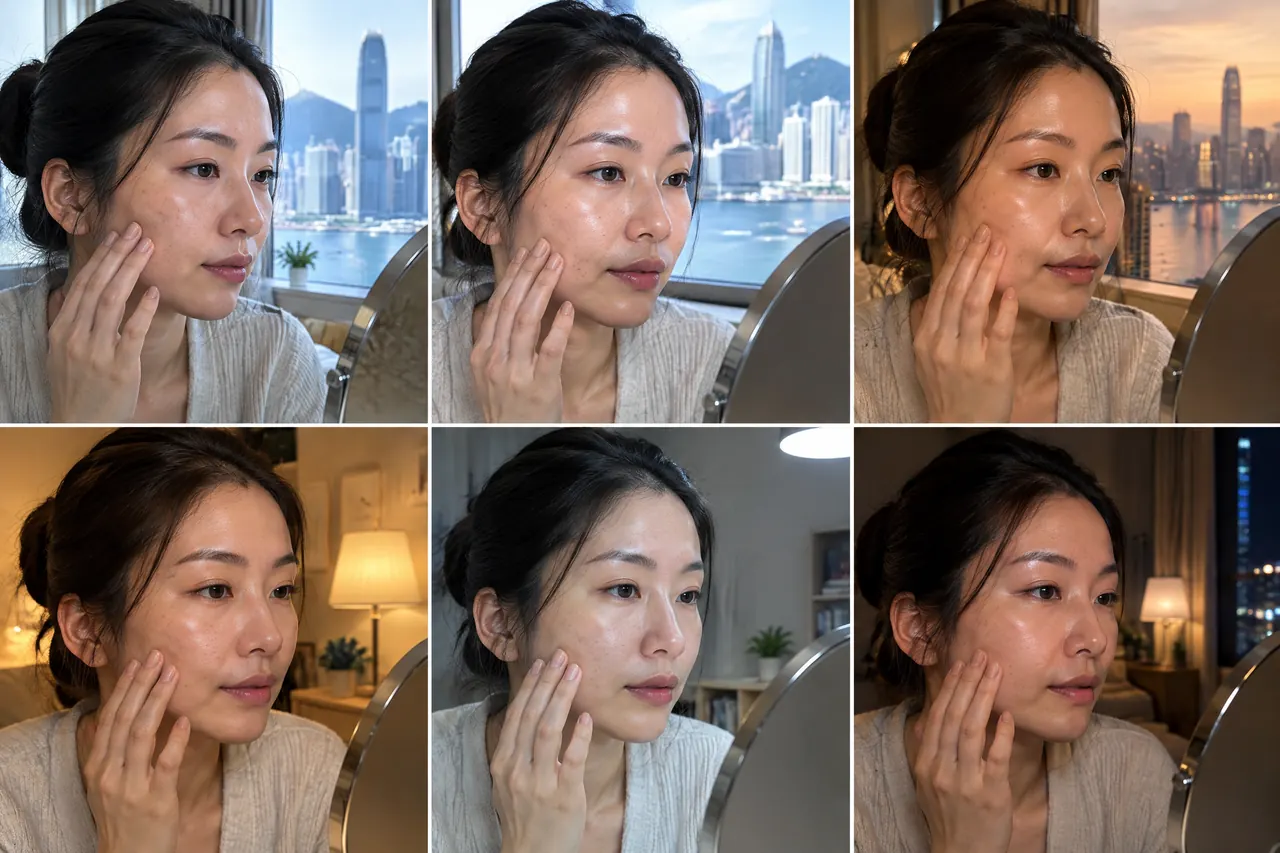
Avoid relying on the inside of the wrist alone; many people have paler inner wrists than their face and can pick a shade that looks mismatched on the jaw. For olive and Asian skin tones the most common problems are foundations that appear too grey or flat. To avoid this, compare two adjacent shades applied as thin swatches at the jawline and view them in daylight and indoor lighting where you usually spend time.
If a swatch looks right at the jaw but feels too warm or too cool in different lights, use a neutralising approach rather than a darker or lighter overall shade. A slightly warmer or cooler concealer placed only where needed can harmonise undertones without changing the whole base. For serious events, book a trial or the Everyday personalised make-up beginner course to practise swatching techniques with Maggie Yeung’s guidance.
For a closer comparison, consider dry skin makeup
02
Foundation coverage and finish: practical choices
Deciding coverage and finish for real life
Choose coverage only after identifying the shade relationship. Decide whether you need spot correction, surface blurring or full coverage. Spot correction and light blurring are best achieved with a thin, skin-like base plus targeted concealer on small discolorations; full coverage often requires a denser formula and careful blending down the jaw to avoid a mask-like edge.
Compare skin-like, satin and radiant finishes by occasion. A natural-matte finish is often better for humid days and long wear; satin gives a healthy glow for evening events and camera work; radiant/luminous finishes suit dry or mature skin that benefits from reflected light. In Hong Kong’s climate a balanced satin or natural-matte usually performs well because it reduces midday shine while keeping the complexion alive.
Think about how the finish interacts with photography and flash. Radiant foundations can look dewy and fresh in person but may reflect flash differently; choose a tested formula and preview with a simple phone photo in both daylight and a dimmer, warmer interior light. If you’re preparing for bridal makeup for cool undertone Hong Kong or bridal makeup for olive skin Hong Kong, request a short trial in similar lighting conditions as the event.
Match your plans with makeup for mature skin
03
Skin type analysis: what to check before applying foundation
Everyday checks for useful skin type analysis
Skin type analysis here is cosmetic and educational, not medical. Begin by noting oiliness, dryness, sensitivity and visible texture on the cheeks, T-zone and under-eyes. Pat the skin lightly with a clean tissue after a few hours of normal activity; where the paper picks up oil suggests where oil-control products or mattifying primers should be used.
A quick test for undertone — cool, warm or neutral — helps select foundations and concealers. Cool undertones have a faint pink or bluish cast, warm undertones show yellow or golden hues, and neutral undertones balance both. For people who read olive, look for a greenish or slightly ashy cast; if a foundation looks grey on Asian skin, the undertone balance is the likely issue rather than coverage level alone.
Texture and surface condition change how formulas apply. Dehydrated skin benefits from hydrating primers and lightweight satin finishes; oily skin benefits from powder-set zones and matte finishes. Make a short checklist of concerns (pore appearance, dryness, flaking, pigmentation) before a lesson; the Everyday personalised make-up beginner course includes light base work and can cover these analysis steps as part of the 3-hour session.
You may also find it useful to compare oily skin makeup
04
Adapting technique to your features and occasion
Assessing the finished look realistically
Place concealer to refine selected areas instead of changing the whole base. Use a concealer one shade lighter for under-eye brightening and a shade matched to skin for spots and redness. Apply concealer only to the area that needs correction and blend the edges with a damp sponge or small brush so the finish remains consistent across the face.
Balance asymmetrical eyes and brows with cosmetic techniques that are temporary and reversible. When one brow is lower or one eyelid more hooded, subtle shadow placement, styling steps and removable eyelid techniques can create visual symmetry for photos and events. These methods do not change anatomy; they are styling choices that work for the moment and can be practised in an Everyday personalised make-up beginner course lesson if requested.
Adapt finish and coverage to the day’s schedule. For daytime events in Hong Kong choose a breathable base with spot concealing and a light powder to control shine; for evening celebrations, add a satin or mild radiant finish on cheeks and high points while keeping the T-zone controlled. Always check the final look in daylight and with a phone photo to ensure the foundation coverage and finish read as intended both in person and on camera.
For another approach, explore sensitive skin makeup
05
Read undertone across daylight, neck and chest rather than one quick test
Local corrections: use concealer instead of replacing the base
A single wrist test won’t replace a daylight jawline check. For accurate foundation shade matching, move swatches from the cheekbone to the jawline and down towards the neck, then step into daylight. For many clients, differences between face and neck are subtle but enough to make an otherwise well-matched foundation appear wrong in photographs or when the collar shows.
When you discover a slight undertone mismatch, correct with localised products rather than replacing the entire foundation. For example, a slightly cool base on warm-toned skin can be warmed with a small amount of peach-coloured corrector under the concealer on targeted areas. This keeps the skin-looking base intact while harmonising visible hue differences.
If you plan a lesson or appointment, bring three or four products you normally use — foundation, concealer and a primer or powder — and a recent selfie in daylight. During the Everyday personalised make-up beginner course lesson the instructor can demonstrate how to place concealer and what coverage level is necessary for your concerns within the 3-hour class time; confirm class size, schedule and tools with customer service before enrolment.
Before deciding, take a look at Makeup Techniques
06
Questions to confirm before booking or attending a class
Practical confirmations for booking foundation shade matching and foundation coverage and finish
Before booking, confirm whether the session is group or private and which aspects will be covered. The Everyday personalised make-up beginner course runs for 3 hours with group HK$780 or private HK$980 per student. The course covers pre-make-up preparation, light base and concealing, natural brow shaping, eye make-up and lip/cheek colour matching — confirm specific tools and schedule with customer service.
Ask how lighting will be handled during a make-up trial or lesson. Request at least one portion of the session in daylight or next to a full-spectrum lamp so that foundation shade matching and finish can be assessed realistically. Confirm the language of instruction and any other arrangements with customer service.
Use independent consumer guidance as general advice about transparent course terms and fee arrangements; this is general consumer information, not an endorsement of any course. Ask for written confirmation of the session content, total cost and cancellation terms so there are no surprises on the day. If anything is unclear, customer service can confirm tools, dates and class size before you enrol.
For a closer comparison, consider makeup for combination skin
Style references
Related makeup style illustrations



Service & lesson fees
Relevant prices and inclusions
Prices and arrangements shown below apply to the listed scope. Confirm timing, location and the final arrangement directly before booking.
All group and private fees are per learner for the entire course.
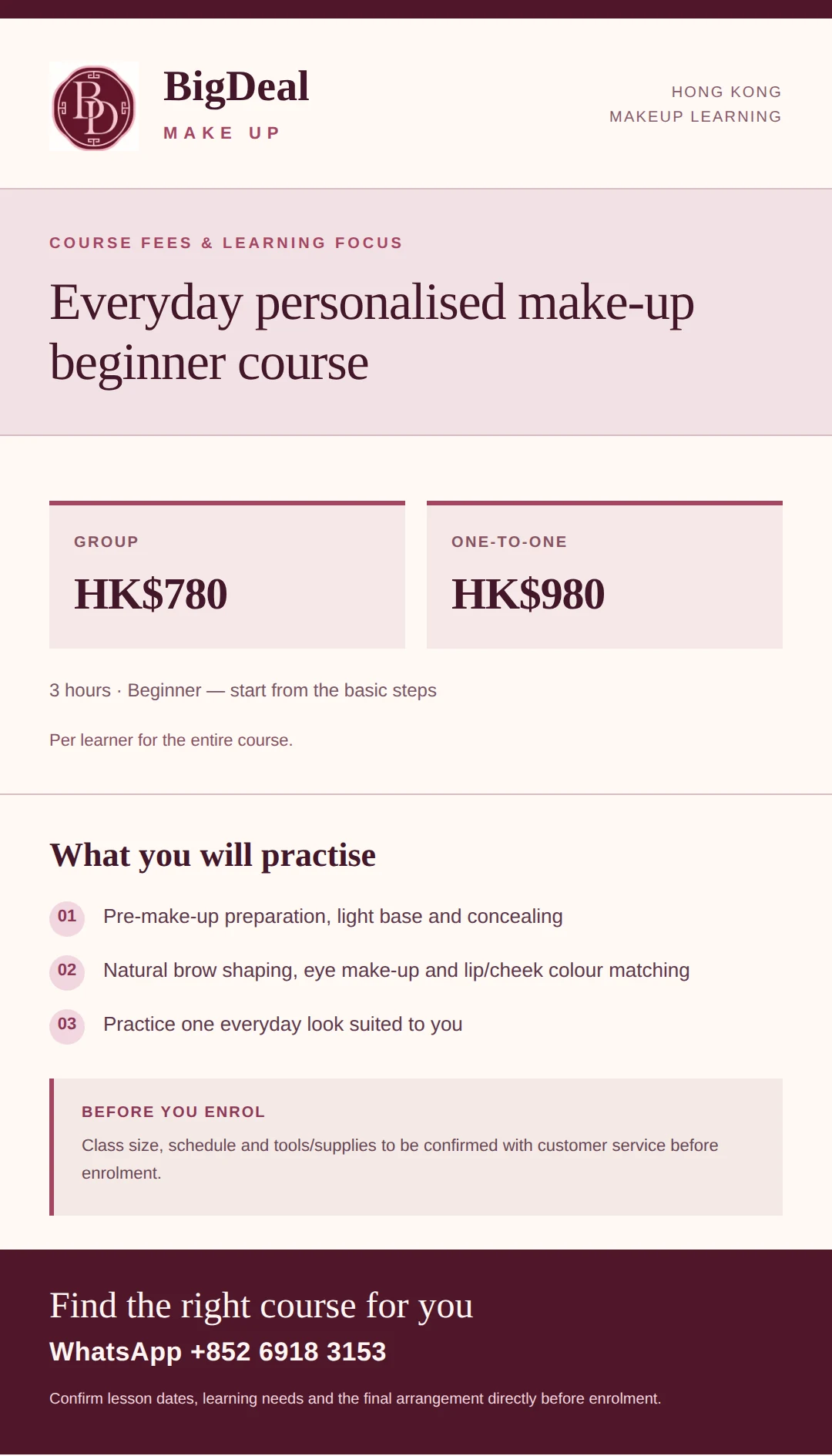
Everyday personalised make-up beginner course
- Group
- HK$780
- Private
- HK$980
3 hours · Beginner — start from the basic steps
Lesson focus
- Pre-make-up preparation, light base and concealing
- Natural brow shaping, eye make-up and lip/cheek colour matching
- Practice one everyday look suited to you
Arrangement: Class size, schedule and tools/supplies to be confirmed with customer service before enrolment.
Practical product-and-budget checklist for a lesson or appointment
| Bring to the lesson | Why it helps | How we use it in class |
|---|---|---|
| Current foundation and concealer | Shows what you normally use and any mismatch issues | Compare swatches at the jawline and decide adjustments |
| A recent daytime selfie and evening photo | Displays how your makeup reads in different lighting | We use photos to discuss finish choices and camera behaviour |
| A small mirror and sponge/brush you prefer | Comfort with tools helps translate advice to home routine | We practise application techniques you’ll replicate at home |
| List of skin concerns and products you can’t use | Speeds up customised recommendations and avoids reactions | Tailor formula suggestions and concealer placement in the session |
Helpful answers
Frequently asked questions
How do I avoid a grey foundation on Asian skin?
A grey appearance usually means the undertone balance is off. Start by checking undertone at the jaw and neck in daylight; olive or slightly yellow undertones need a warmer base or a neutralising corrector. Instead of darkening the foundation, try a warmer concealer or a tiny amount of warm liquid bronzer blended subtly where the skin looks grey. Test with a phone photo in daylight before committing to the whole face.
Can I rely on a wrist test to find my foundation shade in Hong Kong?
Not reliably. The wrist often differs from facial skin and can mislead you. A better method is to swatch two shades at the jawline and view them in natural daylight and the indoor lighting you usually spend time in. If you’re unsure, bring those shades to the Everyday personalised make-up beginner course class or a private trial appointment to compare them under guidance.
What coverage should I choose for humid days in Hong Kong?
For humid days choose a breathable, skin-like base with light-to-medium coverage and mattifying techniques on the T-zone. Spot-concealing for pigmentation or breakouts keeps the face looking natural while reducing the chance of cakey build-up. Set the T-zone lightly with a fine powder and carry blotting sheets for midday touch-ups rather than adding more product.
Will the Everyday personalised make-up beginner course teach foundation shade matching?
Yes. The 3-hour Everyday personalised make-up beginner course includes pre-make-up preparation, light base and concealing and practical application, which covers shade checking and basic undertone discussion. Class size, schedule and tools/supplies must be confirmed with customer service before enrolment. Fees are HK$780 per student for group classes and HK$980 for private lessons.
Will the Everyday personalised make-up beginner course cover flawless base techniques for my oily T-zone?
Yes — the 3-hour Everyday personalised make-up beginner course includes pre-make-up preparation and light base application that teach practical flawless base techniques such as skin prep, targeted mattifying, thin layering and spot concealing for oily areas. You’ll practise under close guidance so you can adapt the steps to your own T-zone. Class size, schedule and which tools or products to bring are confirmed with customer service when you book.
Can you advise on makeup products for skin budget-conscious shoppers in Hong Kong?
We can recommend cost-effective product types during a lesson: a lightweight oil-control primer, a long-wear light-to-medium foundation, a multi-use cream concealer and a translucent powder for setting. In class we’ll discuss which international brands in our kit offer reliable options at different price points and how to get most from smaller budgets by layering and multi-use items.
Do you provide a makeup trial for skin type and how does it work for bridal makeup for warm undertone Hong Kong clients?
We offer a practical makeup trial option within a private lesson where we test formulas on your skin and show removable eyelid techniques and colour choices; this is the recommended approach for a makeup trial for skin type. For bridal makeup for warm undertone Hong Kong clients, the trial focuses on finding warmth-balanced foundation, long-wear setting and colour harmony for photos and venues. Bookings, language and exact venue details are arranged with customer service before the session.
Can you explain a cool warm neutral undertone test Hong Kong clients can do at home before a lesson?
A simple at-home cool warm neutral undertone test Hong Kong clients can try: view your bare jawline in daylight with no jewellery or coloured clothing nearby. Look at your veins—bluer tones suggest cool, greener hints suggest warm, and a mix usually reads neutral. Next, hold a gold and a silver coin to the skin; gold flatters warm, silver flatters cool. Neutral will suit both. Bring photos and your results to the 3-hour Everyday personalised make-up beginner course so Maggie can confirm and refine your undertone in person.
What should I expect from foundation matching for olive skin Hong Kong when I book a private session?
A private session will assess both colour and undertone for foundation matching for olive skin Hong Kong: Maggie checks the jawline and nose under natural light, evaluates any greenish or sallow cast, and recommends whether neutral-warm or olive-specific formulas are needed. You’ll test two to three swatches on the jaw, see how they oxidise on your skin, and learn blending and correcting techniques. Confirm language and booking details with customer service before your private lesson.
Do you show practical steps for how to find my foundation shade Hong Kong and how to avoid grey foundation on Asian skin?
Yes. The 3-hour Everyday personalised make-up beginner course teaches how to find my foundation shade Hong Kong with hands-on swatching at the jawline, daylight checks and mobile photo comparisons. The lesson also covers how to avoid grey foundation on Asian skin by balancing undertone, using tiny amounts of warmer correctors or bronzers and preventing oxidation with suitable primers. Class schedule and what to bring are confirmed with customer service when you book.
What does a makeup artist undertone analysis Hong Kong session involve in a private lesson?
A makeup artist undertone analysis Hong Kong in a private lesson is a practical, hands-on check rather than a certificate. Maggie examines the jawline and neck in daylight, compares veins, and tests small swatches to see how colours oxidise on your skin. You’ll learn to spot cool, warm and neutral cues and receive personalised product and correcting tips. Bookings, preferred language and venue details are confirmed with customer service before the session.
How to choose foundation for pink undertone if my skin looks flushed easily?
Start with a foundation described as neutral-to-warm rather than anything that enhances pink. Test two shades at the jawline in daylight: the correct one should neutralise redness without making you look yellow. Consider a green-tinted corrector only on persistent areas of redness, then apply foundation sparingly and blend outward. Powdering can mute fresh, healthy colour—use translucent powder lightly and prefer a skin-like finish. Bring results to the 3-hour Everyday personalised make-up beginner course for guided practice.
How to choose foundation for yellow undertone and for makeup for neutral undertone clients?
For yellow undertone, seek foundations labelled warm or golden; swatch at the jaw and check in daylight to ensure the base cancels sallowness without turning orange. For makeup for neutral undertone, you have flexibility: neutral undertones suit both warm and cool ranges, so choose whichever complements your natural skin radiance or the look you want. In both cases, test how products oxidise on the skin and practise spot-concealing and blending techniques in the Everyday personalised make-up beginner course to refine the final shade match.
How to match concealer to skin tone without ending up with a patchy finish?
Match concealer to the area you’re correcting rather than the whole face. For under-eye circles, choose a concealer one shade lighter than your foundation with a similar undertone to brighten without looking ashy. For blemishes use an exact skin-tone match; this avoids obvious patches. Test on the jawline and let it sit for a few minutes to check for oxidation. Blend edges with a small damp sponge or brush and set only the corrected spot very lightly with translucent powder to keep surrounding skin radiant.
Do you offer a foundation shade matching Hong Kong makeup artist service as a standalone booking or only within courses?
We provide foundation shade matching Hong Kong makeup artist-style as part of both the 3-hour Everyday personalised make-up beginner course and private lessons. In a private lesson Maggie will swatch two to three shades at your jawline, observe oxidation in natural light and show correcting techniques for undertone issues. Group course places are HK$780 per student; private lessons are HK$980 per learner. Confirm language, exact venue and scheduling with customer service when you book.
What happens in a skin tone makeup consultation Hong Kong — can I get tailored product and technique advice?
A skin tone makeup consultation Hong Kong is a hands-on session where Maggie examines your jawline and neck in daylight, performs undertone checks and tests products to see how they settle. You’ll receive tailored product types and application steps for balancing uneven tone, and temporary corrective hacks like removable eyelid techniques or spot correctors. The same practical guidance is included in the 3-hour Everyday personalised make-up beginner course; book through customer service to confirm class language and schedule.
Ready to discuss it?
Book a 3-hour trial or private session — confirm schedule and language with customer service
Tell us what you are planning, and we will help clarify the service or lesson details that matter for your enquiry.
From the makeup blog