
BigDeal Make Up · Hong Kong
Professional Makeup Course Duration
Course duration matters when you match the hours to what you want to practise. BigDeal Make Up offers options from a 2‑hour Make-up technique taster workshop through focused units such as a 6–8 hour Editorial / commercial shoot basic, to 18–48 hour bridal programmes (Bridal make-up specialist practical course, Professional bridal make-up & hair comprehensive course) and an 80‑hour advanced professional route. Use published hours to plan attendance and practice time; they indicate supervised practice and lesson count, not qualifications, job placement or automatic portfolio inclusion.

At a glance
professional makeup course duration
Professional makeup course duration helps you timetable supervised practice, model bookings and lesson spacing. Compare course hours against your experience and weekly availability — and consider makeup artist career course duration when you plan a pathway. Ask whether sessions are face‑to‑face, how many models you’ll work with, and whether any shoot time is included. Confirm fees, tools and lesson pattern with customer service before you enrol.
01
How professional makeup course duration supports practical learning
Planning professional makeup course duration around your current experience
Published course hours are a practical scheduling tool, not a guarantee of skill. A 2‑hour Make-up technique taster workshop gives focus for one or two techniques (base layering, natural brows), while longer courses provide repeated supervised practice and feedback. Treat the stated hours as an operational detail: they show how much instructor contact and practice you can expect and how many lessons you must arrange in your diary.
When matching duration to your experience, think of hours as ‘practice currency’. If you already know basic day make‑up, an 18‑hour bridal course may be more efficient than a 25‑hour foundational course because it concentrates on correction, trials and timed touch‑up routines used in weddings.
Class duration also affects logistics and cost‑effectiveness. Short, focused units reduce time off work but usually require extra self‑practice; longer formats build layered competence and typically include scene practice or portfolio review. Confirm whether consumables, models and photography time are included so the stated hours become real hands‑on learning.
For a closer comparison, consider bridal hair course duration
02
Compare a two‑hour taster with focused specialist commitments
Using makeup artist career course duration to set a focused learning goal
A 2‑hour Make‑up technique taster workshop suits anyone wanting to try the teaching style or learn a single practical skill quickly. Expect demonstration, guided practice and time‑limited instructor feedback. For beginners it’s an efficient start; for more experienced learners it’s a chance to add a temporary technique to your toolkit.
Focused specialist blocks such as the Editorial / commercial shoot basic (6–8 hours) concentrate on camera techniques and communication with photographers. That unit can teach how lighting affects base work and camera contouring in one session, but you will need further sessions or self‑directed practice to produce a shoot‑ready portfolio.
Longer specialist courses — bridal programmes or advanced routes — let you rehearse trial planning, client communication, multiple looks and timed touch‑ups. They are not employment guarantees, but extra supervised hours let you practise processes under pressure and develop reliable event‑day routines.
Match your plans with CEF eligible makeup course
03
Understand the difference between 18 hours over six lessons and 48 hours overall
Confirm arrangements that affect how hours turn into hands‑on practice
An 18‑hour programme delivered across six lessons helps retention: you practise, reflect, then return with questions. Ask how the lessons are spaced — weekly, fortnightly or as intensive weekend blocks — since spacing affects how quickly you complete rehearsal cycles and prepare for bookings.
A 48‑hour comprehensive programme usually includes more topics, such as hair foundations, dress coordination and extended touch‑up practice. These hours can be organised as longer sessions or compact blocks; both formats have pros and cons for energy, model availability and kit consumption. Confirm the lesson pattern with customer service.
Hours alone do not reveal class size, model practice ratio or whether photography time is scheduled. Smaller groups often mean more individual feedback per hour; larger groups can still work well if there are staged model runs and strong instructor demonstration. Verify how the 18 or 48 hours translate to hands‑on practice and instructor availability.
You may also find it useful to compare HKQF makeup course Hong Kong
04
Treat the 6–8‑hour editorial estimate as scope‑dependent
Planning professional makeup course duration around your intended portfolio outcomes
The Editorial / commercial shoot basic is listed at 6–8 hours because camera‑facing training is scope‑dependent. A focused clean‑base workshop may fit six hours; adding styled shoots, lighting and image review can extend the day to eight hours or more.
If you aim to produce portfolio images, clarify what the hours include: studio time, photographer fees, image selection and hair or wardrobe support are often separate. BigDeal’s notes state that photography packages are not included automatically; get a clear breakdown so you know whether the stated hours will produce usable images.
Repeat practice under camera lighting is crucial for career‑focused students. Use the 6–8 hour estimate to negotiate a plan: you can arrange extra hours or add subsequent sessions to consolidate what you learn. Ask whether a mock shoot day or portfolio review is part of the course or available as an add‑on.
For another approach, explore professional makeup course price
05
When to consider a 25‑hour foundation or an 80‑hour advanced route
Using makeup artist career course duration to choose the right level for your goals
The 25‑hour Professional make‑up artist foundational practical course builds an essential toolkit: colour assessment, day and evening looks, and basic camera make‑up. This duration balances classroom time with self‑practice, offering a compact route to consistent, repeatable results and clearer client communication skills.
The 80‑hour Professional make‑up artist full / advanced practical course offers deeper exposure — make‑up design, commercial camera and creative/theatre work, scene practice and portfolio review. Entry level is confirmed individually; discuss prior experience and a recommended study plan before you enrol.
Choose between 25 and 80 hours by thinking what you must do after the course. If your aim is bridal services, the 18–48‑hour bridal pathways may be more directly relevant. For editorial work, the longer route provides time for portfolio‑building and creative experimentation under supervision.
Before deciding, take a look at Makeup Courses
06
Ask about lesson pattern, venue, class size, tools and practice setup
Confirming arrangements so published hours become effective practice time
Before you enrol, ask specifically about lesson pattern, venue accessibility, typical class size and what proportion of the published hours are hands‑on with live models. BigDeal’s listings state that arrangements — from consumables to model bookings — must be confirmed with customer service; these operational details determine how useful the hours will be.
Check whether the instructor demonstrates with products from recognised brands such as NARS, Dior Beauty, Giorgio Armani Beauty, Estée Lauder, Laura Mercier, Clé de Peau Beauté, Bobbi Brown or M·A·C. The team selects products from these lines as appropriate, but brand use depends on the class plan and availability; it does not imply a formal partnership.
If you plan to attend remotely, confirm explicitly whether online delivery is available. Many courses are designed as in‑person practical sessions and cannot be fully replicated online because hands‑on bridal trials, prosthetics or controlled lighting require physical materials and human models. Verify whether quoted hours include supervised practical practice or are partly self‑study.
07
Can I study remotely or take a makeup artist portfolio course online?
What online study can and can’t deliver for hands‑on portfolio work
Many students ask whether a makeup artist portfolio course online will produce the same outcomes as in‑person practical classes. Online formats work well for theory — colour theory, facial proportion, product selection and instructor demonstrations. Expect recorded demos, live Q&A and critique of submitted images, which teaches planning and visual analysis for a portfolio.
However, a strong camera‑ready portfolio requires supervised, hands‑on practice with live models, controlled lighting and timely instructor correction. Those elements cannot be fully replicated over a screen. If you choose mainly online tuition, plan scheduled in‑person practice days or local model sessions to translate observed technique into consistent, repeatable work.
For a blended approach, discuss how BigDeal will balance online tuition with practical contact hours. For example, the Editorial / commercial shoot basic unit still needs a photographer and studio time if you want publishable images; such photography packages and hands‑on model practice are not included automatically and must be confirmed during enrolment.
Style references
Related makeup style illustrations






Service & lesson fees
Relevant prices and inclusions
Prices and arrangements shown below apply to the listed scope. Confirm timing, location and the final arrangement directly before booking.
All group and private fees are per learner for the entire course.
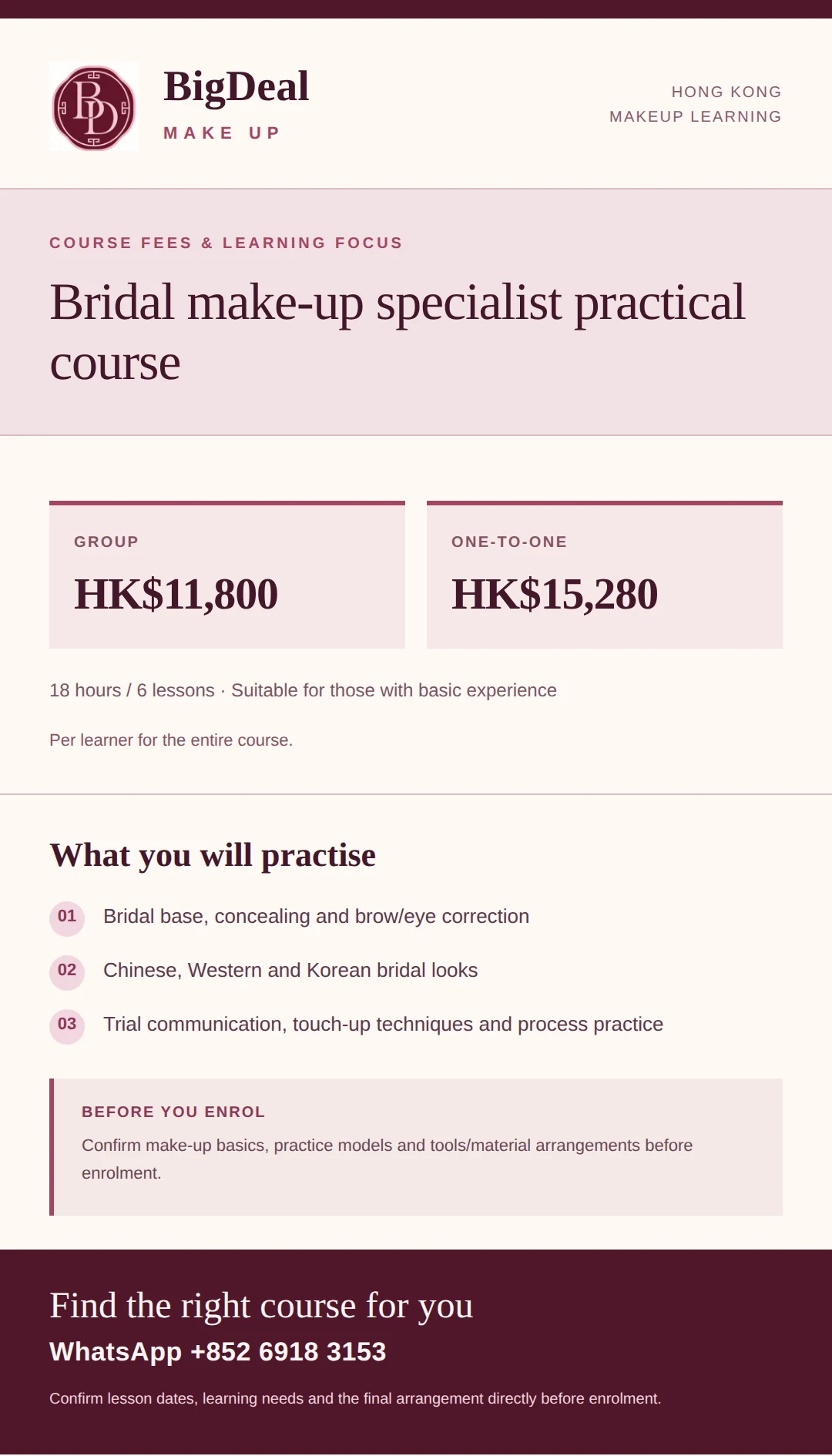
Bridal make-up specialist practical course
- Group
- HK$11,800
- Private
- HK$15,280
18 hours / 6 lessons · Suitable for those with basic experience
Lesson focus
- Bridal base, concealing and brow/eye correction
- Chinese, Western and Korean bridal looks
- Trial communication, touch-up techniques and process practice
Arrangement: Confirm make-up basics, practice models and tools/material arrangements before enrolment.
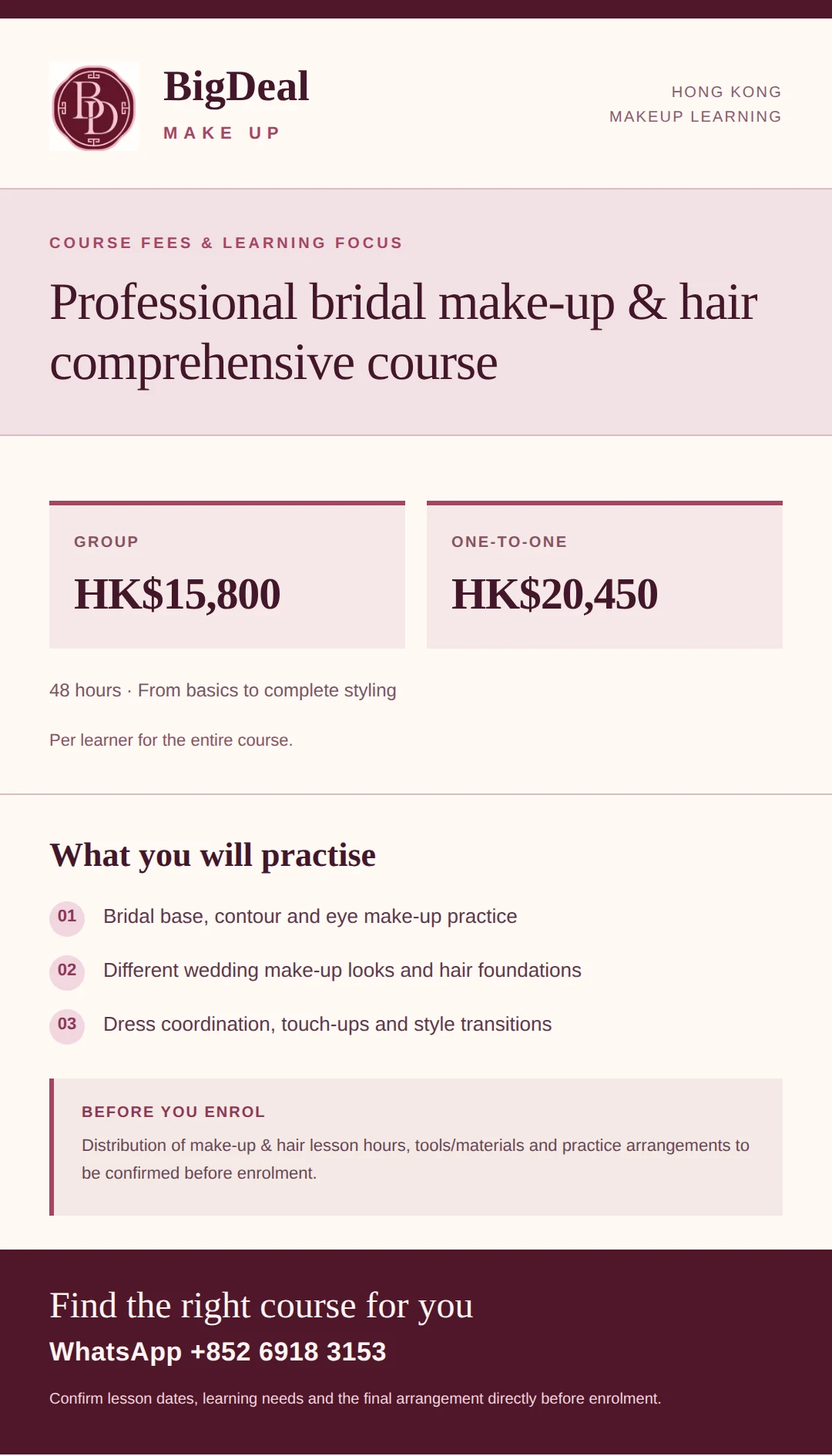
Professional bridal make-up & hair comprehensive course
- Group
- HK$15,800
- Private
- HK$20,450
48 hours · From basics to complete styling
Lesson focus
- Bridal base, contour and eye make-up practice
- Different wedding make-up looks and hair foundations
- Dress coordination, touch-ups and style transitions
Arrangement: Distribution of make-up & hair lesson hours, tools/materials and practice arrangements to be confirmed before enrolment.
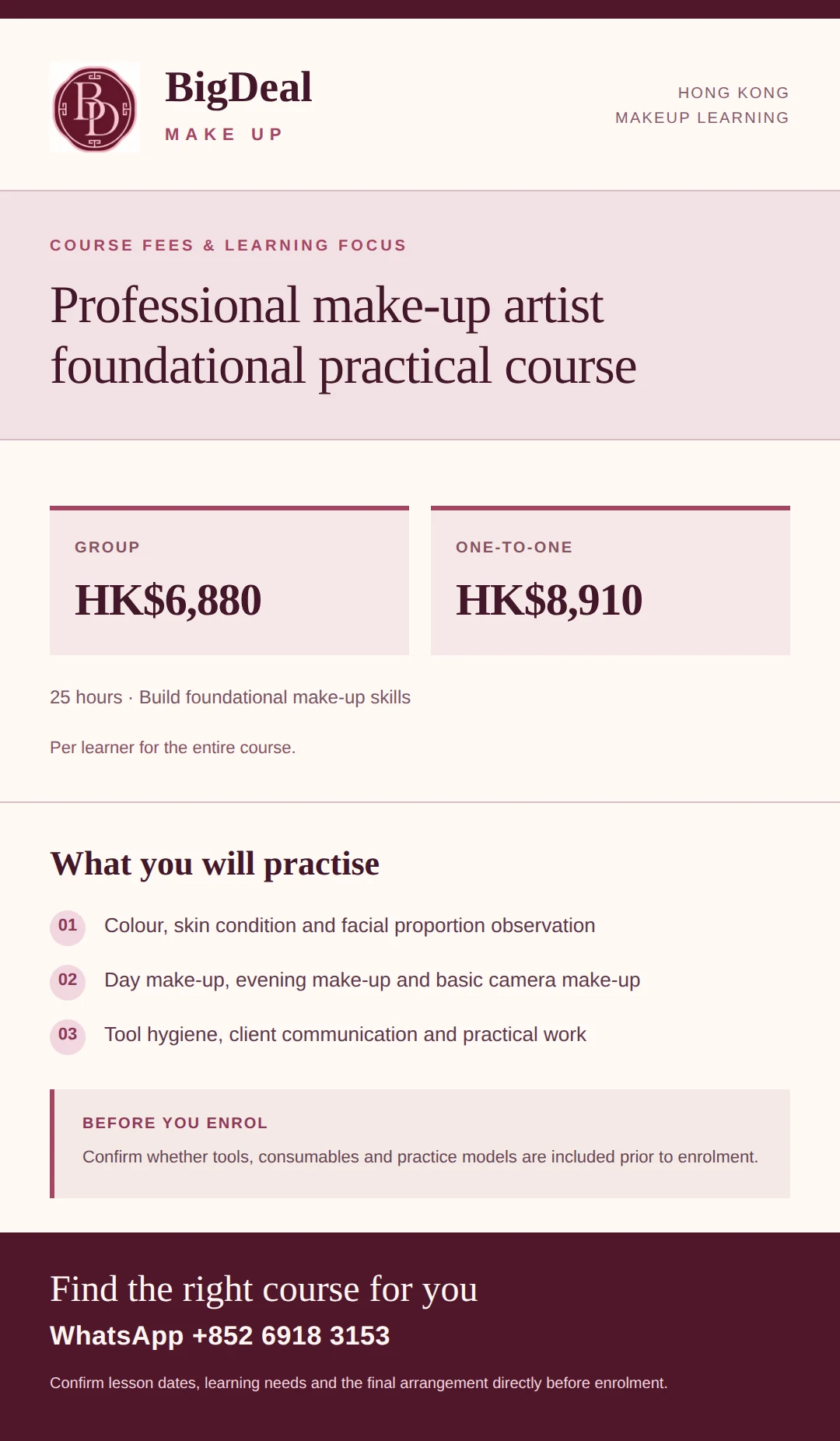
Professional make-up artist foundational practical course
- Group
- HK$6,880
- Private
- HK$8,910
25 hours · Build foundational make-up skills
Lesson focus
- Colour, skin condition and facial proportion observation
- Day make-up, evening make-up and basic camera make-up
- Tool hygiene, client communication and practical work
Arrangement: Confirm whether tools, consumables and practice models are included prior to enrolment.
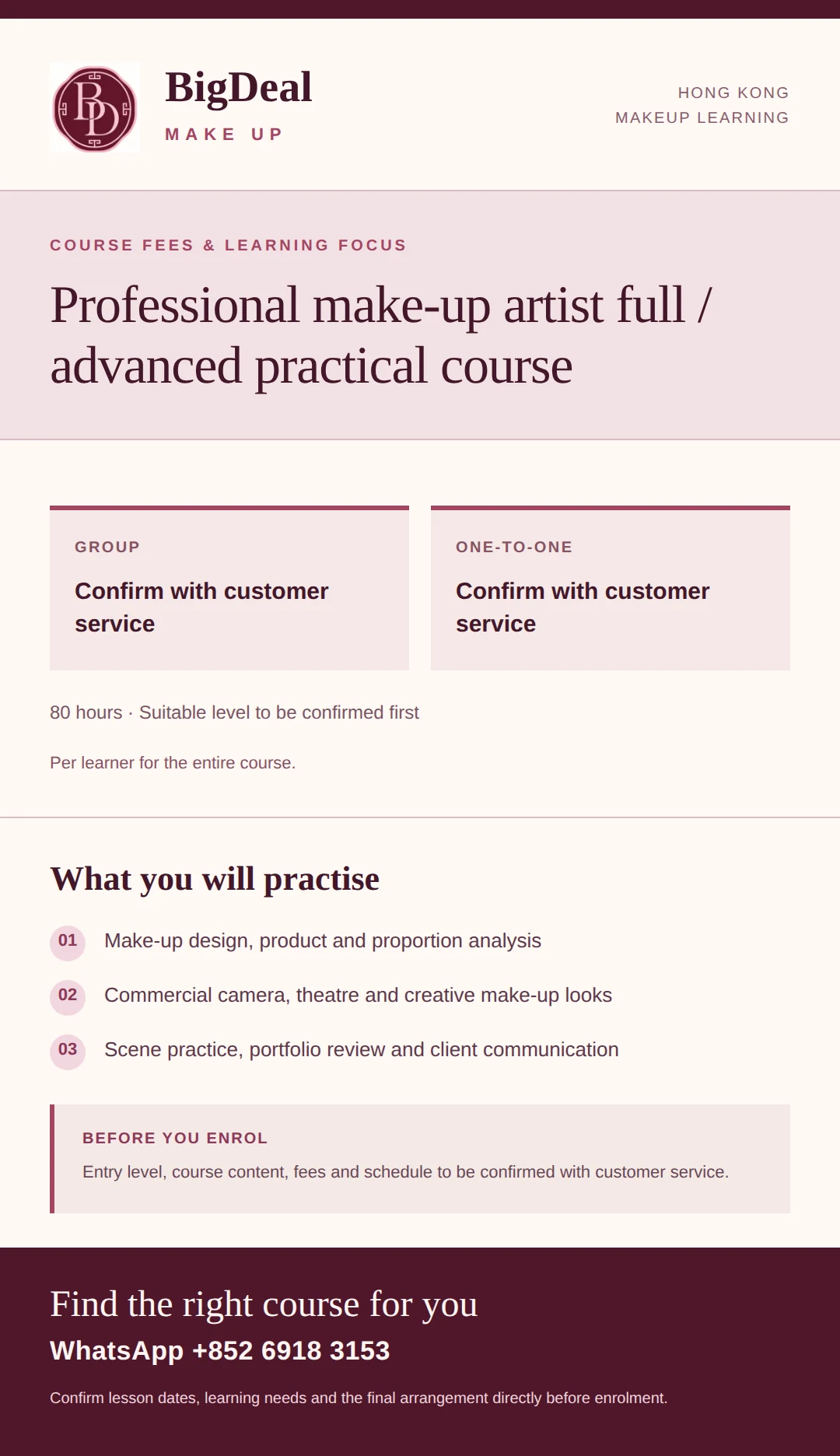
Professional make-up artist full / advanced practical course
- Group
- Confirm with customer service
- Private
- Confirm with customer service
80 hours · Suitable level to be confirmed first
Lesson focus
- Make-up design, product and proportion analysis
- Commercial camera, theatre and creative make-up looks
- Scene practice, portfolio review and client communication
Arrangement: Entry level, course content, fees and schedule to be confirmed with customer service.
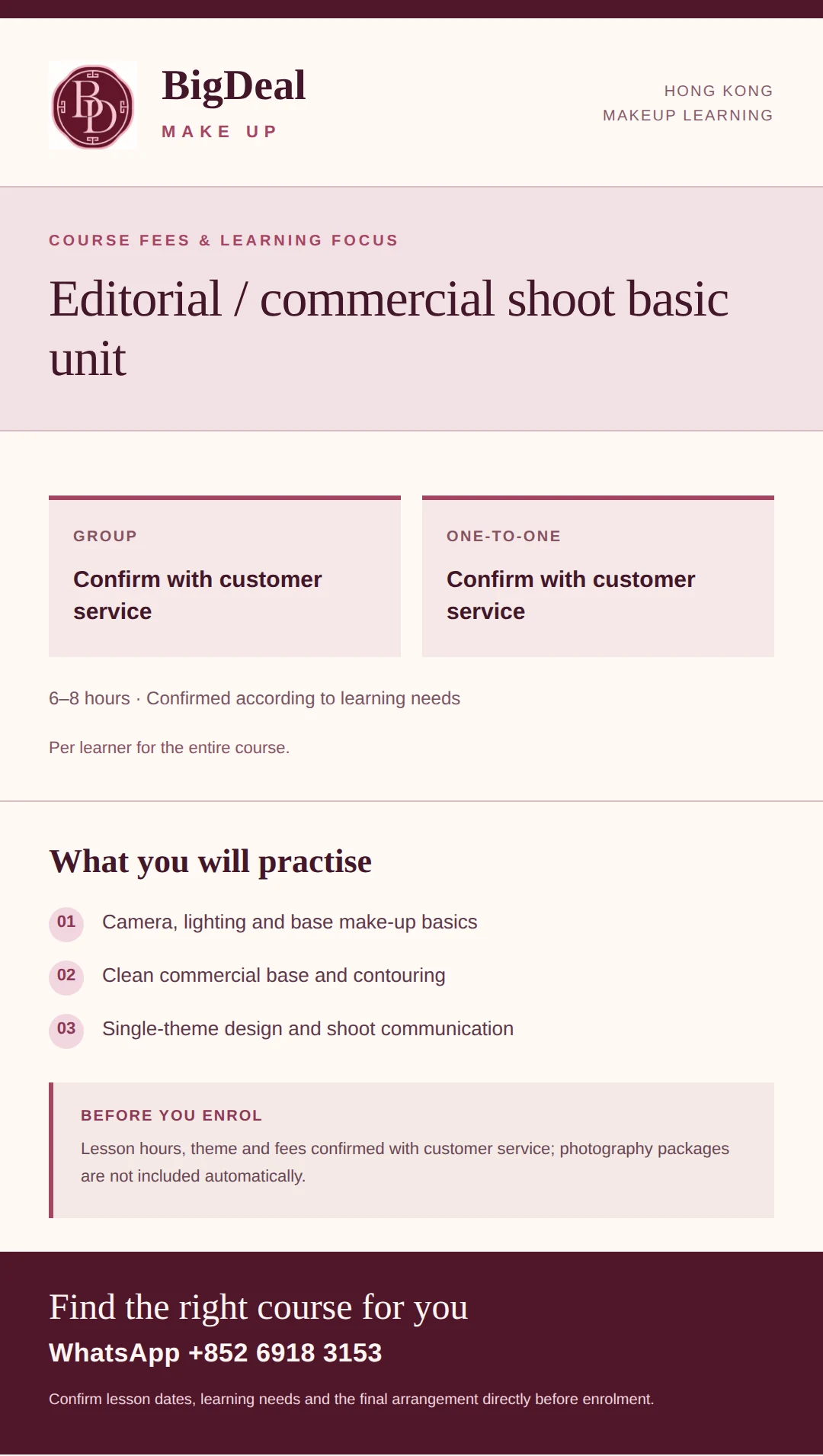
Editorial / commercial shoot basic unit
- Group
- Confirm with customer service
- Private
- Confirm with customer service
6–8 hours · Confirmed according to learning needs
Lesson focus
- Camera, lighting and base make-up basics
- Clean commercial base and contouring
- Single-theme design and shoot communication
Arrangement: Lesson hours, theme and fees confirmed with customer service; photography packages are not included automatically.
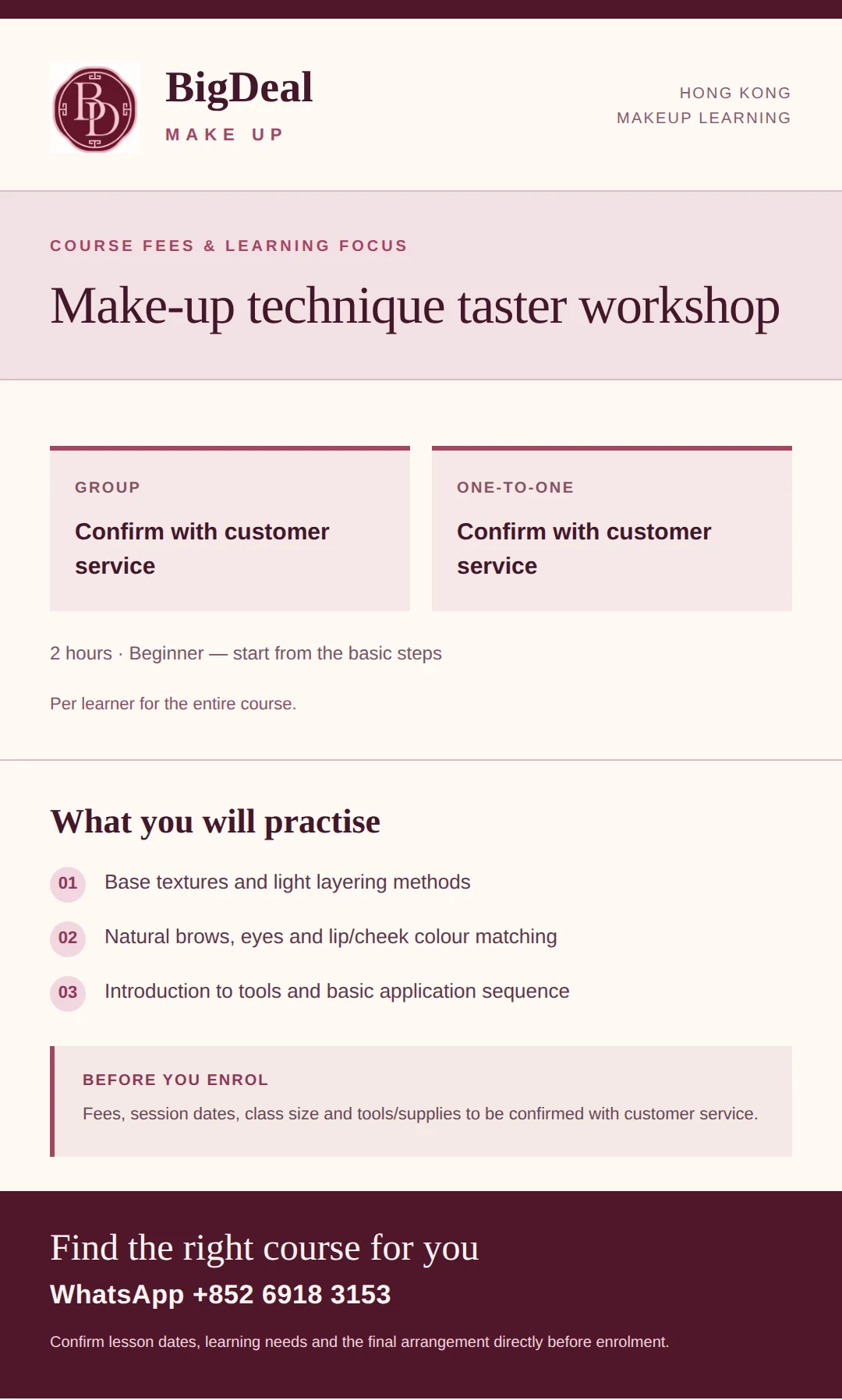
Make-up technique taster workshop
- Group
- Confirm with customer service
- Private
- Confirm with customer service
2 hours · Beginner — start from the basic steps
Lesson focus
- Base textures and light layering methods
- Natural brows, eyes and lip/cheek colour matching
- Introduction to tools and basic application sequence
Arrangement: Fees, session dates, class size and tools/supplies to be confirmed with customer service.
Quick comparison of course durations and practical focus
| Course code & name | Duration (hours) | Typical practical focus |
|---|---|---|
| Make‑up technique taster workshop — Make‑up technique taster workshop | 2 | Base textures, natural brows and light layering; short guided practice with instructor feedback |
| Editorial / commercial shoot basic unit — Editorial / commercial shoot basic | 6–8 | Camera base and lighting awareness; single‑theme shoot practice (photography not automatically included) |
| Bridal make‑up specialist practical course — Bridal make‑up specialist practical course | 18 / 6 lessons | Bridal base, correction, trials and timed touch‑up workflow; model and trial arrangements to be confirmed |
| Professional bridal make‑up & hair comprehensive course — Professional bridal make‑up & hair comprehensive course | 48 | Complete bridal styling, hair foundations, dress coordination and touch‑up technique; extended practice time |
| Professional make‑up artist foundational practical course — Professional make‑up artist foundational practical course | 25 | Colour theory, day/evening looks and basic camera make‑up; hygiene and client communication focus |
| Professional make‑up artist full / advanced practical course — Professional make‑up artist full / advanced practical course | 80 | Make‑up design, commercial camera, theatre and portfolio scene practice; entry level confirmed with customer service |
Helpful answers
Frequently asked questions
How should I use professional makeup course duration when planning my schedule?
Treat duration as a planning tool: choose a course whose hours fit your weekly availability and the amount of supervised practice you need. For example, a 2‑hour Make‑up technique taster workshop suits a single‑skill objective, while a 25‑hour Professional make‑up artist foundational practical course requires more regular rehearsal. Confirm lesson spacing, model availability and consumables with customer service so the stated hours translate into hands‑on time.
Does the listed duration mean portfolio photos are included?
Not automatically. Some units such as the Editorial / commercial shoot basic may include a practical shoot element, but photography packages, retouched images or studio time are often separate items. Always ask whether the course hours include an on‑site photographer, image usage rights or scheduled portfolio review; BigDeal’s arrangements must be confirmed before you enrol.
What’s the difference between an 18‑hour Bridal make‑up specialist practical course over six lessons and an intensive 48‑hour Professional bridal make‑up & hair comprehensive course?
Eighteen hours over six lessons spreads learning and reinforces retention through spaced practice, ideal for staged bridal skill building. A 48‑hour Professional bridal make‑up & hair comprehensive course covers more topics and offers extended practice in hair and dress coordination; it’s deeper but may be delivered in compact blocks. Confirm how many hours are hands‑on and the class size to judge the true student contact time.
Can online delivery replicate the same practical hours as in‑person courses?
Many practical skills require in‑person practice with human models, specific tools and product application; online delivery can work for demonstrations, theory and feedback but may not replace hands‑on hours. If you require remote lessons, confirm with customer service whether the chosen course offers an online option and how hands‑on practice time will be handled to meet your learning objectives.
Will an online course replace the need for in‑studio practice for bridal training?
Online lessons can teach bridal theory, colour correction and trial communication, but bridal work relies on timed touch‑ups, hair coordination and trial management with a live model. BigDeal lists bridal programmes (Bridal make‑up specialist practical course and Professional bridal make‑up & hair comprehensive course) as in‑depth, hands‑on formats; confirm whether any on‑site practice days are offered alongside online instruction before you enrol.
Can I submit makeup photos for portfolio review if I study online?
Yes — many students submit images for critique after an online session and instructors can advise on framing, lighting and correction. Feedback is more effective when corrective work can be demonstrated in person; if you choose online submission, schedule follow‑up practical sessions to put feedback into practice and produce consistent, publishable shots.
Ready to discuss it?
Book a one‑to‑one course consultation
Tell us what you are planning, and we will help clarify the service or lesson details that matter for your enquiry.
From the makeup blog