
BigDeal Make Up · Hong Kong
Career Change Makeup Course Hong Kong
A move into makeup can begin while you are working elsewhere, but it needs realistic planning and steady practice. At BigDeal Make Up, Maggie Yeung and our instructors will discuss your existing skills, the area of makeup you want to pursue and how much time you can commit before recommending the best learning route. Build transferable habits—consultation, hygiene, careful observation and repeat practical work—and confirm dates, class size and materials before you enrol.

At a glance
career change makeup course Hong Kong
If you are looking for a career change makeup course Hong Kong, start by mapping your available evenings or weekends and matching them to a course that fits your skill level. The Professional make-up artist foundational practical course is a 25-hour practical class (Group HK$6,880; Private HK$8,910) ideal for beginners. The 80-hour Professional make-up artist full / advanced practical course is confirmed by customer service. Courses provide structured practice and professional guidance, not guaranteed employment.
01
How a career change makeup course Hong Kong supports practical learning
Plan a career change makeup course Hong Kong around your current skills
Begin by listing daily skills from your current role that transfer to makeup work: client communication, punctuality, attention to detail and basic hygiene. These habits reduce the time needed to learn studio routines, consultation flow and client record-keeping. When you discuss a career change makeup course Hong Kong with BigDeal, describe these competencies so instructors can place you at the right starting point and avoid repeating basics you already do well.
A realistic entry plan recognises that learning alongside a job requires prioritising which techniques to master first. For most career changers, foundational skills such as skin analysis, colour matching and tool hygiene are essential. Professional make-up artist foundational practical course focuses on these exact areas—colour, skin condition and facial proportion observation plus day, evening and basic camera make-up—so it’s often the appropriate first step for those who want a practical base without leaving work.
Honest scheduling makes the difference between inspiration and progress. If you only have two weeknights and occasional weekends free, ask for a timetable that spaces hands‑on practice across those slots. Group and private Professional make-up artist foundational practical course options provide different paces and feedback intensity; the group class is paced to HK$6,880 per person for 25 hours, while private tuition is HK$8,910 for the same duration, giving you a clear cost/time choice for your transition.
For a closer comparison, consider professional bridal hair course
02
Choose a technical foundation before specialising — Where a makeup artist career change course fits
Use a makeup artist career change course to set a clear learning goal
A common mistake is enrolling simultaneously in every available module. Instead, select a clear technical foundation to build from: skin and colour assessment, daytime looks, evening looks and basic camera technique. For someone asking “can I become a makeup artist with no experience?”, a practical, focused class like Professional make-up artist foundational practical course delivers the essential manual repetition and observational training that a career-change path needs.
Professional make-up artist foundational practical course is designed as a foundational practical course, helping you develop repeatable steps for consultation and application. Completing this course gives you the technical vocabulary and practice structure to start offering limited services—trial makeup for friends, portfolio headshots, social‑media practice sessions—so you can test interest and build confidence before considering Professional make-up artist full / advanced practical course or specialist masterclasses.
Professional make-up artist full / advanced practical course—the recommended next step for a more complete professional practice—is an 80-hour advanced practical course. Its entry level, duration, content and fees are confirmed on enquiry because its structure adapts to the student’s current abilities. Treat Professional make-up artist full / advanced practical course as a progression target: once your practical hours and portfolio meet the instructor’s standard, you can plan the deeper commercial, camera and creative work that helps move from hobby to potential freelance practice.
Match your plans with bridal makeup career course
03
Create a repeatable practice schedule around your commitments
Confirm practical arrangements before you enrol
Design a weekly practice schedule that mirrors client work: allocate at least three short focused sessions and one longer practice slot every week. Short sessions (20–40 minutes) will maintain technique—blending, brush control, and colour correction—while one longer session (2–3 hours) can allow full-face practice on a model or face chart, including consultation and finish for photos. Consistent repetition accelerates muscle memory and consultation flow.
Before you book, confirm logistical details that directly affect practice time: whether tools and consumables are included, how many practice models you must bring or arrange, and whether classes are group or private. For Professional make-up artist foundational practical course the arrangement note explicitly asks you to confirm tool and model inclusion prior to enrolment. These small arrangements determine whether an evening class becomes a productive practice block or a logistical scramble.
Ask how the course timetable accommodates working professionals: are there weekday evening slots, weekend blocks, or a blended schedule? Clarify language of instruction (English option requires enquiry), class size, and whether progress checks or portfolio reviews are scheduled during the 25‑hour Professional make-up artist foundational practical course or within Professional make-up artist full / advanced practical course. These confirmations let you plan employer notices, childcare and transport without disrupting study momentum.
You may also find it useful to compare bridal hair assistant training
04
Learn to observe skin, colour and facial proportion with care
Plan observation practice as part of a career change makeup course Hong Kong
Observation is the single most important non-physical skill in professional makeup. Learn to assess skin type, surface condition, undertone and proportions before you touch a brush. BigDeal’s practical classes emphasise observation exercises—comparing skin under natural and camera lighting, mapping facial landmarks for asymmetry, and selecting colours that complement undertones—so you build confident selection habits from the first sessions.
Repeatable observation routines reduce wasted product and improve client trust. For career changers juggling other work, the first weeks of Professional make-up artist foundational practical course are structured to teach quick but thorough checks you can perform in under five minutes. These routines become part of your consultation script—clarifying client expectations, noting contraindications and planning a stepwise application that fits evening‑class timeframes.
Observation also guides the choice of specialisation later: portrait and camera work demands refined skin finishing, while creative and theatre looks require proportion, texture and prosthetic awareness (children’s face paints and prosthetics differ from standard cosmetics). Use early observation practice to decide whether to aim for commercial/photography or creative/theatre routes as you plan progression toward Professional make-up artist full / advanced practical course.
For another approach, explore makeup artist business course
05
Set a gradual progression from foundational skills to advanced study
Use the makeup artist career change course as a performance checkpoint
Treat Professional make-up artist foundational practical course as a performance checkpoint rather than a final credential. After the 25 foundational hours, review your progress with the instructor using concrete evidence—before/after photos under consistent lighting, a small client list of practice assignments, and reflections on consultation outcomes. This evidence-based approach helps determine whether you should repeat sections, take additional masterclasses, or prepare for Professional make-up artist full / advanced practical course’s broader scope.
Professional make-up artist full / advanced practical course is designed as a substantial step-up but should only be pursued once basic practical competence and a modest portfolio exist. Because Professional make-up artist full / advanced practical course’s schedule, level and fee require customer-service confirmation, use your Professional make-up artist foundational practical course outcomes to schedule that discussion. The instructor will consider your portfolio, practice hours and career intentions when advising whether the advanced 80-hour pathway is appropriate for you.
A gradual progression reduces financial risk and builds realistic expectations about income and client acquisition. No course guarantees employment; instead, focus on measurable gains—speed in full application, consistency of finishes in photos, and the depth of your consultation script. Use those metrics to decide whether to invest in further training, specialised workshops or business skills such as branding and client management.
Before deciding, take a look at Makeup Courses
06
Prepare specific practical questions about dates, materials and arrangements
Confirm logistics before you commit to a course
Prepare a concise checklist of practical questions before you call or email customer service: exact dates and times, class language, class size, whether your course is group or private, whether materials and practice models are included, and what the cancellation or reschedule policy is. Asking these reduces surprises and helps you map practice sessions around work or family commitments.
Clarify fees and payment terms for the course you choose. For Professional make-up artist foundational practical course the published group fee is HK$6,880 per person and the private option is HK$8,910 per person for 25 hours. For Professional make-up artist full / advanced practical course, confirm the fee and availability with customer service before assuming details. Also ask about additional costs such as consumables, a recommended starter kit, and the possibility of extra supervised practice hours if you need them.
Finally, confirm the studio set-up and travel times so practical arrangements don’t undermine your study. Ask where classes meet, approximate commute times, whether there is nearby public transport or parking, and whether you should arrive early to set up. These practical confirmations let you treat class time as dedicated practice rather than logistical troubleshooting.
07
Realistic stepping stones to become a makeup artist in Hong Kong
Plan a career change to makeup artist with measurable milestones
If your objective is to become a makeup artist in Hong Kong, treat the move as a series of practical milestones rather than a single leap. Start with a focused, measurable commitment: the Professional make-up artist foundational practical course (25 hours). That course teaches colour and skin observation, day and evening looks and basic camera techniques — the repeatable skills you’ll use daily. After completing the foundational course, collect a small set of before/after photos and a handful of practice clients to evidence progress before discussing the 80‑hour Professional make-up artist full / advanced practical course.
Many students ask whether they can start makeup artist career with no experience; the short answer is yes, provided you use the foundational hours for deliberate practice. Build routines around weekly technique drills and one longer session for full-face work. This approach fast-tracks muscle memory and consultation flow so you can start offering limited services (friends, portfolio shoots) while you decide whether to specialise. BigDeal will confirm whether tools, consumables and practice models are included when you enrol, so you can budget accurately for kit and extra practice time.
If you’re eyeing a full career shift, schedule a portfolio review with the instructor after the foundational course. Use that review to confirm whether the advanced 80‑hour course is right for you: the Professional make-up artist full / advanced practical course is adaptable and its entry level, content and fees are confirmed on enquiry. Progressing gradually reduces risk and gives a clearer idea of how much additional training and practice you need to reach commercial standards.
08
Training options for people balancing work and later-life career switches
Practical choices for makeup artist training for career changers, including those at 30 or 40
A makeup course for working professionals must accommodate other commitments. Choose a timetable that suits your weekly rhythm: evening classes and weekend blocks work best for those juggling shifts or family responsibilities. For most career changers the Professional make-up artist foundational practical course’s 25 hours can be spread across several weeks of evening sessions or condensed into weekend blocks; confirm specific dates and English teaching options with customer service. Protect practice slots and treat them like paid work appointments to keep momentum.
Career changers commonly worry about age: makeup artist career switch at 30 or makeup artist career switch at 40 are both practical and common. Mature entrants often excel because previous careers supply client-facing skills—timekeeping, consultation language and professional reliability—which are directly transferable. The foundational practical course emphasises these consultation and hygiene routines so you can translate existing professional habits into a sustainable makeup practice.
If you need a more bespoke pace, private tuition for the same 25-hour curriculum is available at a higher per-person fee; this option can compress or spread sessions to fit a busy calendar and delivers more targeted feedback. Use the foundational course outcomes to decide whether to invest in the longer Professional make-up artist full / advanced practical course; customer service will confirm the advanced course’s schedule and fees once you’re ready to progress.
Style references
Related makeup style illustrations






Service & lesson fees
Relevant prices and inclusions
Prices and arrangements shown below apply to the listed scope. Confirm timing, location and the final arrangement directly before booking.
All group and private fees are per learner for the entire course.
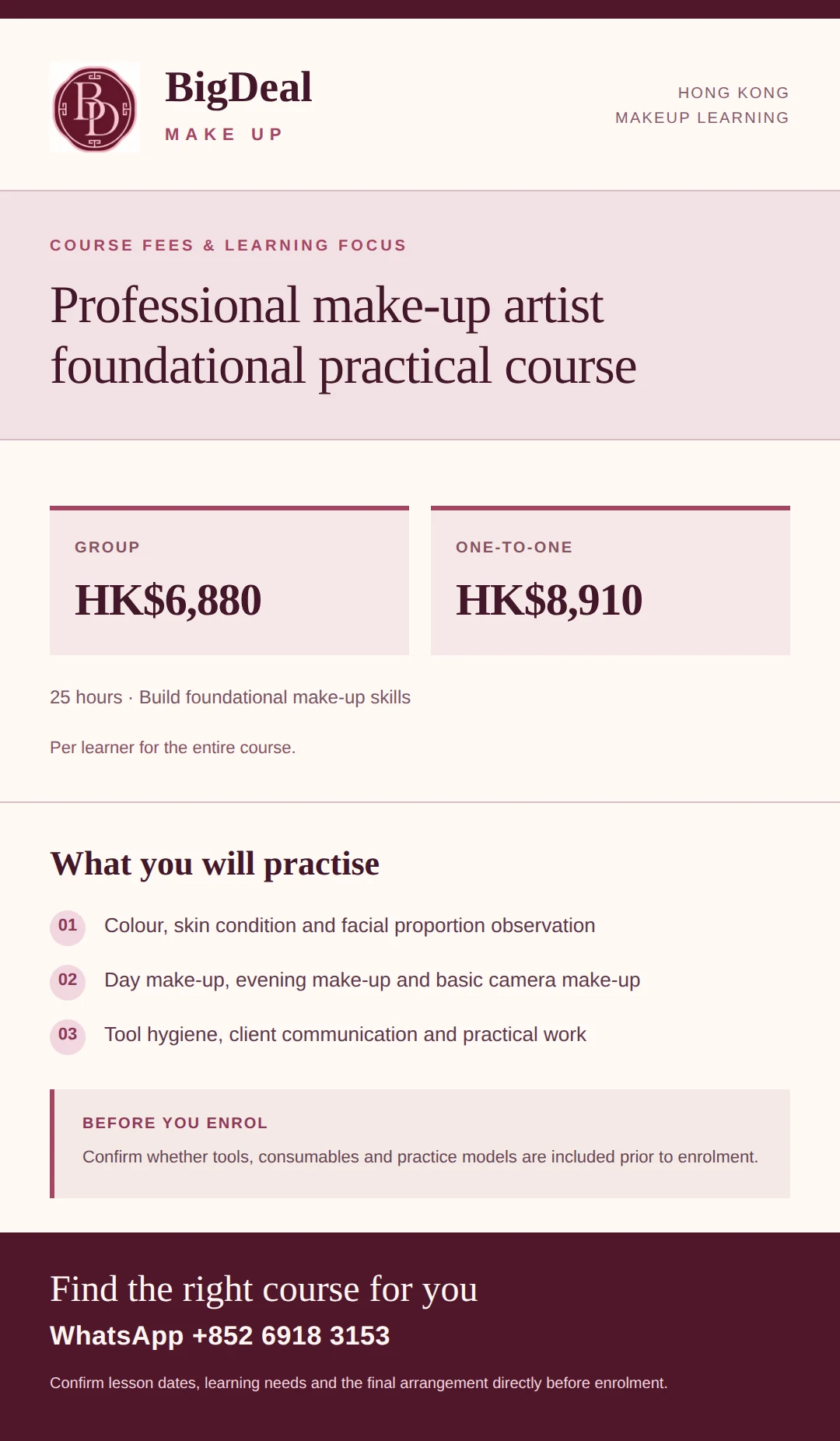
Professional make-up artist foundational practical course
- Group
- HK$6,880
- Private
- HK$8,910
25 hours · Build foundational make-up skills
Lesson focus
- Colour, skin condition and facial proportion observation
- Day make-up, evening make-up and basic camera make-up
- Tool hygiene, client communication and practical work
Arrangement: Confirm whether tools, consumables and practice models are included prior to enrolment.
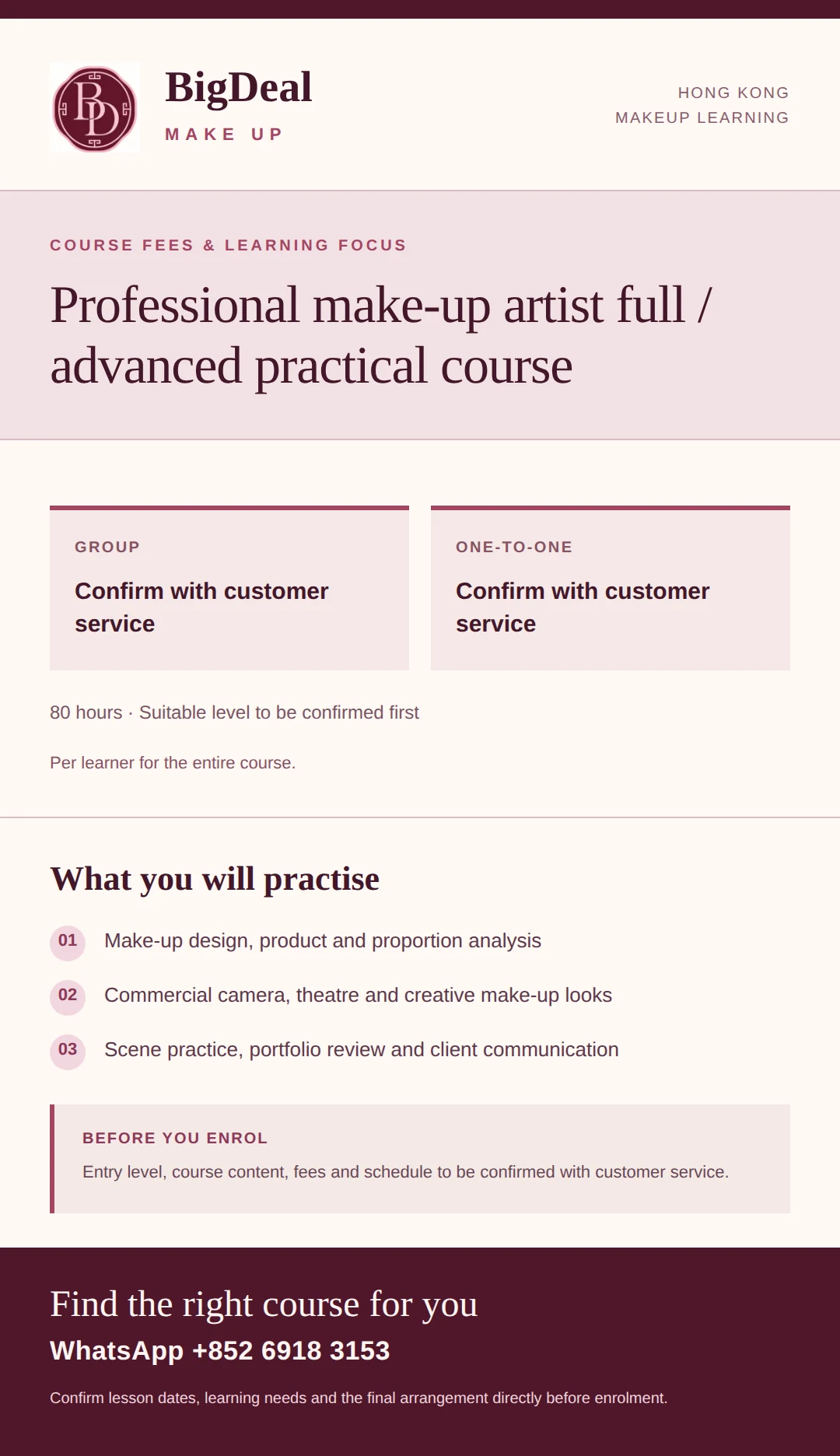
Professional make-up artist full / advanced practical course
- Group
- Confirm with customer service
- Private
- Confirm with customer service
80 hours · Suitable level to be confirmed first
Lesson focus
- Make-up design, product and proportion analysis
- Commercial camera, theatre and creative make-up looks
- Scene practice, portfolio review and client communication
Arrangement: Entry level, course content, fees and schedule to be confirmed with customer service.
Course snapshot: foundational and advanced practical routes for career changers
| Course code | Duration | Focus areas | Published fee (per person) |
|---|---|---|---|
| Professional make-up artist foundational practical course | 25 hours | Colour & skin observation; day, evening & basic camera make-up; hygiene & client communication | Group HK$6,880 / Private HK$8,910 |
| Professional make-up artist full / advanced practical course | 80 hours | Make-up design; commercial camera & theatre; scene practice & portfolio review | Fee & schedule: confirm with customer service |
| Practice schedule suggestion | Weekly | Three short technique sessions + one long model session | Depends on chosen course |
| Materials & models | Preparation | Confirm whether tools, consumables and practice models are included before enrolment | Check with customer service |
Helpful answers
Frequently asked questions
Can I become a makeup artist with no experience if I start with a career change makeup course Hong Kong?
Yes — you can begin with no experience, but a realistic route starts with focused practical hours and deliberate repetition. The Professional make-up artist foundational practical course is designed for beginners and covers skin and colour observation, day/evening looks and basic camera techniques in 25 hours. Use the foundational course to establish reliable techniques, build a small portfolio and a practice record before considering longer courses or paid client work.
What are the makeup artist entry requirements for the foundational and full/advanced courses?
The Professional make-up artist foundational practical course has no formal prerequisites and suits those beginning practical study; simply confirm your language preference and availability. The Professional make-up artist full / advanced practical course is an 80-hour advanced practical course better taken once you have foundational skills; its entry level, schedule and fees must be confirmed with customer service so the instructor can match the course to your current ability.
How do I fit a part-time makeup course for career change around full-time work?
Plan fixed evening or weekend slots and protect them like paid work appointments: three short technique sessions each week and one longer model session will deliver steady progress. Before enrolment, confirm the class timetable and whether sessions are evenings or weekends. Also check whether materials and practice models are included, because logistics affect your actual practice time when balancing a job.
If I’m switching careers at 30 or 40, is makeup training still practical?
Yes. Age does not determine aptitude for practical skills; discipline and deliberate practice do. Options aimed at career changers, such as the Professional make-up artist foundational practical course, provide concentrated, repeatable training suited to those balancing other commitments. Prior work experience often supplies transferable client-facing skills—timekeeping, consultation and professional reliability—that help learning and practice.
Can I become a makeup artist in Hong Kong if I’m starting at 30 or 40?
Yes. Age is not a barrier to a successful career change to makeup artist. People pursuing a makeup artist career switch at 30 or makeup artist career switch at 40 often benefit from transferable workplace skills—client communication, punctuality and organisation—which can speed progress. Begin with the 25-hour Professional make-up artist foundational practical course to build repeatable techniques and a small practice portfolio, then consider the advanced 80-hour course once you and the instructor agree you are ready.
Is there makeup artist training for career changers who work full time?
Yes. BigDeal offers scheduling that can suit a makeup course for working professionals: evening and weekend formats are commonly used and private tuition can be arranged to fit busier timetables. Confirm exact class dates, language of instruction and whether materials/models are provided with customer service before enrolling so you can plan practice sessions around work commitments.
How do I start a makeup artist career with no experience?
Begin with a practical, short course focused on observation and repeatable application steps. The Professional make-up artist foundational practical course (25 hours) is designed for beginners and covers the fundamentals—colour and skin assessment, day/evening and basic camera make-up, plus tool hygiene and client communication. Use structured practice after the course to build a small portfolio before moving on to longer programmes or paid client work.
Ready to discuss it?
Book a short consultation with customer service
Tell us what you are planning, and we will help clarify the service or lesson details that matter for your enquiry.
From the makeup blog