
Baking & procurement
Content updated
On this page
- Map the journey beyond the train ride
- Ask for the complete package measurements
- Confirm what the packing can actually do
- Compare collection with an actual delivery proposal
- Have cold storage ready before setting off
- Work backwards from serving, not guest arrival
- Change the format when the route does not work
- Questions & answers
- Sources & supported claims
Is delicate dessert collection sensible by public transport?
For delicate dessert collection, choose public transport only when the bakery confirms suitable packing and handling for the actual order, you can carry the complete package comfortably, and suitable storage is ready at the destination. A short rail journey is not enough evidence: the walk from the shop, station changes and the final building entrance all matter. Before collecting a mille-feuille across town, ask about the packed dimensions, carrying position, cooling requirements and handover time. If any essential part remains unresolved, compare a confirmed delivery arrangement or change the dessert format.
The decision is not simply whether you can lift a cake box. It is whether one person can manage the entire journey without compromising the merchant's instructions or their own stability. Confirm the package before choosing the route, then check the destination before choosing the collection time. Delivery deserves the same scrutiny: a driver arriving at reception does not resolve an unavailable receiver or an unsuitable fridge.
Map the journey beyond the train ride
Every change of grip belongs in the plan
Write the route from the collection counter to the place where the dessert will actually be stored. Include the walk to the station, entrances with lifts, any interchange, the exit walk and the destination's lift or stairs. A route planner's travel time may omit waiting at the shop and negotiating the building. Use that estimate as a starting point, then allow for the parts where you cannot move at your normal pace while carrying a wide box.
Count occasions when you would need to release a hand or change direction sharply. Paying a fare, checking a phone and opening a heavy door may be straightforward without a dessert, but awkward when both hands support it. Put payment and contact details somewhere accessible before departure. A companion can handle doors and navigation; that does not automatically make a package requiring specialist handling suitable for self-collection.
Assess the journey at the time you would make it, not against an ideal empty carriage. If you expect crowded platforms or would need to hurry for a connection, consider another collection window. Include exposed walking in your decision, particularly if rain would leave you managing an umbrella as well. Do not commit to carrying a box simply because you have already promised to collect it; agree a fallback before the order is finalised.
Ask for the complete package measurements
The cake's advertised size is not the carrying size
Request the finished dessert's dimensions, then separately ask for the board and the closed outer box dimensions. Decorations may need additional clearance above the pastry. If an insulated carrier is required, obtain its external measurements too. The number that matters for your bag, lift entrance and fridge shelf is the complete transport package. A nominal cake diameter cannot tell you whether the box will fit through those spaces without tilting.
Ask for the packed weight and how the package is intended to be held. Compare that with what you can support comfortably for the full walk and waiting time, not just lift briefly at the counter. You can try carrying an empty box of similar dimensions at home, without pretending that this tests the dessert's stability. If it forces your arms into an uncomfortable position or blocks your view of steps, choose a different arrangement.
Use YumYum's Buy Mille-Feuille Online page as a starting point for an enquiry about your intended order. Send the proposed date, portions and route, and ask which finished format can realistically be considered for collection. Request the measurements in the reply rather than estimating them from a photograph. A layered dessert name does not establish its filling, support system or permitted travel conditions, and a product enquiry is not confirmation that collection has been accepted.
Confirm what the packing can actually do
Support and cooling are separate questions
Ask the bakery to describe the board, outer box and any internal restraint for this specific dessert. Which part should your hands support? Must the lid remain closed? Is there a required carrying orientation? Ask whether decorations travel separately and who should place them at the destination. Do not add tape, packing material or improvised supports inside the box without agreement; an alteration that looks helpful could interfere with the intended arrangement.
The Food and Environmental Hygiene Department's Food Hygiene Code says packaging should suit the food, withstand transport conditions and protect against contamination and damage. This is useful trade guidance for your questions, not evidence that any particular box meets the requirements. At handover, ask the merchant to demonstrate the intended grip and check that the package you receive matches the arrangement discussed. Protective packaging should not be treated as permission to stack shopping on top.[1]
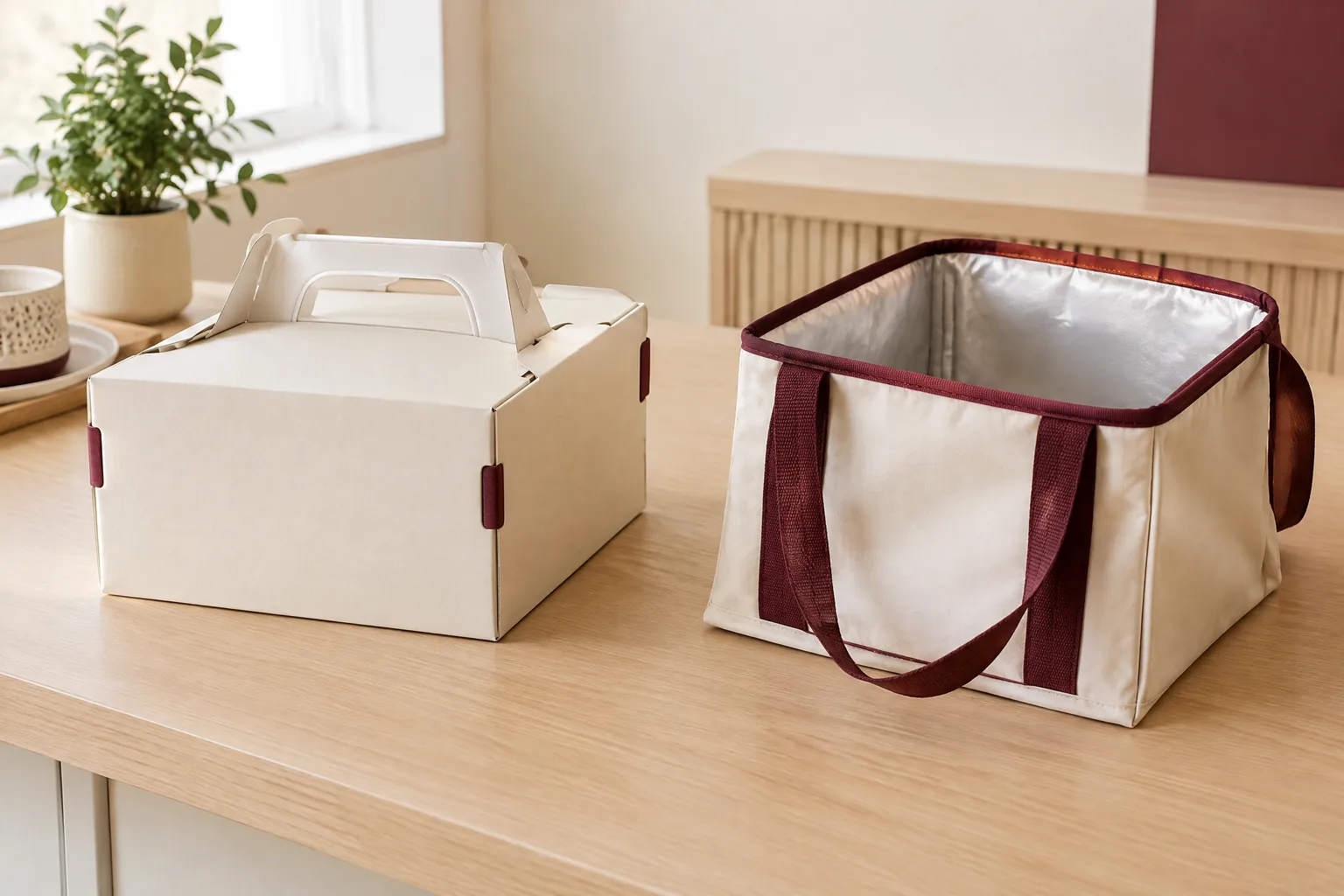
An insulated bag and a rigid cake box have different jobs. Ask whether cooling equipment is required, whether the proposed carrier accommodates the box without pressure, and how any coolant should be positioned. Do not assume a frozen pack can be placed against the dessert or that a bag labelled insulated maintains a particular temperature. Obtain instructions for the whole arrangement. If the merchant cannot advise on your proposed setup, changing transport is more sensible than experimenting during the journey.
Compare collection with an actual delivery proposal
Compare two workable journeys, not a fare against a guess
YumYum's Cake Delivery page is a place to ask about arrangements for the intended order and destination. Give the full address, access restrictions and preferred arrival window, then request confirmation of feasibility and charges. Compare that reply with your collection plan, including your travel time and the help you need. Do not treat a general delivery page as a booking or assume that your preferred time and receiving point have been accepted.
Self-collection gives you direct control of departure, but it also makes you responsible for carrying and managing delays. Delivery may remove the station changes yet still involve a handover downstairs or a wait for access. Ask where responsibility changes hands and who moves the box from that point to storage. For a restaurant, obtain permission to receive and store outside food before choosing either option; a reception desk is not necessarily the final destination.
For questions specific to the layered dessert, the Napoleon Cake Delivery page provides a relevant enquiry route. Ask how the proposed order would be packed, what receiving arrangements are needed and whether the requested journey can be accommodated. Keep any answer attached to the order details. Neither the page name nor a description of protective handling guarantees a particular texture on arrival. Decide using the confirmed proposal rather than assuming that every delivery method is equivalent.
| Your situation | Self-collection decision | What to confirm instead |
|---|---|---|
| Few changes, manageable package, suitable cooling and storage confirmed | May be workable with the merchant's agreement | Packed dimensions, grip, route and handover instructions |
| Crowded interchange or box beyond comfortable carrying limits | Do not rely on willingness alone | Delivery feasibility and exact receiving point, or another format |
| No suitable fridge space at the destination | Transport choice does not resolve storage | Different storage arrangement, serving timing or dessert |
| Delivery ends at reception but storage is upstairs | A final carrying leg still exists | Named receiver and manageable movement to the fridge |
| Required cooling arrangement remains unclear | Do not improvise on departure day | Supplier instructions and a transport method that meets them |
Have cold storage ready before setting off
An available fridge must also fit the box
First establish whether your chosen filling and finished dessert require refrigeration. For potentially hazardous chilled food, the Food Hygiene Code advises transport at 4°C or below. It also describes coolers and ice bricks as temporary measures, not a way to lower the temperature of food that needs cooling. Ask the bakery how its instructions apply to the actual order. An air-conditioned train carriage is not a refrigerated transport arrangement, regardless of how comfortable it feels to passengers.[2]
The Centre for Food Safety identifies fresh cream cakes and pies with milk or egg fillings as perishable bakery products. Its consumer advice is to refrigerate purchased cake promptly and consume it as soon as possible. That guidance supports going directly to suitable storage, not adding shopping stops because the box feels cool. It does not establish the ingredients or shelf life of your mille-feuille; those details still need confirmation from the supplier.[3]
Measure the usable shelf width, depth and height with the fridge door closed. Check whether the complete box can sit in the instructed position without displacing other food unsuitably. If the party is elsewhere, ask the host or venue to confirm the space rather than relying on 'we have a fridge'. Name the person who will clear it and receive the dessert. Delivery cannot solve a box that is too large for the destination's storage.
Work backwards from serving, not guest arrival
The dessert needs a place between collection and cutting
Set the intended serving time separately from the start of the gathering. A dessert collected before lunch for an evening party needs a confirmed storage plan throughout the afternoon. Ask the bakery when it should leave refrigeration for serving, if at all, and who should unpack it. Do not invent a standard resting period for all layered pastries. The actual filling, finish and supplier's instructions determine the questions you need answered.
Check the serving surface and tools before collecting a whole dessert. Ask the merchant about the recommended cutting method and usable portions, then confirm that the host has an appropriate knife, serving utensil and plates. If the table is cramped, discuss a different format rather than planning to cut while holding the box. Photographing the intact cake is optional; do not build a long display period into the schedule without checking the handling instructions.
Record the collection time and pass the storage instructions to the person taking over. If the journey is delayed or you cannot establish how the dessert has been held, ask for advice before serving it. The Centre for Food Safety explains that chilling inhibits bacterial growth but does not kill bacteria. Putting a dessert into the fridge later therefore does not erase uncertainty about earlier handling. Keep questions about appearance separate from questions about whether food remains suitable to eat.[4]
Change the format when the route does not work
Keep the celebration; reconsider the fragile centrepiece
If the complete box is beyond your comfortable carrying limits, ask whether a smaller format or separately packed portions are available. Confirm the total portions and the number of packages before agreeing. Several boxes can be harder to manage than one, particularly if each needs to remain level. Splitting an order only helps when the packing, carrying and storage arrangement genuinely becomes easier; it should not create an armful of unsupported packages.
A different dessert may be the practical choice when the destination lacks the required storage or the route involves unavoidable difficult handling. Explain which constraint you need to remove and ask the supplier to propose alternatives with their own instructions. Do not assume that individual portions, a plain finish or a different pastry name makes food shelf-stable. If another guest collects it instead, give them the full package details and allow them to decline.
Before paying, settle the final transport choice and ask what changes are possible if collection becomes impractical. Keep the confirmed handover details with the order, including the receiver's contact and storage plan. If neither delivery nor self-collection can meet the requirements, choose another supplier, date or dessert rather than relying on luck. The useful outcome is a dessert that fits the gathering's real circumstances, not completing the most complicated journey with the original design.
- Send the full door-to-door collection route and intended serving time to the supplier.
- Confirm finished dessert, board, closed box and any outer carrier dimensions plus packed weight.
- Obtain the intended grip, carrying orientation and order-specific cooling instructions.
- Check personal carrying limits and arrange help for doors or navigation where needed.
- Measure destination fridge space and name the person receiving the dessert.
- Compare a confirmed delivery proposal with self-collection, including the final handover leg.
- Agree an alternative before ordering if the package or route cannot meet the instructions.
Collect the dessert yourself only when the package, route, person carrying it and destination storage work together. None can compensate for an unresolved requirement elsewhere. For a fragile layered dessert, confirmed delivery or a different format may be the more sensible choice. Decide before the order is fixed, and carry the supplier's actual instructions through to the person who will store and serve it.
Is one direct MTR journey enough to make collection sensible?
Not by itself. Check both walks, station access, expected crowds and the destination entrance as well as the rail journey. A direct service still leaves questions about the complete box, cooling and your ability to support it throughout. Tell the bakery the whole route and obtain order-specific instructions. If an essential requirement cannot be met, a short journey is not a reason to ignore it.
Can I put the cake box in a wheeled shopping trolley?
Ask the bakery before choosing that method. Establish whether the box fits in its required orientation and whether the trolley is suitable for this dessert's handling instructions. Pavement transitions, kerbs and stairs remain part of the journey. A trolley may reduce the weight in your hands without resolving movement or cooling. Do not use it as an improvised substitute for an agreed transport arrangement.
Would pre-cut mille-feuille be easier to take across town?
It might simplify serving, but ask how the portions would be supported and packed. Several separate boxes may be less convenient to carry than one properly sized package, and portioning does not remove refrigeration requirements. Request the finished package count and dimensions before deciding. Compare the entire collection and storage plan, not just whether cutting has already been done.
What should I ask if the box looks different at collection?
Pause before departing and confirm whether the agreed carrying and cooling instructions still apply. Check the new dimensions against your carrier and destination fridge, and ask the merchant to show the correct support points. If the change makes your route impractical, discuss the available alternatives before accepting the handover. Avoid opening or repacking the dessert yourself to force it into a bag.
Can I collect early and keep the dessert at my office until dinner?
Only consider that plan after confirming the supplier's storage instructions and suitable office storage for the whole interval. Check the fridge measurements, access hours and the second journey to dinner. An office stop creates another handover and carrying leg; it is not automatically more convenient. If colleagues share the fridge, arrange space explicitly rather than assuming it will be available when you arrive.
Send the supplier your proposed route, serving time and destination fridge measurements. Ask for the complete package details and handling instructions, then confirm collection or request a delivery proposal before ordering.
Sources & supported claims
- Food Hygiene Code, Chapter 4: Safe Food Handling — Food and Environmental Hygiene Department
Section 4.7 advises food-appropriate, durable packaging that protects against contamination and damage during transport.
- Food Hygiene Code, Chapter 4: Safe Food Handling — Food and Environmental Hygiene Department
Section 4.8 advises potentially hazardous chilled food transport at or below 4°C and describes coolers or ice bricks as temporary measures, not means of lowering food temperature.
- Baking and Beyond: Bacillus cereus Risks in Cheesecakes — Centre for Food Safety, September 2026
Fresh cream cakes and pies with milk or egg fillings are listed as perishable bakery products; consumers are advised to refrigerate purchased cake promptly and consume it as soon as possible.
- Temperature Danger Zone and 2-hour / 4-hour rule — Centre for Food Safety
Chilling inhibits bacterial growth but does not kill bacteria.