Baking & procurement
Content updated
On this page
- Define the corporate event use
- Confirm brand and artwork authority
- Distinguish custom production from wholesale
- Review gift-box packaging proofs
- Check label information with the supplier
- Set sample and final approval gates
- Confirm shipment records and exception handling
- Questions & answers
- Sources & supported claims
Custom mooncake approval: freeze artwork before production
A company should complete custom mooncake approval against a named artwork version, an agreed product specification and a physical packaging reference before authorising production. A pleasant tasting sample is not approval of the printed sleeve; a correct logo is not approval of the ingredients label. Give one person authority to release the order only after the separate reviewers have cleared their parts. For a Hong Kong Mid-Autumn event, the practical goal is a gift that matches the approved brief and reaches an identified receiver with usable product information, rather than a collection of encouraging messages scattered across email.
Freeze what will be made, not just how the gift looks. Record which components are standard and which are changing, keep supplier label information distinct from marketing copy, and decide what happens if a revision arrives after approval. Release production and shipment through separate written decisions. The following approach concerns buying gifts for an event; it does not require the organiser to direct a food factory.
Define the corporate event use
One gift brief should explain who receives what and when.
Begin with the moment of handover. A box placed at a client dinner needs different handling from boxes collected by colleagues over several days. State whether the mooncakes will remain sealed as gifts or be opened for sharing. Record the event date separately from the required receiving date, and ask the supplier to confirm a feasible schedule. An office loading bay appointment is not the same as permission to leave food with an unattended reception desk.
Use the Corporate Mooncake page as a starting point for a workplace gifting enquiry, then describe your actual recipient groups. Staff gifts and named client gifts may share a product but need different cards or packing lists. Agree whether the supplier will separate those groups and how each group will be identified without opening every box. Do not assume a website example includes your chosen branding, assortment or delivery arrangement.
Nominate a commercial owner and a receiving owner. The first approves the agreed order scope and any extra charges; the second confirms that the destination can accept and store the selected products. Give marketing responsibility for brand appearance, not unilateral authority to change the filling. Resolve conflicts before asking anyone to sign: a chilled selection should not be chosen solely because its colour matches the campaign when the destination has no confirmed storage arrangement.
Confirm brand and artwork authority
Permission and visual accuracy are different approvals.
The Hong Kong Intellectual Property Department explains that registering a trade mark gives its owner exclusive rights for the goods and services covered by the registration. Use by other traders for the same or similar goods or services in Hong Kong without consent may infringe those rights. For procurement, obtain written clearance from the appropriate brand owner before releasing a logo or partner mark for the proposed gift. A logo downloaded from a public website is not evidence of permission.[1]
Send the supplier a controlled artwork package rather than a selection of attachments from previous campaigns. Identify the approved logo file, language order, greeting and year. For a collaboration, ask each brand owner to clear the relative logo sizes and wording. Check Chinese characters at final print size with someone authorised to review the text. An attractive screen preview can still contain the wrong subsidiary name, an outdated slogan or a greeting copied from last year's gift.
Agree a proof identifier such as sleeve version three, with its date, and use it in the approval message. Keep an annotated copy showing which face is the lid, base and opening edge. Ask the supplier to identify the print method and any colour reference it can actually work to. If a physical colour proof is necessary, request it explicitly and confirm its cost and timing. Do not treat a phone screenshot as an agreed metallic finish.
Distinguish custom production from wholesale
Approve the changed components, not a vague promise of customisation.
A Mooncake Wholesale enquiry can be appropriate when the company wants an existing product in an agreed bulk format. Ask whether the product, inner wrapping and original box remain unchanged. If branding is limited to a card or removable sleeve, the main decisions concern that addition and its fit. Confirm whether the supplied packing format is suitable for individual gifting; a bulk supply enquiry does not itself settle how each recipient's gift will be presented.
Write a component list with one line for the mooncake, another for its wrapper, and separate entries for the tray, box, sleeve and card. Mark each as unchanged, modified or new. This makes the approval effort proportionate. A new sleeve need not imply a new recipe, while a changed mooncake size can affect both the tray and the stated contents. Ask the supplier to confirm which specifications it can accept rather than assuming every component can be altered independently.
The Custom Mooncake Manufacturing destination is relevant when the enquiry genuinely concerns product specifications or a more extensive branded production brief. State the proposed change in plain terms and request a written response on feasibility. Ask which sample will represent the eventual order and which details remain provisional. Keep production methods with the manufacturer; your role is to agree the deliverable, the acceptance reference and the consequences of a change, not to instruct factory operations.

Review gift-box packaging proofs
Look beyond the closed lid.
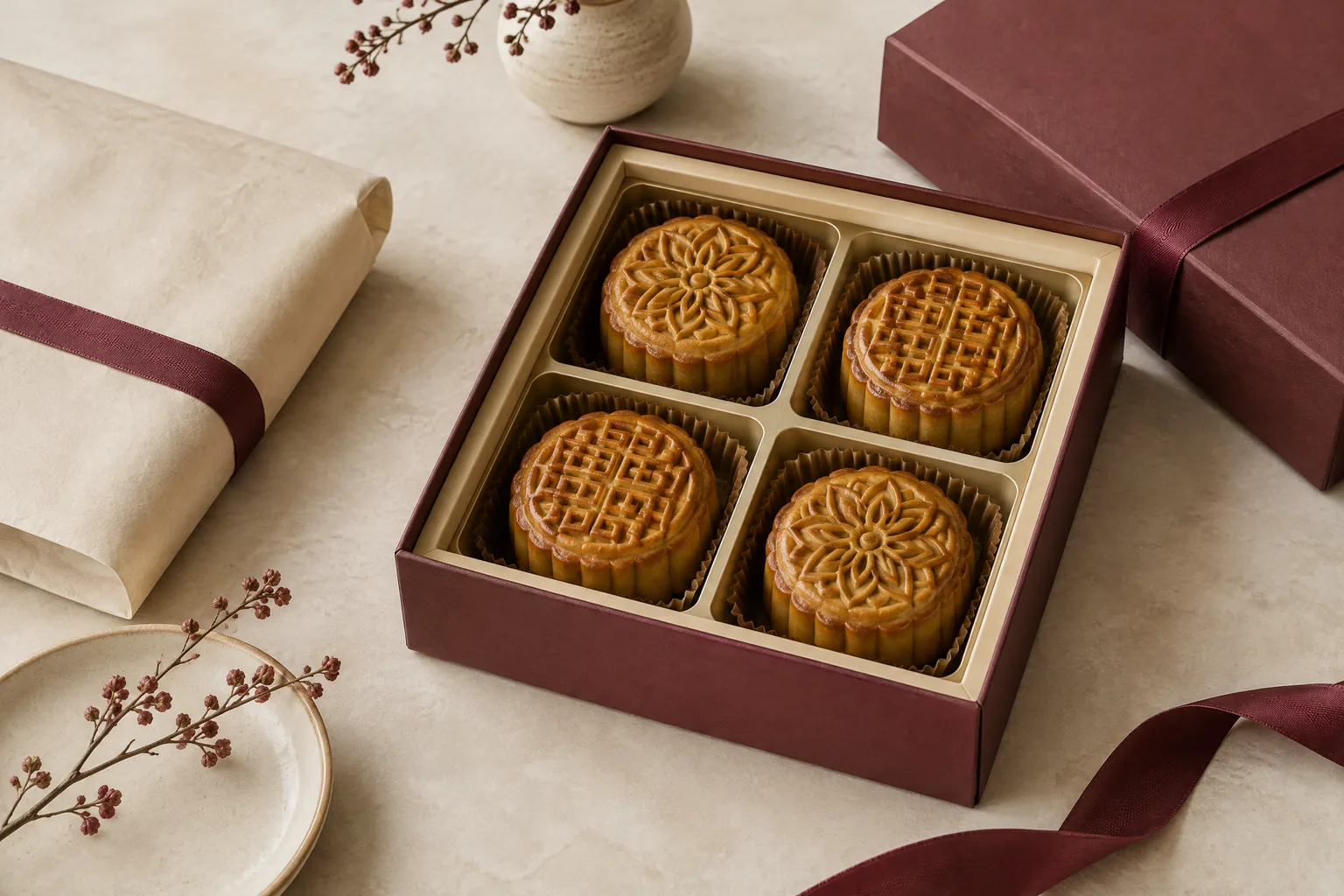
Use Mooncake Gift Box presentation references to explain the arrangement you want to discuss, then obtain a proof for the actual proposed contents. Confirm the number of pieces and their positions rather than judging the lid alone. Request views of the open box and underside, showing where the product label and date marking will sit. A beautiful mock-up with empty compartments cannot confirm that wrapped mooncakes, a greeting card and the closing mechanism will fit together.
Ask to inspect an assembled reference when physical fit matters. Open and close it, lift it using the intended handle if there is one, and check whether the sleeve slides over the fully packed box. Keep printed paper and decorative inserts away from exposed food; ask the supplier to confirm suitable packaging for its product. The buyer should not add an unreviewed scented insert, loose glitter or a decorative item inside food wrapping to improve the photograph.
Record the scope of each packaging proof. A plain structural sample may show dimensions but not final colour or surface finish. A printed sheet may show wording but not how text crosses a fold. If an imperfection is accepted, describe it narrowly and keep an image: approval of a slight sleeve gap should not become permission to change the board, remove a divider or cover the ingredients panel. Ask for a revised proof when the agreed design changes.

Check label information with the supplier
Brand copy must not displace product information.
The Centre for Food Safety lists the general labelling information for prepackaged food, subject to exemptions and specified exceptions: food name, ingredients, durability date, applicable storage or use instructions, manufacturer or packer particulars, and count, net weight or net volume. It also states that when both Chinese and English are used in labelling, the food name and ingredient list must appear in both languages. Have the supplier confirm the requirements for the proposed pack and provide the applicable label proof; do not infer an exemption because the gifts are corporate purchases.[2]
CFS allergen guidance requires specified allergens to be identified in the ingredient list when present; a separate warning is not a substitute for the required declaration. Have the supplier check the exact assortment, including any individually wrapped varieties. Do not shorten ingredient text to make the design cleaner or copy one filling's label across the whole range. A dietary product name is not certification or an allergen-free guarantee. Ask separately about ingredients and cross-contact information where recipients have particular needs.[3]
Reserve space for variable information such as the actual durability marking and the supplier's batch identifier. The artwork proof can approve its position without inventing a future date. Ask for a legible finished-pack example before dispatch and confirm which information appears on the outer box and individual packs. Keep claims such as reduced sugar or a certification logo out of decorative copy unless the supplier has provided the relevant basis and cleared their use on this specific product.

Set sample and final approval gates
Every approval should say what it releases.
Give samples a purpose before they arrive. A tasting sample can support a flavour decision, but record whether it matches the intended size, filling and product specification. A packaging sample can support fit without representing the final print. If the supplier cannot provide a fully representative sample, list the differences and decide whether the remaining uncertainty is acceptable. Avoid writing only 'sample approved', which leaves everyone to guess whether that includes the recipe, appearance and complete gift presentation.
At final sign-off, bring the approved records together: product specification, artwork identifier, packaging reference and supplier label version. Name the person authorising release and the supplier contact acknowledging it. Specify whether that message authorises printing, the agreed production stage or the full order. Ask the supplier to identify any earlier commitment that becomes difficult to reverse, such as a bespoke packaging purchase. Agree those commercial consequences before giving permission rather than discovering them during a late revision.
If the company needs images for its event announcement, photograph the approved presentation and keep the image version tied to the sign-off record. BigDeal's 商品拍攝 page, which is in Chinese, concerns product photography enquiries only; it does not provide food manufacturing approval. Arrange photography separately if useful. Mark a concept image as illustrative until the real presentation is settled, and do not let an early promotional picture pressure the team into accepting an unresolved label or unsuitable box.
This BigDeal guide covers 商品拍攝; the linked page is in Chinese. (Chinese page)
| Decision | Evidence to request | What it does not approve |
|---|---|---|
| Brand and wording | Identified artwork proof cleared by the authorised brand reviewer | Recipe, shelf life or physical packaging fit |
| Product selection | Representative sample linked to a written specification | Final print colour or complete label layout |
| Gift presentation | Assembled packaging reference and finished artwork | Unseen substitutions or an altered assortment |
| Production release | Written approval naming the accepted versions and release scope | Automatic approval of later revisions |
| Shipment release | Packing reconciliation, finished-label evidence and receiving arrangements | Acceptance of damage or missing information on arrival |
Confirm shipment records and exception handling
A frozen design still needs a controlled handover.
Before dispatch, reconcile the approved order with the packing list by product and recipient group. Request a record that connects the supplied products with their batch identifiers and durability markings. Agree what evidence of the finished packaging will be available, such as clear photographs of the label and assembled gift. Keep the supplier's order reference with these records so the receiving team can describe a concern precisely without needing to know who designed the sleeve.
Give the receiver the agreed arrival window, contact details and product-specific storage instructions supplied for the order. Confirm access restrictions and who can take over if that person is absent. Ask the receiver to record quantities and visible damage on arrival, while distinguishing receipt from final acceptance. If a label is missing or an assortment differs, separate the affected gifts from distribution and ask the supplier for instructions. Do not solve a product information problem by writing an improvised replacement sticker.
For late changes, identify the affected component before reopening the whole order. A different recipient name may require a new card and packing record without changing the product sample approval. A replacement filling needs a fresh specification and label review, not merely permission from the event host. Record the agreed response to shortages, damaged boxes and delayed arrival, including who can authorise a substitute. After handover, retain the final accepted versions rather than deleting everything except the original quotation.
| Requested change | Recheck before agreeing | Keep unchanged only if confirmed |
|---|---|---|
| Recipient spelling | Card proof, recipient list and packing instructions | Product specification and label |
| Logo replacement | Brand authority, artwork and print schedule | Physical box structure |
| Different filling | Product specification, ingredients, labels and storage needs | Outer design where it remains accurate |
| Different box size | Tray fit, sleeve dimensions, contents statement and transport packing | Artwork only where dimensions still match |

- Identify the event handover, receiving date and responsible receiver.
- Confirm authority to use every company and partner mark.
- List unchanged, modified and new product or packaging components.
- Approve named artwork, packaging and supplier label versions.
- Record what each sample represents and any unresolved differences.
- Issue a written release with its scope and late-change procedure.
- Reconcile the shipment and share product-specific receiving instructions.
The useful approval is a clear instruction tied to a complete set of accepted versions. Keep brand permission, product selection, packaging fit and label information visible until each has an accountable decision. Then freeze the agreed artwork and require any later change to be acknowledged in writing. Shipment should follow a separate check that the packed gifts and receiving arrangements still match the order.
Does approving the logo PDF authorise the whole order?
Not unless the approval explicitly says so and the other required checks are complete. Name the file version and the scope of release. If only wording is cleared, say that printing or production remains on hold pending the outstanding product, packaging or label decision. Ask the supplier to acknowledge the same scope.
Can we use a tasting sample from a different box format?
It may help select a flavour if the supplier confirms what matches the intended product. It does not prove that the final mooncakes fit the proposed tray or that the complete label is correct. Record the sample's differences and request separate evidence for the changed presentation before authorising that part of the order.
What if the supplier offers only a digital packaging proof?
Ask what the proof can establish and what remains untested. It can show text placement, but cannot demonstrate the feel of the board or the fit of an assembled sleeve. Consider a simpler established box format if a physical reference is unavailable and those unresolved details matter to the event. Confirm the alternative rather than assuming it is in stock.
Must the marketing team write the ingredients label?
The supplier should provide and confirm product-specific label information. Marketing can check readability and prevent artwork from obscuring it, but should not reconstruct ingredients from a sample description. Keep a record of the supplied label version and seek appropriate specialist advice if legal applicability or proposed claims remain unclear.
Should we accept a substitute filling to protect the event date?
Only after reviewing the actual proposal. Ask for the revised specification, label and handling requirements, then consider recipient needs and whether approval can be completed in time. If not, discuss an unchanged alternative or revised distribution plan. An approaching event is not a reason to waive unresolved ingredient information.
Before releasing your mooncake order, ask the supplier to acknowledge the final artwork and label versions, the representative sample and the exact scope of production approval in writing.
Sources & supported claims
- Intellectual Property Department: Trade mark basics
Registration gives exclusive rights for the registered goods and services; unauthorised use by other traders for the same or similar goods or services in Hong Kong may infringe those rights.
- Centre for Food Safety: Food Labelling
General prepackaged food labelling fields, subject to exemptions and exceptions, include food name, ingredients, durability, applicable storage/use instructions, manufacturer/packer particulars and quantity; bilingual labels require both food name and ingredients in both languages.
- Centre for Food Safety: Labelling Guidelines on Food Allergens, Food Additives and Date Format
Specified allergens present in a food must be declared in its ingredient list; a separate allergen warning does not replace the required ingredient-list declaration.