
Gifts & occasions
Content updated
On this page
- Choose the display position before the flowers
- Distinguish preserved flowers, dried flowers and the finished shape
- Allow for wreath depth, movement and fixing
- Ask for care instructions you can actually follow
- Reserve the storage space before December ends
- Plan the journey home as part of the project
- Choose a smaller project if storage is the limiting factor
- Questions & answers
- Sources & supported claims
A lasting festive flower craft that fits your home
For a lasting festive flower craft in a humid Hong Kong flat, start with a small indoor piece that fits a real shelf and a real storage box. Choose the material only after checking how that spot behaves and what care the finished object needs. Preserved flowers are not automatically suitable for a damp room, while a dried wreath may take more cupboard space than its ring suggests. If you cannot identify somewhere suitable for both December display and the months afterwards, a smaller project is a better choice than a larger keepsake you cannot accommodate.
Treat display, handling and storage as one decision. Measure the completed decoration rather than its bare frame, find out which parts are fresh, dried or preserved, and ask for care instructions for the whole piece. A neutral arrangement with removable festive ribbon can remain on display after Christmas. A seasonal wreath needs a supported home in a box, not simply an empty hook until January.
Choose the display position before the flowers
A photograph of the intended spot is more useful than a colour palette alone.
Walk through the flat and choose one specific position, rather than assuming you will find space later. Look at it during normal use: when cooking, drying laundry or opening the window. A shelf near a shower room may behave differently from a cabinet in the living room. Note visible condensation or recurring dampness nearby. You do not need to diagnose the building; you need to avoid choosing a delicate decoration for a location that is already troublesome.
Measure the usable surface with the objects you intend to keep there. Leave room for fingers to lift the base without pinching the flowers. Check height under a shelf and clearance from cupboard doors. For a wall piece, make a paper outline of its proposed outside dimensions and put it in position temporarily. This shows whether the decoration competes with a light switch, catches a coat or projects into a narrow passage.
Take a picture from the distance at which you will actually see it. A compact arrangement can look effective on a dining sideboard but disappear above a tall cabinet. Conversely, a large wreath may dominate a small entrance. Tell the workshop organiser where the piece will live and show the measurements. That gives the enquiry a practical starting point without requiring anyone to promise that a material will tolerate unsuitable conditions.
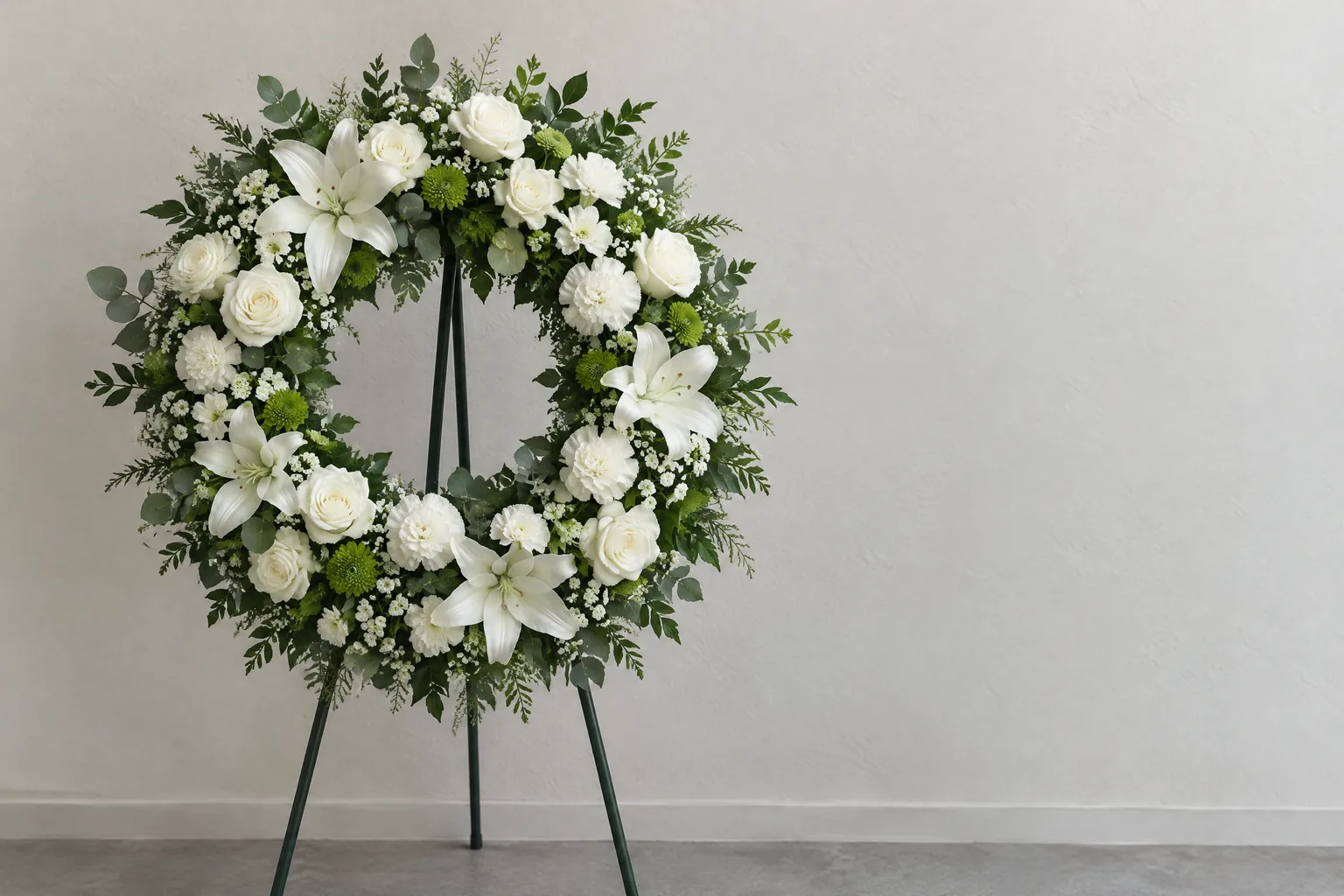
Distinguish preserved flowers, dried flowers and the finished shape
The material label does not tell you everything about a mixed arrangement.
Dried flowers have had moisture removed, but that does not make them permanent or especially forgiving of handling. University of Missouri Extension explains that petals can become brittle after drying and that even well-kept dried flowers gradually fade. If you enjoy grasses and papery textures, consider whether the arrangement can stay undisturbed. A stem that looks attractive in a sample photograph may be awkward beside a drawer you open several times a day.[1]
Preserved flowers undergo a different treatment. Manufacturer Verdissimo describes replacing natural sap with a preservation solution, rather than simply dehydrating the plant. This distinction helps explain why two arrangements can have different textures and care instructions. It does not identify the treatment of every workshop material. Ask which flowers and foliage are preserved, which are dried, and whether any fresh elements are intended to change or be removed after the festive period.[2]
The Preserved flower workshop page provides a starting point for an enquiry about this craft direction. Bring a photograph of your display space and ask what completed format is currently possible. Check whether the flowers are exposed, set in an open container or enclosed in a display case. Do not assume a pictured case, its size or its inclusion in the session has been confirmed until you receive the actual project details.
Use the Dried flower workshop page to explore a different botanical style, then ask about the proposed stems and how the finished piece is supported. The practical comparison is not which label sounds longer-lasting. It is which arrangement suits your handling habits, display conditions and willingness to care for it. A wreath is only a shape: it can contain several material types, so its care cannot be inferred from the word alone.
Allow for wreath depth, movement and fixing
The ring diameter is not the finished footprint.
Ask for the approximate finished width, height and depth, including projecting foliage, ribbon tails and ornaments. A shallow ring with decoration concentrated on one side has different storage needs from a fully dressed circular wreath. Check the back as well as the front: exposed wire ends or bulky bindings may need clearance from the surface. If the project dimensions are flexible, agree the maximum outer size before the making begins, not after the last stems are attached.
The Christmas wreath workshop page is useful for opening a seasonal project enquiry. Ask whether the intended design is for an indoor wall, a door or a tabletop, and whether its fixing point is part of the project. These are different uses. A ribbon that looks right in a photograph is not evidence that the finished object can hang securely from it, and a table arrangement does not become a hanging wreath simply by adding a loop.
For a door, check the full opening movement and whether the piece will strike a wall or door closer. Follow the fixing manufacturer's instructions for the surface and load, and obtain any necessary building or landlord permission. Do not put a decoration where it interferes with door operation or an escape route. If the position cannot accept a suitable fixing, change the display location rather than improvising with the flowers or relying on an untested hook.
Ask for care instructions you can actually follow
No watering does not mean no attention.
For its preserved products, Verdissimo recommends indoor use away from direct sunlight, heat and excessive humidity. It says not to water or spray them with water, and recommends periodic dust removal with a feather duster or cool air at low power. These are that manufacturer's instructions, not confirmation that a particular workshop uses its materials. Ask the organiser for guidance covering the flowers actually supplied, especially if the arrangement combines several treatments or finishes.[3]
Request a demonstration of where to hold the piece and how to reach dusty areas without bending stems. A very intricate wreath may be attractive but inconvenient if its layers are difficult to access. Ask whether the ribbon or ornaments can be removed for separate care. Do not assume a household cleaning spray, scented mist or damp cloth suitable for the base is also suitable for the petals. Keep the care note with a photograph of the finished work.
There is no need to agree to a demanding routine simply because the result looks impressive. If the only available spot is steamy or gets strong direct sun, say so before booking and ask about another project. A display cover may reduce handling, but it is not proof of moisture control. Likewise, a general lifespan estimate cannot tell you how the piece will fare in your particular flat. Choose something whose recommended conditions you can reasonably provide.
Reserve the storage space before December ends
Check the box and the cupboard, not just the arrangement.
University of Missouri Extension advises tightly sealed containers to help prevent insects entering stored dried material, along with occasional checks of the boxes. That guidance is about dried botanical storage; it is not a universal instruction to seal every mixed workshop piece in plastic. Ask how your completed arrangement should be packed and whether its base, adhesives and other components need different treatment. A box should not be used to hide a damp or deteriorating object until next Christmas.[4]
Choose a clean, dry storage position you can inspect, rather than the last gap beside a troublesome wall. Measure the proposed box externally and check that it fits through the cupboard opening. Then check its usable internal dimensions, including lid clearance. Flowers should not have to bend to let the lid close. If another household member normally stacks things in that cupboard, explain which box must not have weight placed on it and choose a position that makes this realistic.
Before packing, photograph the arrangement and note any removable details. Ask how to support the frame or base so that delicate flowers do not bear the load. Put detachable ornaments in a separate labelled compartment where appropriate. Keep the care instructions accessible and plan to look at the stored piece occasionally, rather than discovering its condition next December. If storage requires taking apart most of the design, establish whether reassembly is practical for you before selecting that project.
Plan the journey home as part of the project
A beautiful object still has to get through the station and your front door.
Ask how the completed work leaves the session: in a fitted box, an open tray or packaging you need to provide. Confirm the packed dimensions as well as the display dimensions. Check whether you can keep it upright and carry it without holding the stems. Packaging should support the intended handling method; a large shopping bag alone does not explain how the object will stay still inside it. Request a simple packing demonstration before leaving.
Consider your actual return journey, including stairs, umbrellas and anything else you will carry. Avoid scheduling other shopping around a bulky wreath. If two people are attending, do not assume both finished objects will fit comfortably in one bag. For a delicate project, ask whether there is a more compact version you can complete instead. Transport arrangements, collection options and any related charges need separate confirmation; they should not be inferred from a general workshop page.
Prepare the display space before going out so the decoration does not spend its first evening balanced on a crowded table. At home, open the packaging on a clear surface and lift it by the demonstrated support points. Retain useful inserts if they are suitable for later storage and can be kept dry. If something has loosened, photograph it and seek guidance instead of pressing petals back into place or adding unfamiliar glue.

Choose a smaller project if storage is the limiting factor
Festive detail can be removable rather than permanent.
Where cupboard space is scarce, consider a small arrangement that can remain on display after the holiday. Ask whether a neutral botanical design can take a removable Christmas ribbon or ornament. You then store the festive detail rather than the entire object. This works only if you genuinely like the underlying design throughout the year and have a suitable indoor position for it; keeping an unwanted object on show is not a storage solution.
Another option is a smaller wreath or a design with fewer projecting stems, provided the organiser can offer it. Compare the whole packed footprint rather than choosing a project simply because it uses fewer flowers. A tall narrow arrangement can still need an awkwardly high box, while a compact base may fit an existing shelf. If no option suits the home, ask whether a different craft format is available rather than buying extra storage furniture for one decoration.
Finally, decide what success means this Christmas. You may want an enjoyable making session and one season of display, rather than an object kept indefinitely. That is a valid brief, but it should be stated clearly so nobody builds the project around an imagined permanence. If the goal is repeated use, prioritise manageable dimensions, replaceable festive details and clear care guidance. The best choice is the one you can enjoy without negotiating space for it every week.
| Proposed piece | Worth considering when | Resolve before choosing |
|---|---|---|
| Small preserved-flower arrangement | You have a suitable indoor shelf and prefer a compact focal point | Exact materials, care note and whether any cover is included |
| Open dried-flower arrangement | You like papery textures and can avoid frequent handling | Support points, access for care and protection in storage |
| Seasonal wreath | You have an appropriate fixing position and room for a supported box | Finished outer dimensions, depth, weight and fixing method |
| Neutral piece with removable festive detail | You want to keep the main arrangement on display | How decorations detach without disturbing the flowers |
- Photograph and measure one intended indoor display position.
- Confirm which components are preserved, dried, fresh or decorative.
- Request finished and packed dimensions, including projecting details.
- Check fixing suitability, door movement and any relevant building permission.
- Obtain material-specific care and handling instructions.
- Reserve a suitable storage position and confirm the packing method.
- Agree how the completed piece will be supported on the journey home.
For a small flat, start with the space you can offer rather than the largest design you can make. Match the actual materials to the display position, check the whole packed size and decide whether the piece will stay out or go away after Christmas. Those choices make a festive keepsake manageable without pretending that preserved or dried flowers are permanent, damp-proof or maintenance-free.
Is preserved flower material the better choice for a humid flat?
Not automatically. Preserved material still needs appropriate conditions, and the maker's instructions matter more than a broad material label. If the proposed spot is damp, do not assume choosing preserved instead of dried flowers solves that problem. Describe the location, ask about the actual materials and be willing to choose a different position or project.
Can I display the wreath outside my front door?
Only consider that after confirming the material's intended use, the fixing and your building's rules. A shared corridor is not the same setting as an indoor wall, and a wreath must not interfere with door movement or access. If you cannot establish a suitable arrangement, use an indoor position instead. A workshop photograph is not permission for a particular location.
Will a display case solve the dust and humidity problem?
A case can change how you handle the piece and may reduce exposed surfaces, but it should not be treated as a dehumidifier. Check how it opens, whether the flowers can touch the sides, and what the maker recommends for cleaning and storage. Also include the case's outer measurements when checking your shelf and cupboard.
What should I ask if I want to reuse the wreath next Christmas?
Ask which components are intended for reuse and which may need replacing. Request a packing method for the complete design and find out whether ribbon and ornaments can be removed independently. Photograph its condition before storage. Reuse is an intention, not a guarantee that every flower will look unchanged a year later.
What if I have room to display a piece but nowhere to store it?
Choose a design you would enjoy beyond Christmas, with seasonal details that can come off, or reduce the project size to fit an existing suitable box. Tell the organiser your maximum dimensions before booking. If neither option works, choose the session for a limited seasonal display only if that outcome meets your expectations; do not plan around storage space you do not have.
Before booking, send the workshop organiser a photo of your intended display spot and your maximum finished and packed dimensions. Ask for the proposed materials, care guidance and take-home packaging, then confirm current arrangements directly with YumYum if using its enquiry pages.
Sources & supported claims
- Drying Flowers and Foliage for Arrangements — University of Missouri Extension
Petals can become brittle after drying, and even well-kept dried flowers gradually fade.
- FAQs — Verdissimo Innovaflora S.L.
Verdissimo distinguishes dried flowers produced by dehydration from preserved flowers treated by replacing natural sap with a preservation solution.
- FAQs — Verdissimo Innovaflora S.L.
For its products, Verdissimo recommends indoor use away from direct sun, heat and excessive humidity, no watering or water spraying, and dust removal using a feather duster or cool air at low power.
- Drying Flowers and Foliage for Arrangements — University of Missouri Extension
Tightly sealed containers help prevent insects entering stored dried material, and stored boxes should be checked occasionally.